

The solution of this equation allows obtaining information on the quality of the
initially adopted geometry of the studied system (spatial configuration of atoms).
Usually, the assumed geometry deviates from the equilibrium geometry and the
atoms are subjected to the forces that can be easily calculated (as a potential energy
gradient with respect to the atomic position). Information about forces acting on
atoms allows the geometry modification (optimization) by changing the positions of
all atoms according to the direction and magnitude of the respective forces and
repeating the total energy calculations, another forces estimation, geometry modification according to new forces calculated, and repeating the whole procedure until
the calculated forces on the atoms are smaller than the assumed precision. In
most cases, the relaxation of the structure (minimization of forces on atoms) is a
necessary step in the calculation, because the majority of physical quantities that are
of interest is defined for systems that are in the minimum of potential energy well
(relaxed, equilibrium geometry).
1.2.1.3 Hartree–Fock Method and Post-HF Extensions
The solution of the nuclear time-independent Schrödinger equation allows determination of a large variety of molecular properties (e.g., vibrational energy levels,
phonon dispersion in crystals). But this is just the first step, since by employing
Born–Oppenheimer approximation we have simplified our Hamiltonian a little; but
we still have to solve electronic TISE for our multi-electron system, which is
impossible to be done exactly (the reason being the last term in electronic
Hamiltonian, namely electron–electron interactions) and we need to make further
approximations. Since we cannot calculate exactly very complicated electron–
electron interactions, let us assume that electrons are independent from each other
and every single electron is moving in an effective single-particle potential due to
all fixed nuclei and the average electron density distribution of all remaining
electrons. This simple idea, called independent electrons approximation (IEA) , was
first formulated by Hartree [28] and led to the development of famous Hartree–
Fock SCF method, consisting of a set of self-consistent single-particle equations
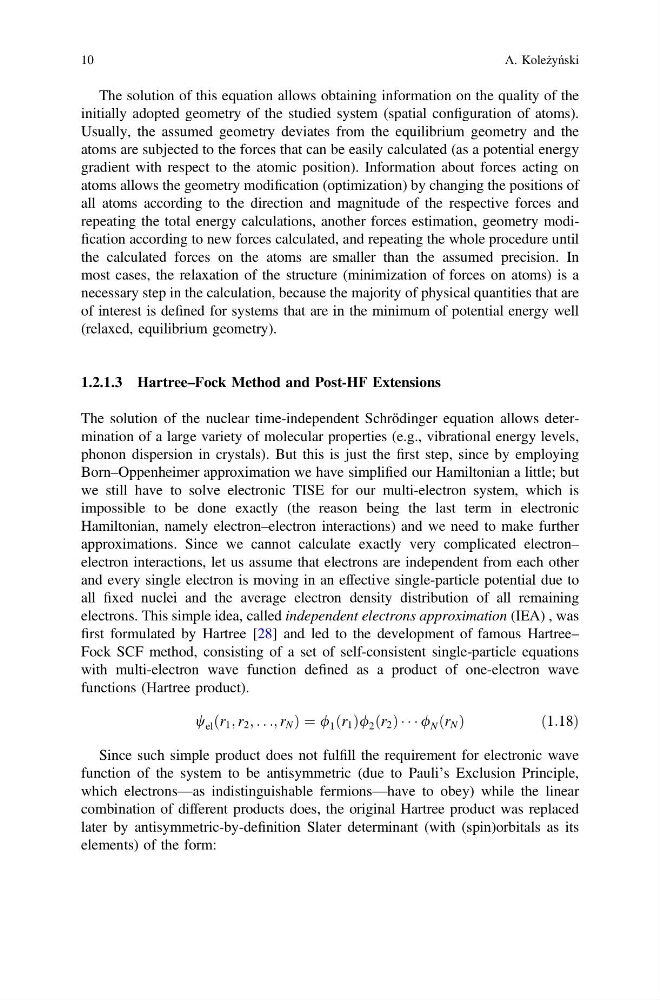
with multi-electron wave function defined as a product of one-electron wave
functions (Hartree product).
w el ðr 1 ; r 2 ; . . .; r N Þ ¼ / 1 ðr 1 Þ/ 2 ðr 2 Þ Á Á Á / N ðr N Þ
ð 1:18Þ
Since such simple product does not fulfill the requirement for electronic wave
function of the system to be antisymmetric (due to Pauli’s Exclusion Principle,
which electrons—as indistinguishable fermions—have to obey) while the linear
combination of different products does, the original Hartree product was replaced
later by antisymmetric-by-definition Slater determinant (with (spin)orbitals as its
elements) of the form:
10
A. Koleżyński
initially adopted geometry of the studied system (spatial configuration of atoms).
Usually, the assumed geometry deviates from the equilibrium geometry and the
atoms are subjected to the forces that can be easily calculated (as a potential energy
gradient with respect to the atomic position). Information about forces acting on
atoms allows the geometry modification (optimization) by changing the positions of
all atoms according to the direction and magnitude of the respective forces and
repeating the total energy calculations, another forces estimation, geometry modification according to new forces calculated, and repeating the whole procedure until
the calculated forces on the atoms are smaller than the assumed precision. In
most cases, the relaxation of the structure (minimization of forces on atoms) is a
necessary step in the calculation, because the majority of physical quantities that are
of interest is defined for systems that are in the minimum of potential energy well
(relaxed, equilibrium geometry).
1.2.1.3 Hartree–Fock Method and Post-HF Extensions
The solution of the nuclear time-independent Schrödinger equation allows determination of a large variety of molecular properties (e.g., vibrational energy levels,
phonon dispersion in crystals). But this is just the first step, since by employing
Born–Oppenheimer approximation we have simplified our Hamiltonian a little; but
we still have to solve electronic TISE for our multi-electron system, which is
impossible to be done exactly (the reason being the last term in electronic
Hamiltonian, namely electron–electron interactions) and we need to make further
approximations. Since we cannot calculate exactly very complicated electron–
electron interactions, let us assume that electrons are independent from each other
and every single electron is moving in an effective single-particle potential due to
all fixed nuclei and the average electron density distribution of all remaining
electrons. This simple idea, called independent electrons approximation (IEA) , was
first formulated by Hartree [28] and led to the development of famous Hartree–
Fock SCF method, consisting of a set of self-consistent single-particle equations
with multi-electron wave function defined as a product of one-electron wave
functions (Hartree product).
w el ðr 1 ; r 2 ; . . .; r N Þ ¼ / 1 ðr 1 Þ/ 2 ðr 2 Þ Á Á Á / N ðr N Þ
ð 1:18Þ
Since such simple product does not fulfill the requirement for electronic wave
function of the system to be antisymmetric (due to Pauli’s Exclusion Principle,
which electrons—as indistinguishable fermions—have to obey) while the linear
combination of different products does, the original Hartree product was replaced
later by antisymmetric-by-definition Slater determinant (with (spin)orbitals as its
elements) of the form:
10
A. Koleżyński