

the second more stable one are smaller than 0.8%, i.e., below the detection limit of
the experimental technique; that of the second more stable conformer is *6%, and
in principle large enough to allow for its experimental detection. However, the
energy barrier separating this form from the most stable conformer is very small
(ca. 5 kJ mol
−1 ), and under these conditions, it shall promptly convert to the lowest
energy conformer during matrix deposition. Indeed, conformational cooling leading
to conversion, at the time of matrix deposition, of higher energy conformers into
lower energy forms from which they are separated by small energy barriers (of a
few kJ mol
−1 ) is a well-known common phenomenon [31, 32].
Detailed assignments for the matrix isolation spectra of the studied hydantoins
have been described by Ildiz et al. [26] and Nogueira et al. [28, 29].
7.3 Photochemistry for the Matrix-Isolated Molecules
7.3.1 Mercaptoimidazoles
The matrix-isolated thione tautomers of the studied mercaptoimidazoles were
irradiated with narrowband ultraviolet (UV) light provided by a tunable Laser/
MOPO system. The chosen UV wavelengths (261 nm, in the case of MTI, and
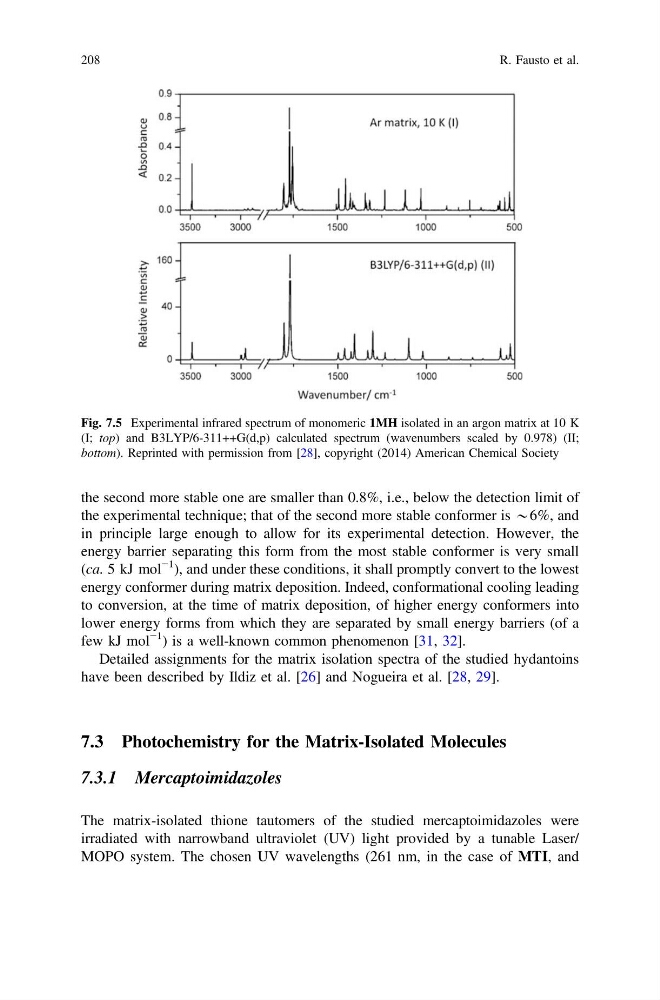
Fig. 7.5 Experimental infrared spectrum of monomeric 1MH isolated in an argon matrix at 10 K
(I; top) and B3LYP/6-311++G(d,p) calculated spectrum (wavenumbers scaled by 0.978) (II;
bottom). Reprinted with permission from [28], copyright (2014) American Chemical Society
208
R. Fausto et al.
the experimental technique; that of the second more stable conformer is *6%, and
in principle large enough to allow for its experimental detection. However, the
energy barrier separating this form from the most stable conformer is very small
(ca. 5 kJ mol
−1 ), and under these conditions, it shall promptly convert to the lowest
energy conformer during matrix deposition. Indeed, conformational cooling leading
to conversion, at the time of matrix deposition, of higher energy conformers into
lower energy forms from which they are separated by small energy barriers (of a
few kJ mol
−1 ) is a well-known common phenomenon [31, 32].
Detailed assignments for the matrix isolation spectra of the studied hydantoins
have been described by Ildiz et al. [26] and Nogueira et al. [28, 29].
7.3 Photochemistry for the Matrix-Isolated Molecules
7.3.1 Mercaptoimidazoles
The matrix-isolated thione tautomers of the studied mercaptoimidazoles were
irradiated with narrowband ultraviolet (UV) light provided by a tunable Laser/
MOPO system. The chosen UV wavelengths (261 nm, in the case of MTI, and
Fig. 7.5 Experimental infrared spectrum of monomeric 1MH isolated in an argon matrix at 10 K
(I; top) and B3LYP/6-311++G(d,p) calculated spectrum (wavenumbers scaled by 0.978) (II;
bottom). Reprinted with permission from [28], copyright (2014) American Chemical Society
208
R. Fausto et al.