

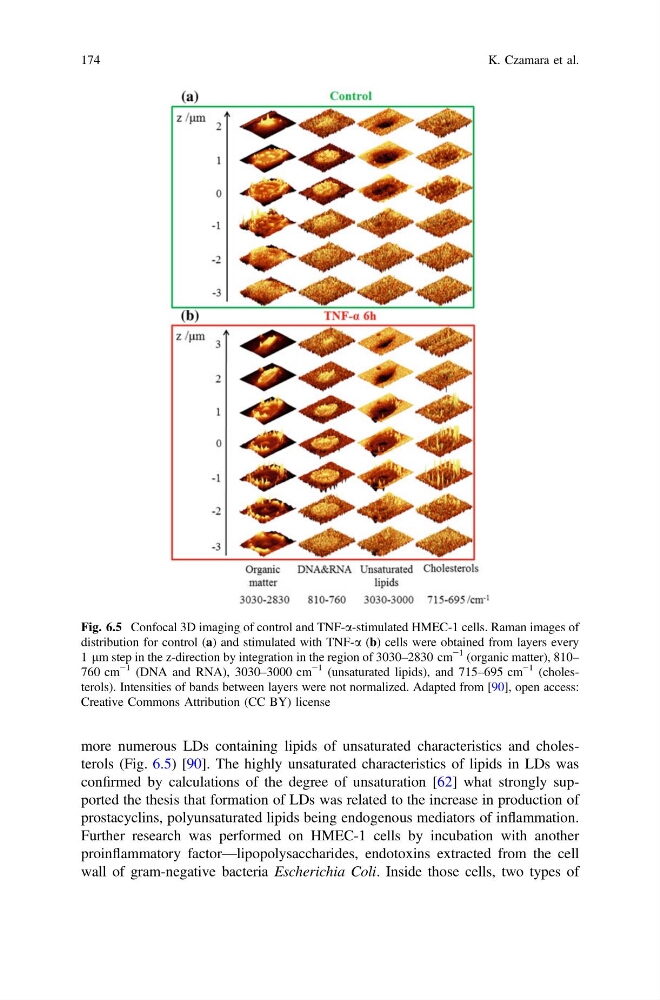
more numerous LDs containing lipids of unsaturated characteristics and cholesterols (Fig. 6.5) [90]. The highly unsaturated characteristics of lipids in LDs was
confirmed by calculations of the degree of unsaturation [62] what strongly supported the thesis that formation of LDs was related to the increase in production of
prostacyclins, polyunsaturated lipids being endogenous mediators of inflammation.
Further research was performed on HMEC-1 cells by incubation with another
proinflammatory factor—lipopolysaccharides, endotoxins extracted from the cell
wall of gram-negative bacteria Escherichia Coli. Inside those cells, two types of
Fig. 6.5 Confocal 3D imaging of control and TNF-a-stimulated HMEC-1 cells. Raman images of
distribution for control (a) and stimulated with TNF-a (b) cells were obtained from layers every
1 lm step in the z-direction by integration in the region of 3030–2830 cm
−1 (organic matter), 810–
760 cm
−1 (DNA and RNA), 3030–3000 cm
−1 (unsaturated lipids), and 715–695 cm
−1 (cholesterols). Intensities of bands between layers were not normalized. Adapted from [90], open access:
Creative Commons Attribution (CC BY) license
174
K. Czamara et al.
confirmed by calculations of the degree of unsaturation [62] what strongly supported the thesis that formation of LDs was related to the increase in production of
prostacyclins, polyunsaturated lipids being endogenous mediators of inflammation.
Further research was performed on HMEC-1 cells by incubation with another
proinflammatory factor—lipopolysaccharides, endotoxins extracted from the cell
wall of gram-negative bacteria Escherichia Coli. Inside those cells, two types of
Fig. 6.5 Confocal 3D imaging of control and TNF-a-stimulated HMEC-1 cells. Raman images of
distribution for control (a) and stimulated with TNF-a (b) cells were obtained from layers every
1 lm step in the z-direction by integration in the region of 3030–2830 cm
−1 (organic matter), 810–
760 cm
−1 (DNA and RNA), 3030–3000 cm
−1 (unsaturated lipids), and 715–695 cm
−1 (cholesterols). Intensities of bands between layers were not normalized. Adapted from [90], open access:
Creative Commons Attribution (CC BY) license
174
K. Czamara et al.