

mechanism is a report of Cîntǎ-Pînzaru et al. [54], who probed interactions of
antiomalarials (chloroquine and mefloquine) with hematin by colloidal AuNPs.
Jaworska et al. [55–57] have investigated in detail SERS features of nicotinamide and its seven derivatives, i.e., trigonelline, nicorandil, 1-methylnicorandil,
1-methylpyridinium, dimethylpyridinium chlorides proposed as potential therapeutics for treatment of diseases resulted from endothelial dysfunction. These works
have shown SERS applicability in a rapid examination of similarities in surface
behavior of a group of potential drugs possessing the identical core structure.
Sensitivity of surface-enhanced Raman spectroscopy to determine differences in the
adsorption mechanism due to exchange of functional groups, variation of pH, and
anions in the pyridinium cation has been clearly proven. Each precursor adopts a
specific orientation with respect to the metal which is strongly dependent on the
functional groups attached to the pyridinium ring rather than on its aromatic system.
Both presented here Raman-based techniques are demanding but very promising
and useful in the research of molecular structure and intramolecular interactions.
Over a dozen attempts to combine SERS and ROA or RROA (SEROA or
SERROA) are presented in the literature. SEROA is even more demanding than
RROA but constitutes a perfect probe of chirality in diluted samples. Most of
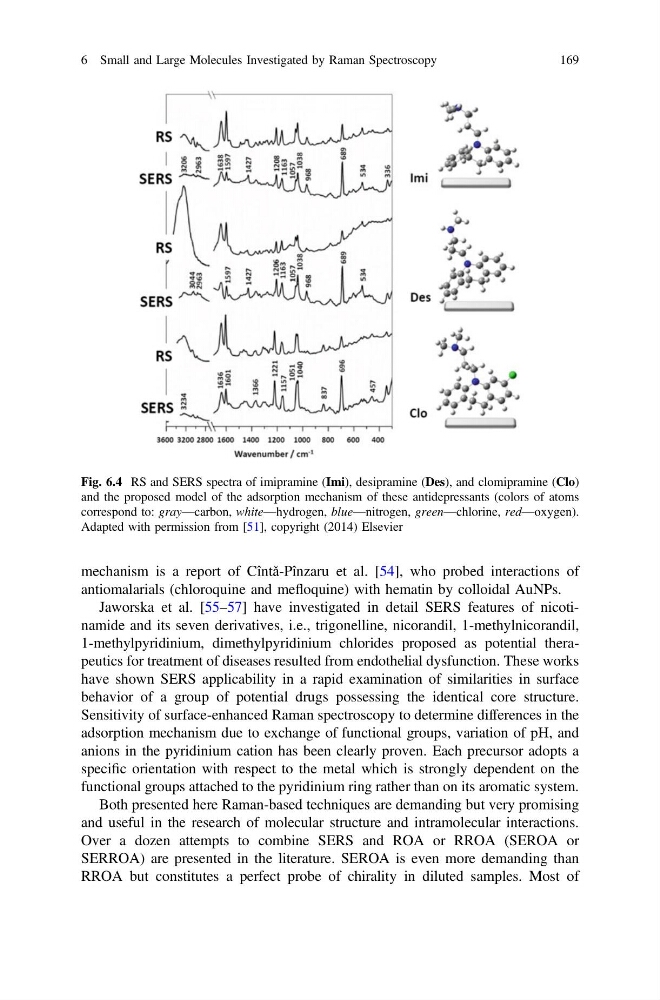
Fig. 6.4 RS and SERS spectra of imipramine (Imi), desipramine (Des), and clomipramine (Clo)
and the proposed model of the adsorption mechanism of these antidepressants (colors of atoms
correspond to: gray—carbon, white—hydrogen, blue—nitrogen, green—chlorine, red—oxygen).
Adapted with permission from [51], copyright (2014) Elsevier
6 Small and Large Molecules Investigated by Raman Spectroscopy
169
antiomalarials (chloroquine and mefloquine) with hematin by colloidal AuNPs.
Jaworska et al. [55–57] have investigated in detail SERS features of nicotinamide and its seven derivatives, i.e., trigonelline, nicorandil, 1-methylnicorandil,
1-methylpyridinium, dimethylpyridinium chlorides proposed as potential therapeutics for treatment of diseases resulted from endothelial dysfunction. These works
have shown SERS applicability in a rapid examination of similarities in surface
behavior of a group of potential drugs possessing the identical core structure.
Sensitivity of surface-enhanced Raman spectroscopy to determine differences in the
adsorption mechanism due to exchange of functional groups, variation of pH, and
anions in the pyridinium cation has been clearly proven. Each precursor adopts a
specific orientation with respect to the metal which is strongly dependent on the
functional groups attached to the pyridinium ring rather than on its aromatic system.
Both presented here Raman-based techniques are demanding but very promising
and useful in the research of molecular structure and intramolecular interactions.
Over a dozen attempts to combine SERS and ROA or RROA (SEROA or
SERROA) are presented in the literature. SEROA is even more demanding than
RROA but constitutes a perfect probe of chirality in diluted samples. Most of
Fig. 6.4 RS and SERS spectra of imipramine (Imi), desipramine (Des), and clomipramine (Clo)
and the proposed model of the adsorption mechanism of these antidepressants (colors of atoms
correspond to: gray—carbon, white—hydrogen, blue—nitrogen, green—chlorine, red—oxygen).
Adapted with permission from [51], copyright (2014) Elsevier
6 Small and Large Molecules Investigated by Raman Spectroscopy
169