

porphyrin-gold dyads was also studied with the use of advanced methods, and it
showed dynamics of the processes [41–45].
3.5 Corroles and Fullerene
The great hopes are associated with corroles—an analogue of porphyrins. They are
very intriguing materials of specific physicochemical properties. Corroles are also
aromatic tetrapyrroles planar p-electron systems, and thus they are characterized by
intense absorption in the visible region. However, their molecular structure differs
significantly compared to porphyrins and phthalocyanines [46]. They are characterized by three carbon meso-positions and one direct bond between the pyrrole
rings [47–51]. The direct linkage between the pyrrole rings leads to reduction of the
symmetry from D 4h (as in porphyrins) to C 2v . Corroles possess four nitrogen atoms
and three –NH groups in their macroring. Moreover, corroles are a typical example
of the porphyrin-derivative dyes that are able to stabilize metals in higher oxidation
states compared to porphyrins which have two ionizable NHs. The significant
advantage of corroles over porphyrins is stronger absorption in the 700–550 nm
region, higher fluorescence quantum yield, lower first oxidation potentials, and
entirely different coordination chemistry [52, 53]. Due to their specific properties
like lower symmetry (C 2v ) (one meso-carbon bridge is missed and in consequence it
can result in strong changes of spectroscopic properties), the ring of corroles is
smaller, and there is a slightly less space in the middle of it which results in sitting
of many metals slightly out of plane and they are very reactive and sensitive to
oxidation and more difficult to be reduced. The corroles exist in a form of tautomers
—there are two forms of tautomers—Tautomer 1 (T1) and Tautomer 2 (T2) with
different location of proton H. In this chapter, some results concerning selected
spectroscopic investigations of corroles fullerene covalent dyads are also presented.
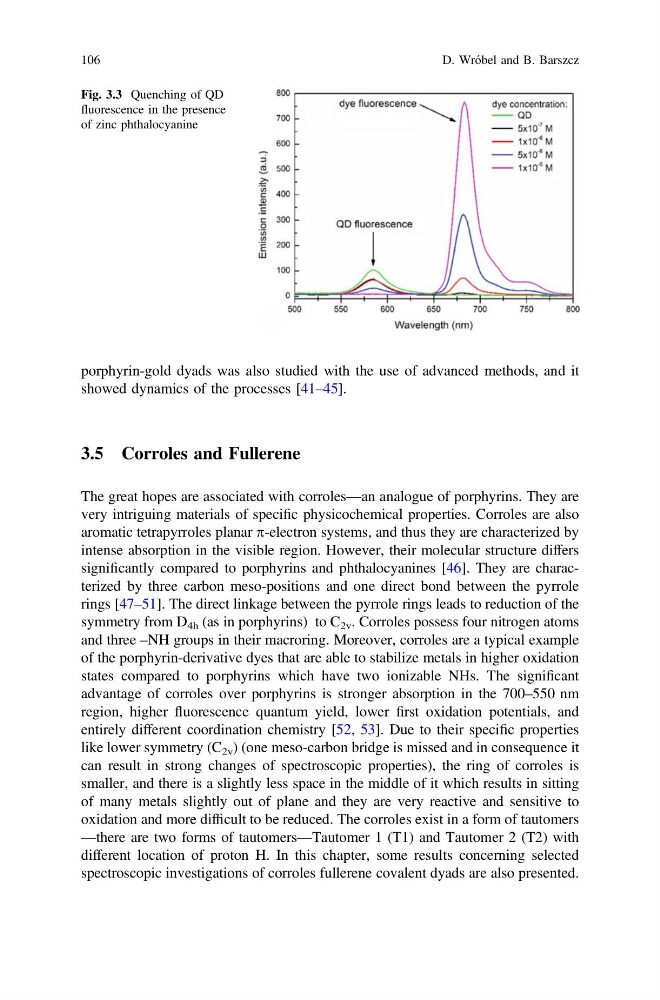
Fig. 3.3 Quenching of QD
fluorescence in the presence
of zinc phthalocyanine
106
D. Wróbel and B. Barszcz
showed dynamics of the processes [41–45].
3.5 Corroles and Fullerene
The great hopes are associated with corroles—an analogue of porphyrins. They are
very intriguing materials of specific physicochemical properties. Corroles are also
aromatic tetrapyrroles planar p-electron systems, and thus they are characterized by
intense absorption in the visible region. However, their molecular structure differs
significantly compared to porphyrins and phthalocyanines [46]. They are characterized by three carbon meso-positions and one direct bond between the pyrrole
rings [47–51]. The direct linkage between the pyrrole rings leads to reduction of the
symmetry from D 4h (as in porphyrins) to C 2v . Corroles possess four nitrogen atoms
and three –NH groups in their macroring. Moreover, corroles are a typical example
of the porphyrin-derivative dyes that are able to stabilize metals in higher oxidation
states compared to porphyrins which have two ionizable NHs. The significant
advantage of corroles over porphyrins is stronger absorption in the 700–550 nm
region, higher fluorescence quantum yield, lower first oxidation potentials, and
entirely different coordination chemistry [52, 53]. Due to their specific properties
like lower symmetry (C 2v ) (one meso-carbon bridge is missed and in consequence it
can result in strong changes of spectroscopic properties), the ring of corroles is
smaller, and there is a slightly less space in the middle of it which results in sitting
of many metals slightly out of plane and they are very reactive and sensitive to
oxidation and more difficult to be reduced. The corroles exist in a form of tautomers
—there are two forms of tautomers—Tautomer 1 (T1) and Tautomer 2 (T2) with
different location of proton H. In this chapter, some results concerning selected
spectroscopic investigations of corroles fullerene covalent dyads are also presented.
Fig. 3.3 Quenching of QD
fluorescence in the presence
of zinc phthalocyanine
106
D. Wróbel and B. Barszcz