

investigations are needed to determine the best conditions to get Langmuir–Blodgett
layers of good quality (transfer ratio close to 1). The in situ light absorption technique
lets to establish interaction among closely packed species and creation of molecular
aggregates. Formation of the LB layers is usually performed on mica, quartz, gold or
silicon or other substrates. The number of layers can be controlled to get optimal
conditions for spectroscopic and photoelectric studies. It is well known that efficiency
of electron and energy transfer depends on the layer ordering, and thus, the spectroscopic studies are very often done with polarized light (in the UV-VIS and IR
regions) to follow bonding responsible for interaction with the solid surface.
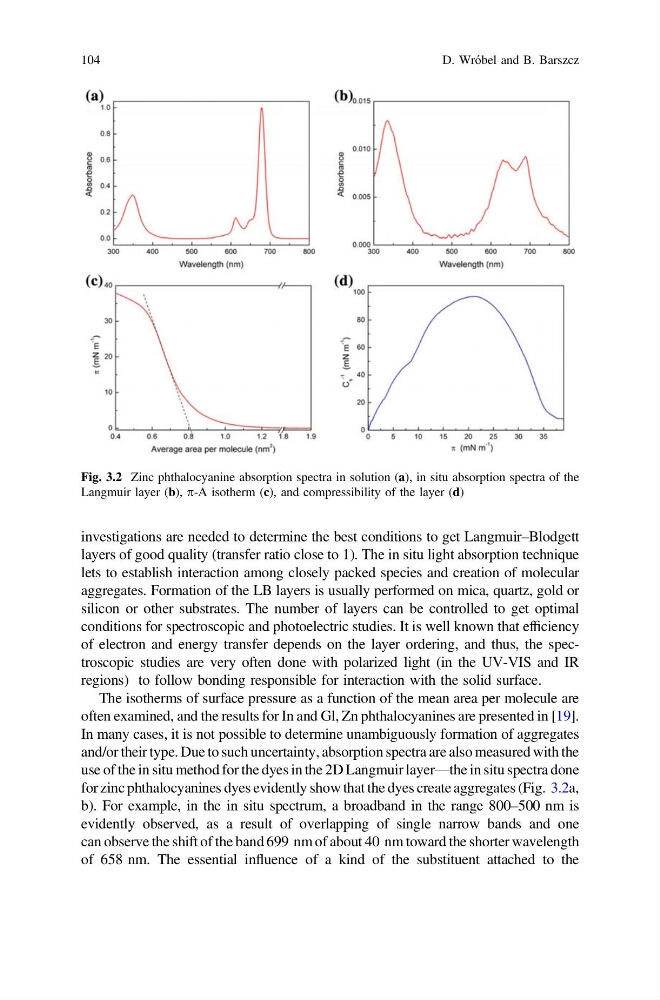
The isotherms of surface pressure as a function of the mean area per molecule are
often examined, and the results for In and Gl, Zn phthalocyanines are presented in [19].
In many cases, it is not possible to determine unambiguously formation of aggregates
and/or their type. Due to such uncertainty, absorption spectra are also measured with the
use of the in situ method for the dyes in the 2D Langmuir layer—the in situ spectra done
for zinc phthalocyanines dyes evidently show that the dyes create aggregates (Fig. 3.2a,
b). For example, in the in situ spectrum, a broadband in the range 800–500 nm is
evidently observed, as a result of overlapping of single narrow bands and one
can observe the shift of the band 699 nm of about 40 nm toward the shorter wavelength
of 658 nm. The essential influence of a kind of the substituent attached to the
Fig. 3.2 Zinc phthalocyanine absorption spectra in solution (a), in situ absorption spectra of the
Langmuir layer (b), p-A isotherm (c), and compressibility of the layer (d)
104
D. Wróbel and B. Barszcz
layers of good quality (transfer ratio close to 1). The in situ light absorption technique
lets to establish interaction among closely packed species and creation of molecular
aggregates. Formation of the LB layers is usually performed on mica, quartz, gold or
silicon or other substrates. The number of layers can be controlled to get optimal
conditions for spectroscopic and photoelectric studies. It is well known that efficiency
of electron and energy transfer depends on the layer ordering, and thus, the spectroscopic studies are very often done with polarized light (in the UV-VIS and IR
regions) to follow bonding responsible for interaction with the solid surface.
The isotherms of surface pressure as a function of the mean area per molecule are
often examined, and the results for In and Gl, Zn phthalocyanines are presented in [19].
In many cases, it is not possible to determine unambiguously formation of aggregates
and/or their type. Due to such uncertainty, absorption spectra are also measured with the
use of the in situ method for the dyes in the 2D Langmuir layer—the in situ spectra done
for zinc phthalocyanines dyes evidently show that the dyes create aggregates (Fig. 3.2a,
b). For example, in the in situ spectrum, a broadband in the range 800–500 nm is
evidently observed, as a result of overlapping of single narrow bands and one
can observe the shift of the band 699 nm of about 40 nm toward the shorter wavelength
of 658 nm. The essential influence of a kind of the substituent attached to the
Fig. 3.2 Zinc phthalocyanine absorption spectra in solution (a), in situ absorption spectra of the
Langmuir layer (b), p-A isotherm (c), and compressibility of the layer (d)
104
D. Wróbel and B. Barszcz