

photocurrent generation were also the subjects of the studies [7–21]. However, the
efficiency of the systems proposed in [2–10] is still too low to fulfill current
technical and economic as well as ecological requirements.
3.3 Porphyrins and Phthalocyanies
It is very essential to develop molecular materials, which will be characterized by
not only strong light absorption in the range of the maximal solar exposure but also
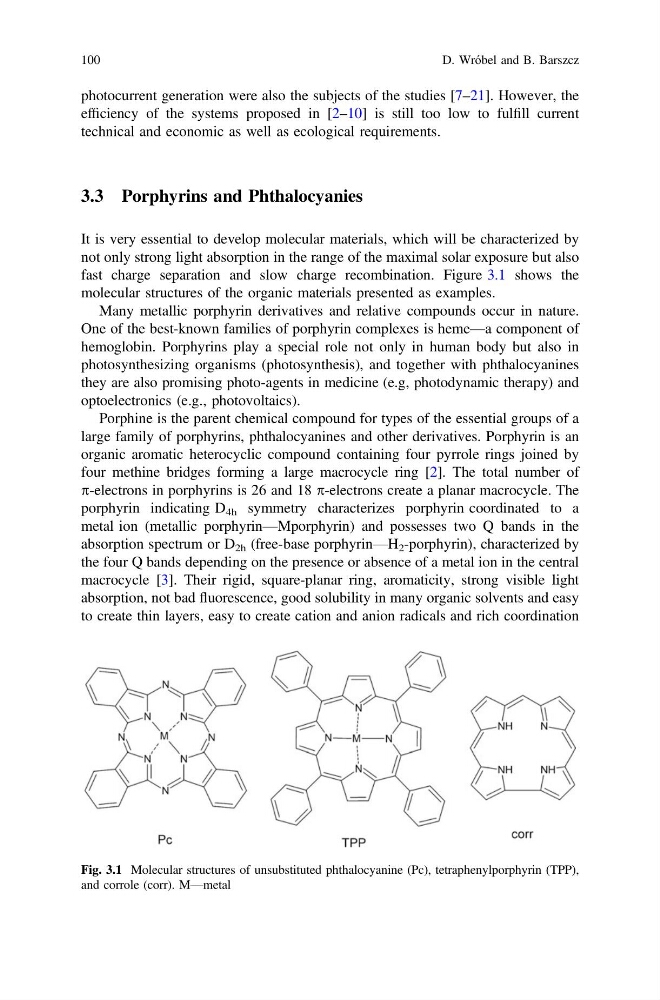
fast charge separation and slow charge recombination. Figure 3.1 shows the
molecular structures of the organic materials presented as examples.
Many metallic porphyrin derivatives and relative compounds occur in nature.
One of the best-known families of porphyrin complexes is heme—a component of
hemoglobin. Porphyrins play a special role not only in human body but also in
photosynthesizing organisms (photosynthesis), and together with phthalocyanines
they are also promising photo-agents in medicine (e.g, photodynamic therapy) and
optoelectronics (e.g., photovoltaics).
Porphine is the parent chemical compound for types of the essential groups of a
large family of porphyrins, phthalocyanines and other derivatives. Porphyrin is an
organic aromatic heterocyclic compound containing four pyrrole rings joined by
four methine bridges forming a large macrocycle ring [2]. The total number of
p-electrons in porphyrins is 26 and 18 p-electrons create a planar macrocycle. The
porphyrin indicating D 4h symmetry characterizes porphyrin coordinated to a
metal ion (metallic porphyrin—Mporphyrin) and possesses two Q bands in the
absorption spectrum or D 2h (free-base porphyrin—H 2 -porphyrin), characterized by
the four Q bands depending on the presence or absence of a metal ion in the central
macrocycle [3]. Their rigid, square-planar ring, aromaticity, strong visible light
absorption, not bad fluorescence, good solubility in many organic solvents and easy
to create thin layers, easy to create cation and anion radicals and rich coordination
Fig. 3.1 Molecular structures of unsubstituted phthalocyanine (Pc), tetraphenylporphyrin (TPP),
and corrole (corr). M—metal
100
D. Wróbel and B. Barszcz
efficiency of the systems proposed in [2–10] is still too low to fulfill current
technical and economic as well as ecological requirements.
3.3 Porphyrins and Phthalocyanies
It is very essential to develop molecular materials, which will be characterized by
not only strong light absorption in the range of the maximal solar exposure but also
fast charge separation and slow charge recombination. Figure 3.1 shows the
molecular structures of the organic materials presented as examples.
Many metallic porphyrin derivatives and relative compounds occur in nature.
One of the best-known families of porphyrin complexes is heme—a component of
hemoglobin. Porphyrins play a special role not only in human body but also in
photosynthesizing organisms (photosynthesis), and together with phthalocyanines
they are also promising photo-agents in medicine (e.g, photodynamic therapy) and
optoelectronics (e.g., photovoltaics).
Porphine is the parent chemical compound for types of the essential groups of a
large family of porphyrins, phthalocyanines and other derivatives. Porphyrin is an
organic aromatic heterocyclic compound containing four pyrrole rings joined by
four methine bridges forming a large macrocycle ring [2]. The total number of
p-electrons in porphyrins is 26 and 18 p-electrons create a planar macrocycle. The
porphyrin indicating D 4h symmetry characterizes porphyrin coordinated to a
metal ion (metallic porphyrin—Mporphyrin) and possesses two Q bands in the
absorption spectrum or D 2h (free-base porphyrin—H 2 -porphyrin), characterized by
the four Q bands depending on the presence or absence of a metal ion in the central
macrocycle [3]. Their rigid, square-planar ring, aromaticity, strong visible light
absorption, not bad fluorescence, good solubility in many organic solvents and easy
to create thin layers, easy to create cation and anion radicals and rich coordination
Fig. 3.1 Molecular structures of unsubstituted phthalocyanine (Pc), tetraphenylporphyrin (TPP),
and corrole (corr). M—metal
100
D. Wróbel and B. Barszcz