

utilization of the SQM scaling is not possible, on account of the determination of
only the frequencies and normal modes (eigenvectors), rather than the molecular
FFs. The ESFF scaling can be applied, though. Admittedly, the FCs enter the
expression for the PED coefficients, Eq. (2.54); however, this problem is easily
eliminated with the aid of the described ESFF2 procedure [75], according to which
the contributions of the local vibrations to the normal modes can be determined
only on the basis of the amplitudes of the atomic displacements from the equilibrium positions, Eq. (2.62). As described earlier, this procedure turned out to be as
efficient as the original one.
References
1. Pulay P, Fogarasi G, Pang F, Boggs JE (1979) Systematic ab initio gradient calculation of
molecular geometries, force constants, and dipole-moment derivatives. J Am Chem Soc
101:2550–2560
2. Lide DR, Frederikse HPR (eds) (1994) CRC handbook of chemistry and physics. CRC Press,
London
3. Atkins PW (1993) Molecular quantum mechanics. Oxford University Press, New York
4. Wilson EB Jr, Decius JC, Cross PC (1955) Molecular vibrations. The theory of infrared and
Raman vibrational spectra. Dover Publications Inc., New York
5. Califano S (1976) Vibrational states. Wiley, London
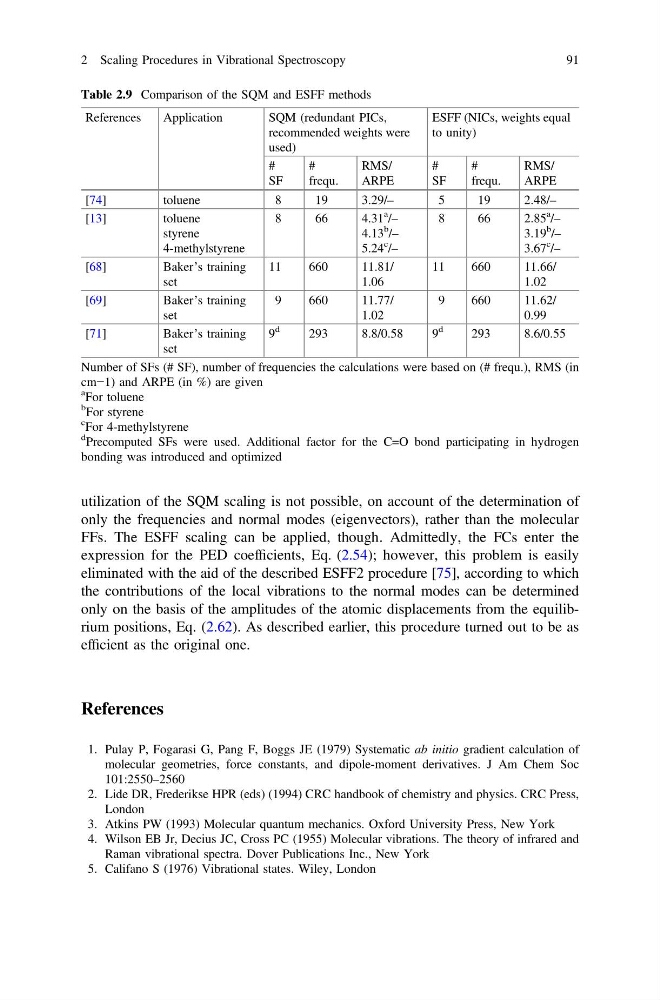
Table 2.9 Comparison of the SQM and ESFF methods
References
Application
SQM (redundant PICs,
recommended weights were
used)
ESFF (NICs, weights equal
to unity)
#
SF
#
frequ.
RMS/
ARPE
#
SF
#
frequ.
RMS/
ARPE
[74]
toluene
8
19
3.29/–
5
19
2.48/–
[13]
toluene
styrene
4-methylstyrene
8
66
4.31
a /–
4.13
b
/–
5.24
c /–
8
66
2.85
a /–
3.19
b
/–
3.67
c /–
[68]
Baker’s training
set
11
660
11.81/
1.06
11
660
11.66/
1.02
[69]
Baker’s training
set
9
660
11.77/
1.02
9
660
11.62/
0.99
[71]
Baker’s training
set
9
d
293
8.8/0.58
9
d
293
8.6/0.55
Number of SFs (# SF), number of frequencies the calculations were based on (# frequ.), RMS (in
cm−1) and ARPE (in %) are given
a For toluene
b
For styrene
c For 4-methylstyrene
d
Precomputed SFs were used. Additional factor for the C=O bond participating in hydrogen
bonding was introduced and optimized
2 Scaling Procedures in Vibrational Spectroscopy
91
only the frequencies and normal modes (eigenvectors), rather than the molecular
FFs. The ESFF scaling can be applied, though. Admittedly, the FCs enter the
expression for the PED coefficients, Eq. (2.54); however, this problem is easily
eliminated with the aid of the described ESFF2 procedure [75], according to which
the contributions of the local vibrations to the normal modes can be determined
only on the basis of the amplitudes of the atomic displacements from the equilibrium positions, Eq. (2.62). As described earlier, this procedure turned out to be as
efficient as the original one.
References
1. Pulay P, Fogarasi G, Pang F, Boggs JE (1979) Systematic ab initio gradient calculation of
molecular geometries, force constants, and dipole-moment derivatives. J Am Chem Soc
101:2550–2560
2. Lide DR, Frederikse HPR (eds) (1994) CRC handbook of chemistry and physics. CRC Press,
London
3. Atkins PW (1993) Molecular quantum mechanics. Oxford University Press, New York
4. Wilson EB Jr, Decius JC, Cross PC (1955) Molecular vibrations. The theory of infrared and
Raman vibrational spectra. Dover Publications Inc., New York
5. Califano S (1976) Vibrational states. Wiley, London
Table 2.9 Comparison of the SQM and ESFF methods
References
Application
SQM (redundant PICs,
recommended weights were
used)
ESFF (NICs, weights equal
to unity)
#
SF
#
frequ.
RMS/
ARPE
#
SF
#
frequ.
RMS/
ARPE
[74]
toluene
8
19
3.29/–
5
19
2.48/–
[13]
toluene
styrene
4-methylstyrene
8
66
4.31
a /–
4.13
b
/–
5.24
c /–
8
66
2.85
a /–
3.19
b
/–
3.67
c /–
[68]
Baker’s training
set
11
660
11.81/
1.06
11
660
11.66/
1.02
[69]
Baker’s training
set
9
660
11.77/
1.02
9
660
11.62/
0.99
[71]
Baker’s training
set
9
d
293
8.8/0.58
9
d
293
8.6/0.55
Number of SFs (# SF), number of frequencies the calculations were based on (# frequ.), RMS (in
cm−1) and ARPE (in %) are given
a For toluene
b
For styrene
c For 4-methylstyrene
d
Precomputed SFs were used. Additional factor for the C=O bond participating in hydrogen
bonding was introduced and optimized
2 Scaling Procedures in Vibrational Spectroscopy
91