

5.7 Phases in Decision-Making
87
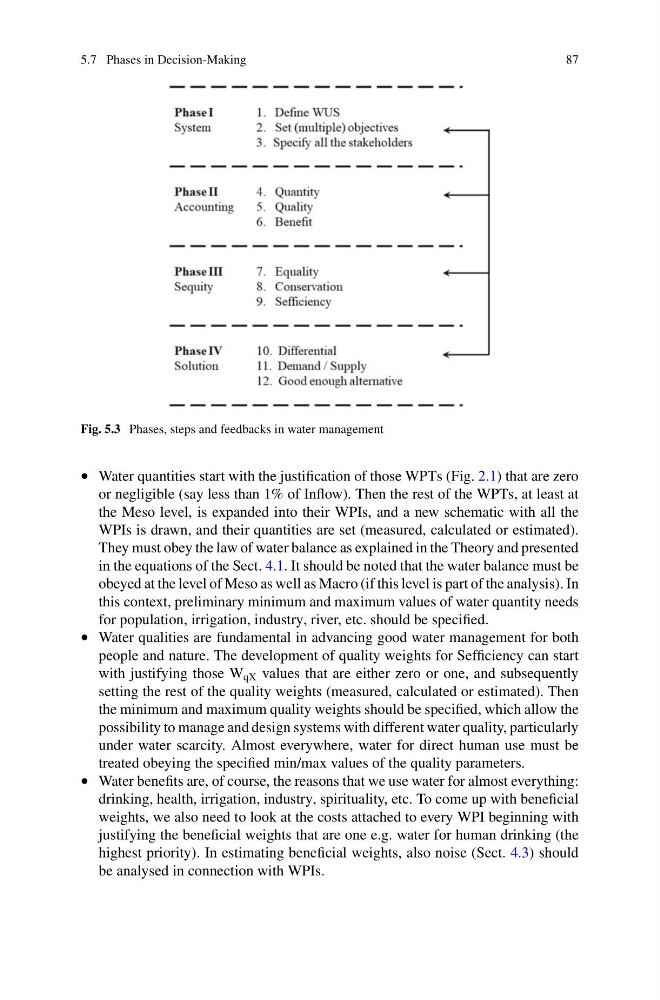
Fig. 5.3 Phases, steps and feedbacks in water management
• Water quantities start with the justification of those WPTs (Fig. 2.1) that are zero
or negligible (say less than 1% of Inflow). Then the rest of the WPTs, at least at
the Meso level, is expanded into their WPIs, and a new schematic with all the
WPIs is drawn, and their quantities are set (measured, calculated or estimated).
They must obey the law of water balance as explained in the Theory and presented
in the equations of the Sect. 4.1. It should be noted that the water balance must be
obeyed at the level of Meso as well as Macro (if this level is part of the analysis). In
this context, preliminary minimum and maximum values of water quantity needs
for population, irrigation, industry, river, etc. should be specified.
• Water qualities are fundamental in advancing good water management for both
people and nature. The development of quality weights for Sefficiency can start
with justifying those W qX values that are either zero or one, and subsequently
setting the rest of the quality weights (measured, calculated or estimated). Then
the minimum and maximum quality weights should be specified, which allow the
possibility to manage and design systems with different water quality, particularly
under water scarcity. Almost everywhere, water for direct human use must be
treated obeying the specified min/max values of the quality parameters.
• Water benefits are, of course, the reasons that we use water for almost everything:
drinking, health, irrigation, industry, spirituality, etc. To come up with beneficial
weights, we also need to look at the costs attached to every WPI beginning with
justifying the beneficial weights that are one e.g. water for human drinking (the
highest priority). In estimating beneficial weights, also noise (Sect. 4.3) should
be analysed in connection with WPIs.
87
Fig. 5.3 Phases, steps and feedbacks in water management
• Water quantities start with the justification of those WPTs (Fig. 2.1) that are zero
or negligible (say less than 1% of Inflow). Then the rest of the WPTs, at least at
the Meso level, is expanded into their WPIs, and a new schematic with all the
WPIs is drawn, and their quantities are set (measured, calculated or estimated).
They must obey the law of water balance as explained in the Theory and presented
in the equations of the Sect. 4.1. It should be noted that the water balance must be
obeyed at the level of Meso as well as Macro (if this level is part of the analysis). In
this context, preliminary minimum and maximum values of water quantity needs
for population, irrigation, industry, river, etc. should be specified.
• Water qualities are fundamental in advancing good water management for both
people and nature. The development of quality weights for Sefficiency can start
with justifying those W qX values that are either zero or one, and subsequently
setting the rest of the quality weights (measured, calculated or estimated). Then
the minimum and maximum quality weights should be specified, which allow the
possibility to manage and design systems with different water quality, particularly
under water scarcity. Almost everywhere, water for direct human use must be
treated obeying the specified min/max values of the quality parameters.
• Water benefits are, of course, the reasons that we use water for almost everything:
drinking, health, irrigation, industry, spirituality, etc. To come up with beneficial
weights, we also need to look at the costs attached to every WPI beginning with
justifying the beneficial weights that are one e.g. water for human drinking (the
highest priority). In estimating beneficial weights, also noise (Sect. 4.3) should
be analysed in connection with WPIs.