

5.2 Segments
77
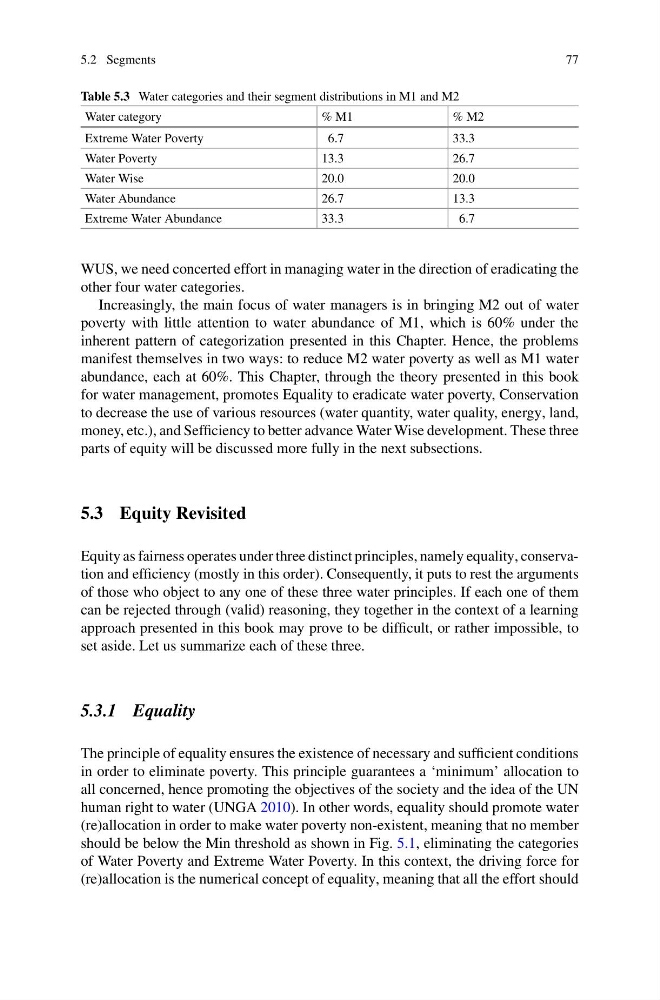
Table 5.3 Water categories and their segment distributions in M1 and M2
Water category
% M1
% M2
Extreme Water Poverty
6.7
33.3
Water Poverty
13.3
26.7
Water Wise
20.0
20.0
Water Abundance
26.7
13.3
Extreme Water Abundance
33.3
6.7
WUS, we need concerted effort in managing water in the direction of eradicating the
other four water categories.
Increasingly, the main focus of water managers is in bringing M2 out of water
poverty with little attention to water abundance of M1, which is 60% under the
inherent pattern of categorization presented in this Chapter. Hence, the problems
manifest themselves in two ways: to reduce M2 water poverty as well as M1 water
abundance, each at 60%. This Chapter, through the theory presented in this book
for water management, promotes Equality to eradicate water poverty, Conservation
to decrease the use of various resources (water quantity, water quality, energy, land,
money, etc.), and Sefficiency to better advance Water Wise development. These three
parts of equity will be discussed more fully in the next subsections.
5.3 Equity Revisited
Equity as fairness operates under three distinct principles, namely equality, conservation and efficiency (mostly in this order). Consequently, it puts to rest the arguments
of those who object to any one of these three water principles. If each one of them
can be rejected through (valid) reasoning, they together in the context of a learning
approach presented in this book may prove to be difficult, or rather impossible, to
set aside. Let us summarize each of these three.
5.3.1 Equality
The principle of equality ensures the existence of necessary and sufficient conditions
in order to eliminate poverty. This principle guarantees a ‘minimum’ allocation to
all concerned, hence promoting the objectives of the society and the idea of the UN
human right to water (UNGA 2010). In other words, equality should promote water
(re)allocation in order to make water poverty non-existent, meaning that no member
should be below the Min threshold as shown in Fig. 5.1, eliminating the categories
of Water Poverty and Extreme Water Poverty. In this context, the driving force for
(re)allocation is the numerical concept of equality, meaning that all the effort should
77
Table 5.3 Water categories and their segment distributions in M1 and M2
Water category
% M1
% M2
Extreme Water Poverty
6.7
33.3
Water Poverty
13.3
26.7
Water Wise
20.0
20.0
Water Abundance
26.7
13.3
Extreme Water Abundance
33.3
6.7
WUS, we need concerted effort in managing water in the direction of eradicating the
other four water categories.
Increasingly, the main focus of water managers is in bringing M2 out of water
poverty with little attention to water abundance of M1, which is 60% under the
inherent pattern of categorization presented in this Chapter. Hence, the problems
manifest themselves in two ways: to reduce M2 water poverty as well as M1 water
abundance, each at 60%. This Chapter, through the theory presented in this book
for water management, promotes Equality to eradicate water poverty, Conservation
to decrease the use of various resources (water quantity, water quality, energy, land,
money, etc.), and Sefficiency to better advance Water Wise development. These three
parts of equity will be discussed more fully in the next subsections.
5.3 Equity Revisited
Equity as fairness operates under three distinct principles, namely equality, conservation and efficiency (mostly in this order). Consequently, it puts to rest the arguments
of those who object to any one of these three water principles. If each one of them
can be rejected through (valid) reasoning, they together in the context of a learning
approach presented in this book may prove to be difficult, or rather impossible, to
set aside. Let us summarize each of these three.
5.3.1 Equality
The principle of equality ensures the existence of necessary and sufficient conditions
in order to eliminate poverty. This principle guarantees a ‘minimum’ allocation to
all concerned, hence promoting the objectives of the society and the idea of the UN
human right to water (UNGA 2010). In other words, equality should promote water
(re)allocation in order to make water poverty non-existent, meaning that no member
should be below the Min threshold as shown in Fig. 5.1, eliminating the categories
of Water Poverty and Extreme Water Poverty. In this context, the driving force for
(re)allocation is the numerical concept of equality, meaning that all the effort should