

4.5 Alternatives
63
Second, the European Union has defined a number of building blocks for
water efficiency activities (European Commission Water 2019) which highlights
the following two points, among others:
• “A study from 2007 on the water saving potential in Europe, estimates that
water efficiency could be improved by nearly 40%”. This study (Dworak 2007)
was funded by the European Commission, Directorate-General Environment and
produced a report that goes into many sectors and services. Its overall outlook
defines water saving potential stating that it “can be achieved by improving the
efficiency of various uses of water without decreasing services or by cutting back
the use of a resource, even if that means cutting back the goods and services
produced by using that resource.” This definition gives two possibilities, which
Eq. (4.16) should be used for their understanding: (i) CE 2 > CE 1 and X b2 ≥ X b1 ,
(ii) after “or”, VA 2 < VA 1 and X 2b ≤ X b1 with an implicit assumption that CE 2 ≥
CE 1 .
• “The study identifies the need for an EU approach that could contribute to water
efficiency across Europe, regardless of the variation in climate, population or
land use practices in Member States.” This study on water efficiency standards
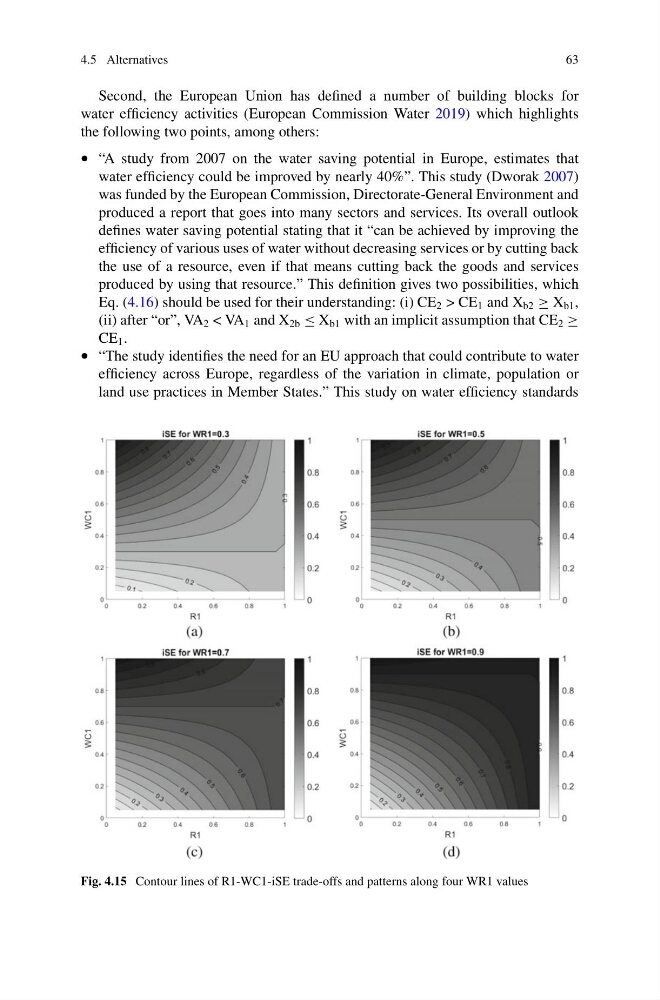
Fig. 4.15 Contour lines of R1-WC1-iSE trade-offs and patterns along four WR1 values
63
Second, the European Union has defined a number of building blocks for
water efficiency activities (European Commission Water 2019) which highlights
the following two points, among others:
• “A study from 2007 on the water saving potential in Europe, estimates that
water efficiency could be improved by nearly 40%”. This study (Dworak 2007)
was funded by the European Commission, Directorate-General Environment and
produced a report that goes into many sectors and services. Its overall outlook
defines water saving potential stating that it “can be achieved by improving the
efficiency of various uses of water without decreasing services or by cutting back
the use of a resource, even if that means cutting back the goods and services
produced by using that resource.” This definition gives two possibilities, which
Eq. (4.16) should be used for their understanding: (i) CE 2 > CE 1 and X b2 ≥ X b1 ,
(ii) after “or”, VA 2 < VA 1 and X 2b ≤ X b1 with an implicit assumption that CE 2 ≥
CE 1 .
• “The study identifies the need for an EU approach that could contribute to water
efficiency across Europe, regardless of the variation in climate, population or
land use practices in Member States.” This study on water efficiency standards
Fig. 4.15 Contour lines of R1-WC1-iSE trade-offs and patterns along four WR1 values