

34
3 Theory
about the activities that change the quantity and quality of water, particularly in
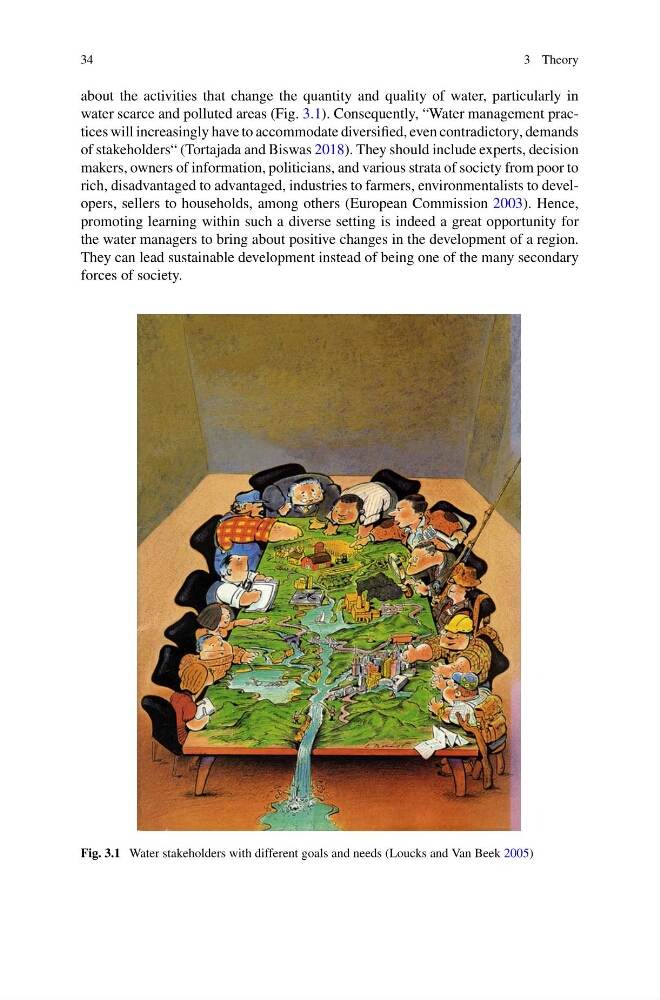
water scarce and polluted areas (Fig. 3.1). Consequently, “Water management practices will increasingly have to accommodate diversified, even contradictory, demands
of stakeholders“ (Tortajada and Biswas 2018). They should include experts, decision
makers, owners of information, politicians, and various strata of society from poor to
rich, disadvantaged to advantaged, industries to farmers, environmentalists to developers, sellers to households, among others (European Commission 2003). Hence,
promoting learning within such a diverse setting is indeed a great opportunity for
the water managers to bring about positive changes in the development of a region.
They can lead sustainable development instead of being one of the many secondary
forces of society.
Fig. 3.1 Water stakeholders with different goals and needs (Loucks and Van Beek 2005)
3 Theory
about the activities that change the quantity and quality of water, particularly in
water scarce and polluted areas (Fig. 3.1). Consequently, “Water management practices will increasingly have to accommodate diversified, even contradictory, demands
of stakeholders“ (Tortajada and Biswas 2018). They should include experts, decision
makers, owners of information, politicians, and various strata of society from poor to
rich, disadvantaged to advantaged, industries to farmers, environmentalists to developers, sellers to households, among others (European Commission 2003). Hence,
promoting learning within such a diverse setting is indeed a great opportunity for
the water managers to bring about positive changes in the development of a region.
They can lead sustainable development instead of being one of the many secondary
forces of society.
Fig. 3.1 Water stakeholders with different goals and needs (Loucks and Van Beek 2005)