

24
3 Theory
3.1 Five FIWs (Foundational Ideas About WUS)
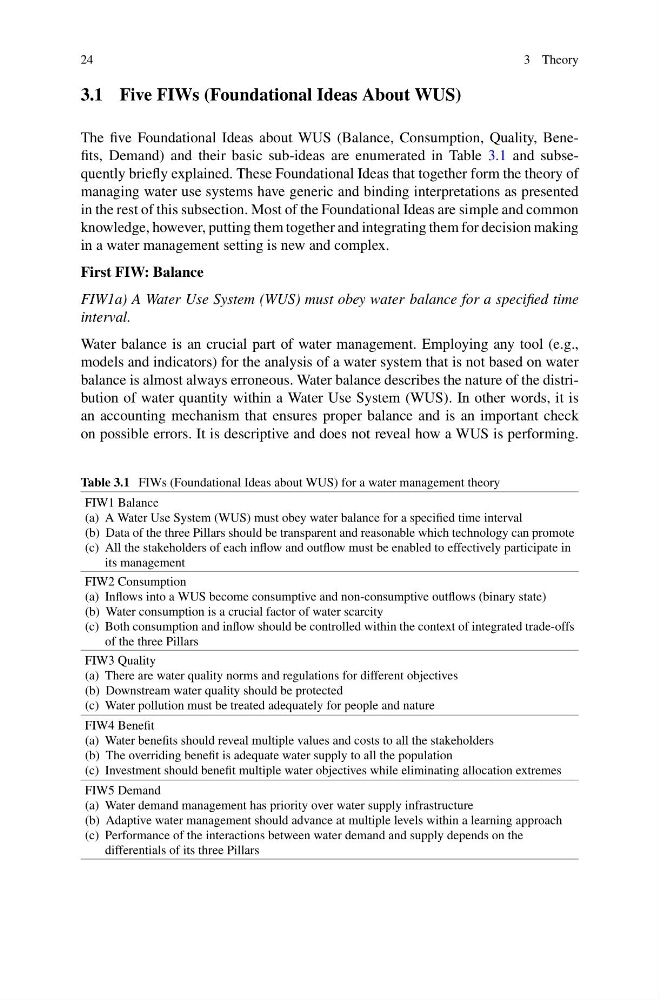
The five Foundational Ideas about WUS (Balance, Consumption, Quality, Benefits, Demand) and their basic sub-ideas are enumerated in Table 3.1 and subsequently briefly explained. These Foundational Ideas that together form the theory of
managing water use systems have generic and binding interpretations as presented
in the rest of this subsection. Most of the Foundational Ideas are simple and common
knowledge, however, putting them together and integrating them for decision making
in a water management setting is new and complex.
First FIW: Balance
FIW1a) A Water Use System (WUS) must obey water balance for a specified time
interval.
Water balance is an crucial part of water management. Employing any tool (e.g.,
models and indicators) for the analysis of a water system that is not based on water
balance is almost always erroneous. Water balance describes the nature of the distribution of water quantity within a Water Use System (WUS). In other words, it is
an accounting mechanism that ensures proper balance and is an important check
on possible errors. It is descriptive and does not reveal how a WUS is performing.
Table 3.1 FIWs (Foundational Ideas about WUS) for a water management theory
FIW1 Balance
(a) A Water Use System (WUS) must obey water balance for a specified time interval
(b) Data of the three Pillars should be transparent and reasonable which technology can promote
(c) All the stakeholders of each inflow and outflow must be enabled to effectively participate in
its management
FIW2 Consumption
(a) Inflows into a WUS become consumptive and non-consumptive outflows (binary state)
(b) Water consumption is a crucial factor of water scarcity
(c) Both consumption and inflow should be controlled within the context of integrated trade-offs
of the three Pillars
FIW3 Quality
(a) There are water quality norms and regulations for different objectives
(b) Downstream water quality should be protected
(c) Water pollution must be treated adequately for people and nature
FIW4 Benefit
(a) Water benefits should reveal multiple values and costs to all the stakeholders
(b) The overriding benefit is adequate water supply to all the population
(c) Investment should benefit multiple water objectives while eliminating allocation extremes
FIW5 Demand
(a) Water demand management has priority over water supply infrastructure
(b) Adaptive water management should advance at multiple levels within a learning approach
(c) Performance of the interactions between water demand and supply depends on the
differentials of its three Pillars
3 Theory
3.1 Five FIWs (Foundational Ideas About WUS)
The five Foundational Ideas about WUS (Balance, Consumption, Quality, Benefits, Demand) and their basic sub-ideas are enumerated in Table 3.1 and subsequently briefly explained. These Foundational Ideas that together form the theory of
managing water use systems have generic and binding interpretations as presented
in the rest of this subsection. Most of the Foundational Ideas are simple and common
knowledge, however, putting them together and integrating them for decision making
in a water management setting is new and complex.
First FIW: Balance
FIW1a) A Water Use System (WUS) must obey water balance for a specified time
interval.
Water balance is an crucial part of water management. Employing any tool (e.g.,
models and indicators) for the analysis of a water system that is not based on water
balance is almost always erroneous. Water balance describes the nature of the distribution of water quantity within a Water Use System (WUS). In other words, it is
an accounting mechanism that ensures proper balance and is an important check
on possible errors. It is descriptive and does not reveal how a WUS is performing.
Table 3.1 FIWs (Foundational Ideas about WUS) for a water management theory
FIW1 Balance
(a) A Water Use System (WUS) must obey water balance for a specified time interval
(b) Data of the three Pillars should be transparent and reasonable which technology can promote
(c) All the stakeholders of each inflow and outflow must be enabled to effectively participate in
its management
FIW2 Consumption
(a) Inflows into a WUS become consumptive and non-consumptive outflows (binary state)
(b) Water consumption is a crucial factor of water scarcity
(c) Both consumption and inflow should be controlled within the context of integrated trade-offs
of the three Pillars
FIW3 Quality
(a) There are water quality norms and regulations for different objectives
(b) Downstream water quality should be protected
(c) Water pollution must be treated adequately for people and nature
FIW4 Benefit
(a) Water benefits should reveal multiple values and costs to all the stakeholders
(b) The overriding benefit is adequate water supply to all the population
(c) Investment should benefit multiple water objectives while eliminating allocation extremes
FIW5 Demand
(a) Water demand management has priority over water supply infrastructure
(b) Adaptive water management should advance at multiple levels within a learning approach
(c) Performance of the interactions between water demand and supply depends on the
differentials of its three Pillars