

2.4 Binary Opposites in Water
17
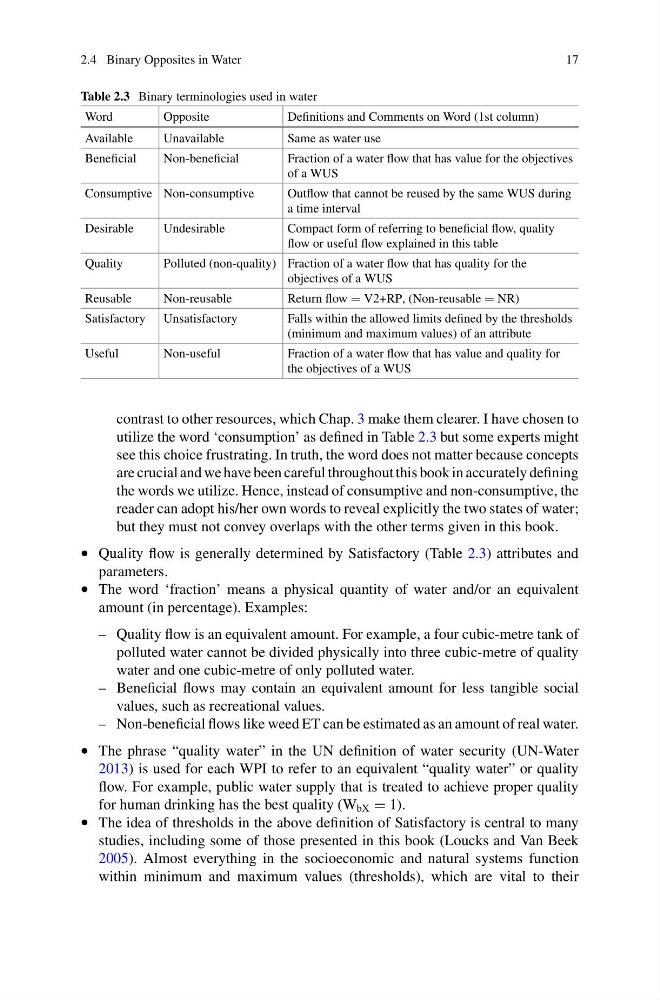
Table 2.3 Binary terminologies used in water
Word
Opposite
Definitions and Comments on Word (1st column)
Available
Unavailable
Same as water use
Beneficial
Non-beneficial
Fraction of a water flow that has value for the objectives
of a WUS
Consumptive Non-consumptive
Outflow that cannot be reused by the same WUS during
a time interval
Desirable
Undesirable
Compact form of referring to beneficial flow, quality
flow or useful flow explained in this table
Quality
Polluted (non-quality) Fraction of a water flow that has quality for the
objectives of a WUS
Reusable
Non-reusable
Return flow = V2+RP, (Non-reusable = NR)
Satisfactory Unsatisfactory
Falls within the allowed limits defined by the thresholds
(minimum and maximum values) of an attribute
Useful
Non-useful
Fraction of a water flow that has value and quality for
the objectives of a WUS
contrast to other resources, which Chap. 3 make them clearer. I have chosen to
utilize the word ‘consumption’ as defined in Table 2.3 but some experts might
see this choice frustrating. In truth, the word does not matter because concepts
are crucial and we have been careful throughout this book in accurately defining
the words we utilize. Hence, instead of consumptive and non-consumptive, the
reader can adopt his/her own words to reveal explicitly the two states of water;
but they must not convey overlaps with the other terms given in this book.
• Quality flow is generally determined by Satisfactory (Table 2.3) attributes and
parameters.
• The word ‘fraction’ means a physical quantity of water and/or an equivalent
amount (in percentage). Examples:
– Quality flow is an equivalent amount. For example, a four cubic-metre tank of
polluted water cannot be divided physically into three cubic-metre of quality
water and one cubic-metre of only polluted water.
– Beneficial flows may contain an equivalent amount for less tangible social
values, such as recreational values.
– Non-beneficial flows like weed ET can be estimated as an amount of real water.
• The phrase “quality water” in the UN definition of water security (UN-Water
2013) is used for each WPI to refer to an equivalent “quality water” or quality
flow. For example, public water supply that is treated to achieve proper quality
for human drinking has the best quality (W bX = 1).
• The idea of thresholds in the above definition of Satisfactory is central to many
studies, including some of those presented in this book (Loucks and Van Beek
2005). Almost everything in the socioeconomic and natural systems function
within minimum and maximum values (thresholds), which are vital to their
17
Table 2.3 Binary terminologies used in water
Word
Opposite
Definitions and Comments on Word (1st column)
Available
Unavailable
Same as water use
Beneficial
Non-beneficial
Fraction of a water flow that has value for the objectives
of a WUS
Consumptive Non-consumptive
Outflow that cannot be reused by the same WUS during
a time interval
Desirable
Undesirable
Compact form of referring to beneficial flow, quality
flow or useful flow explained in this table
Quality
Polluted (non-quality) Fraction of a water flow that has quality for the
objectives of a WUS
Reusable
Non-reusable
Return flow = V2+RP, (Non-reusable = NR)
Satisfactory Unsatisfactory
Falls within the allowed limits defined by the thresholds
(minimum and maximum values) of an attribute
Useful
Non-useful
Fraction of a water flow that has value and quality for
the objectives of a WUS
contrast to other resources, which Chap. 3 make them clearer. I have chosen to
utilize the word ‘consumption’ as defined in Table 2.3 but some experts might
see this choice frustrating. In truth, the word does not matter because concepts
are crucial and we have been careful throughout this book in accurately defining
the words we utilize. Hence, instead of consumptive and non-consumptive, the
reader can adopt his/her own words to reveal explicitly the two states of water;
but they must not convey overlaps with the other terms given in this book.
• Quality flow is generally determined by Satisfactory (Table 2.3) attributes and
parameters.
• The word ‘fraction’ means a physical quantity of water and/or an equivalent
amount (in percentage). Examples:
– Quality flow is an equivalent amount. For example, a four cubic-metre tank of
polluted water cannot be divided physically into three cubic-metre of quality
water and one cubic-metre of only polluted water.
– Beneficial flows may contain an equivalent amount for less tangible social
values, such as recreational values.
– Non-beneficial flows like weed ET can be estimated as an amount of real water.
• The phrase “quality water” in the UN definition of water security (UN-Water
2013) is used for each WPI to refer to an equivalent “quality water” or quality
flow. For example, public water supply that is treated to achieve proper quality
for human drinking has the best quality (W bX = 1).
• The idea of thresholds in the above definition of Satisfactory is central to many
studies, including some of those presented in this book (Loucks and Van Beek
2005). Almost everything in the socioeconomic and natural systems function
within minimum and maximum values (thresholds), which are vital to their