

2.2 Pillars: Quantity, Quality, Benefits
15
The reason for the inequality, of course, is the fact that the three weights are not
equal having in mind that X b1 is the beneficial fraction of X1.
Property 2: Let us consider the following:
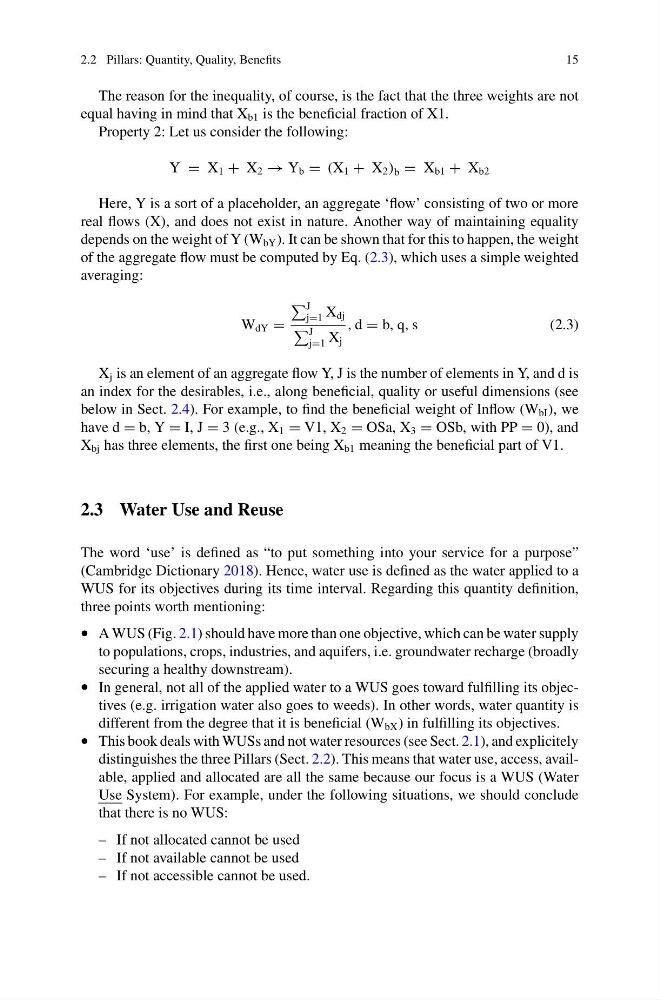
Y = X 1 + X 2 → Y b = (X 1 + X 2 ) b = X b1 + X b2
Here, Y is a sort of a placeholder, an aggregate ‘flow’ consisting of two or more
real flows (X), and does not exist in nature. Another way of maintaining equality
depends on the weight of Y (W bY ). It can be shown that for this to happen, the weight
of the aggregate flow must be computed by Eq. (2.3), which uses a simple weighted
averaging:
W dY =
J
j=1 X dj
J
j=1 X j
, d = b, q, s
(2.3)
X j is an element of an aggregate flow Y, J is the number of elements in Y, and d is
an index for the desirables, i.e., along beneficial, quality or useful dimensions (see
below in Sect. 2.4). For example, to find the beneficial weight of Inflow (W bI ), we
have d = b, Y = I, J = 3 (e.g., X 1 = V1, X 2 = OSa, X 3 = OSb, with PP = 0), and
X bj has three elements, the first one being X b1 meaning the beneficial part of V1.
2.3 Water Use and Reuse
The word ‘use’ is defined as “to put something into your service for a purpose”
(Cambridge Dictionary 2018). Hence, water use is defined as the water applied to a
WUS for its objectives during its time interval. Regarding this quantity definition,
three points worth mentioning:
• A WUS (Fig. 2.1) should have more than one objective, which can be water supply
to populations, crops, industries, and aquifers, i.e. groundwater recharge (broadly
securing a healthy downstream).
• In general, not all of the applied water to a WUS goes toward fulfilling its objectives (e.g. irrigation water also goes to weeds). In other words, water quantity is
different from the degree that it is beneficial (W bX ) in fulfilling its objectives.
• This book deals with WUSs and not water resources (see Sect. 2.1), and explicitely
distinguishes the three Pillars (Sect. 2.2). This means that water use, access, available, applied and allocated are all the same because our focus is a WUS (Water
Use System). For example, under the following situations, we should conclude
that there is no WUS:
– If not allocated cannot be used
– If not available cannot be used
– If not accessible cannot be used.
15
The reason for the inequality, of course, is the fact that the three weights are not
equal having in mind that X b1 is the beneficial fraction of X1.
Property 2: Let us consider the following:
Y = X 1 + X 2 → Y b = (X 1 + X 2 ) b = X b1 + X b2
Here, Y is a sort of a placeholder, an aggregate ‘flow’ consisting of two or more
real flows (X), and does not exist in nature. Another way of maintaining equality
depends on the weight of Y (W bY ). It can be shown that for this to happen, the weight
of the aggregate flow must be computed by Eq. (2.3), which uses a simple weighted
averaging:
W dY =
J
j=1 X dj
J
j=1 X j
, d = b, q, s
(2.3)
X j is an element of an aggregate flow Y, J is the number of elements in Y, and d is
an index for the desirables, i.e., along beneficial, quality or useful dimensions (see
below in Sect. 2.4). For example, to find the beneficial weight of Inflow (W bI ), we
have d = b, Y = I, J = 3 (e.g., X 1 = V1, X 2 = OSa, X 3 = OSb, with PP = 0), and
X bj has three elements, the first one being X b1 meaning the beneficial part of V1.
2.3 Water Use and Reuse
The word ‘use’ is defined as “to put something into your service for a purpose”
(Cambridge Dictionary 2018). Hence, water use is defined as the water applied to a
WUS for its objectives during its time interval. Regarding this quantity definition,
three points worth mentioning:
• A WUS (Fig. 2.1) should have more than one objective, which can be water supply
to populations, crops, industries, and aquifers, i.e. groundwater recharge (broadly
securing a healthy downstream).
• In general, not all of the applied water to a WUS goes toward fulfilling its objectives (e.g. irrigation water also goes to weeds). In other words, water quantity is
different from the degree that it is beneficial (W bX ) in fulfilling its objectives.
• This book deals with WUSs and not water resources (see Sect. 2.1), and explicitely
distinguishes the three Pillars (Sect. 2.2). This means that water use, access, available, applied and allocated are all the same because our focus is a WUS (Water
Use System). For example, under the following situations, we should conclude
that there is no WUS:
– If not allocated cannot be used
– If not available cannot be used
– If not accessible cannot be used.