

12
2 Terminology
2.2 Pillars: Quantity, Quality, Benefits
Figure 1.1 shows the idea of the three fundamental water Pillars, namely water quantity, water quality and water benefits (economic or not). One of the most difficult parts
of this book is to continuously remember that the theory presented here is systemic,
i.e., based on a predefined system (WUS) that explains all of its water quantities as
described in the previous subsection. There are, of course, clear distinctions between
the three Pillars of water management. Water quantity is the liquid/vapor part and
water quality and benefits are the attributes of water quantity. For example, one litre
of water is one litre of water whether it is beneficial or not, polluted or not.
In many studies, the two water attributes manifest their influence on the performance of systems through two weights, varying from 0 (worst) to 1 (best). This
means that each WPI of a WUS (denoted as X for ease of reference in symbols
and equations) has a beneficial weight (W bX ) and a quality weight (W qX ) with their
product giving Usefulness Criterion (W sX ), as defined below:
• Beneficial Weight (W bX ) represents the fraction of a water flow that has value for
the objectives of a WUS.
• Quality Weight (W qX ) represents the fraction of a water flow that has quality for
the objectives of a WUS.
• Usefulness Criterion (W sX ) represents the fraction of a water flow that has value
and quality for the objectives of a WUS.
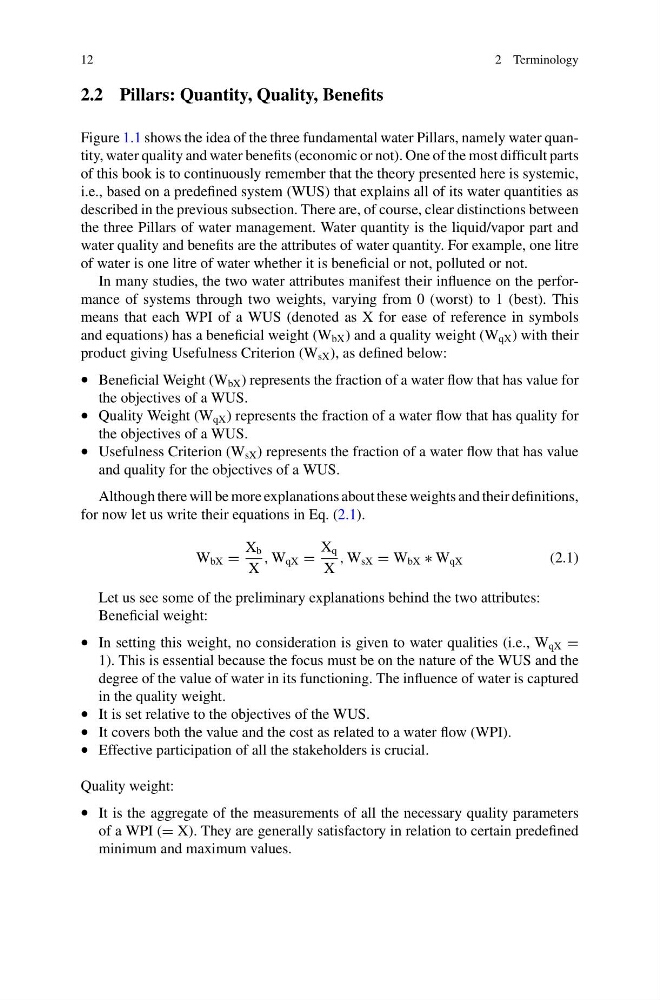
Although there will be more explanations about these weights and their definitions,
for now let us write their equations in Eq. (2.1).
W bX =
X b
X
, W qX =
X q
X
, W sX = W bX ∗ W qX
(2.1)
Let us see some of the preliminary explanations behind the two attributes:
Beneficial weight:
• In setting this weight, no consideration is given to water qualities (i.e., W qX =
1). This is essential because the focus must be on the nature of the WUS and the
degree of the value of water in its functioning. The influence of water is captured
in the quality weight.
• It is set relative to the objectives of the WUS.
• It covers both the value and the cost as related to a water flow (WPI).
• Effective participation of all the stakeholders is crucial.
Quality weight:
• It is the aggregate of the measurements of all the necessary quality parameters
of a WPI (= X). They are generally satisfactory in relation to certain predefined
minimum and maximum values.
2 Terminology
2.2 Pillars: Quantity, Quality, Benefits
Figure 1.1 shows the idea of the three fundamental water Pillars, namely water quantity, water quality and water benefits (economic or not). One of the most difficult parts
of this book is to continuously remember that the theory presented here is systemic,
i.e., based on a predefined system (WUS) that explains all of its water quantities as
described in the previous subsection. There are, of course, clear distinctions between
the three Pillars of water management. Water quantity is the liquid/vapor part and
water quality and benefits are the attributes of water quantity. For example, one litre
of water is one litre of water whether it is beneficial or not, polluted or not.
In many studies, the two water attributes manifest their influence on the performance of systems through two weights, varying from 0 (worst) to 1 (best). This
means that each WPI of a WUS (denoted as X for ease of reference in symbols
and equations) has a beneficial weight (W bX ) and a quality weight (W qX ) with their
product giving Usefulness Criterion (W sX ), as defined below:
• Beneficial Weight (W bX ) represents the fraction of a water flow that has value for
the objectives of a WUS.
• Quality Weight (W qX ) represents the fraction of a water flow that has quality for
the objectives of a WUS.
• Usefulness Criterion (W sX ) represents the fraction of a water flow that has value
and quality for the objectives of a WUS.
Although there will be more explanations about these weights and their definitions,
for now let us write their equations in Eq. (2.1).
W bX =
X b
X
, W qX =
X q
X
, W sX = W bX ∗ W qX
(2.1)
Let us see some of the preliminary explanations behind the two attributes:
Beneficial weight:
• In setting this weight, no consideration is given to water qualities (i.e., W qX =
1). This is essential because the focus must be on the nature of the WUS and the
degree of the value of water in its functioning. The influence of water is captured
in the quality weight.
• It is set relative to the objectives of the WUS.
• It covers both the value and the cost as related to a water flow (WPI).
• Effective participation of all the stakeholders is crucial.
Quality weight:
• It is the aggregate of the measurements of all the necessary quality parameters
of a WPI (= X). They are generally satisfactory in relation to certain predefined
minimum and maximum values.