

2 Ecology, War, and Nuclear Testing in the Pacific …
25
an absolute truth of the urgency of climate change, and thus a prompt to save the rest of the
planet. (p. 47)
According to Farbotko’s logic, rather than embodying inherent value in and of itself,
‘sinking’ Tuvalu may seemingly serve a better (and more enduring) purpose by ‘going
under’ and thereby serving humanity through its bigger utilitarian function of epitomising a warning to the rest of the world that climate change is real and needs urgent
attention. Relatedly, only as the utter destruction, enduring contamination and longterm uninhabitability of the Bikini and Enewetak atolls in the Marshall Islands were
laid bare during (and following) nuclear testing—along with the destruction brought
on in Christmas (Kiritimati) Island, French Polynesia and Johnston (Kalama) Atoll—
did these unspoilt ecosystems serve a meaningful utilitarian purpose by embodying
a warning to humanity to guard against the risks of nuclear apocalypse (cf. ICAN
2014, 2017; Krieger 2017; Moruroa Files 2021). The inhabitants of these impacted
island regions could be forgiven for concluding that, despite some expressions of
regret, in the eyes of the great powers their lives and homes were ultimately regarded
as being of little consequence as hundreds of nuclear tests were conducted in the
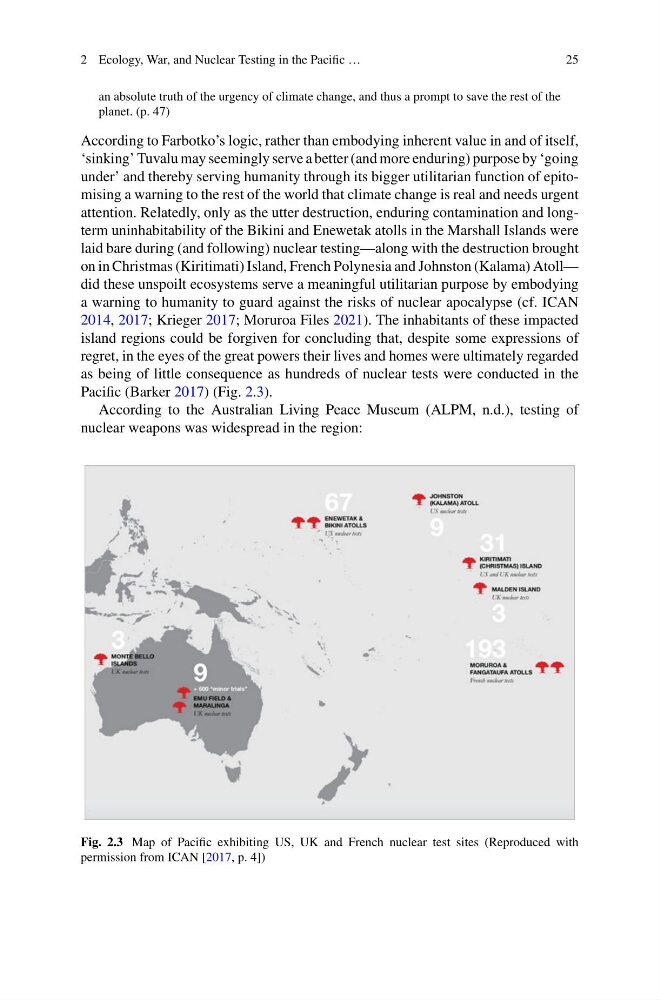
Pacific (Barker 2017) (Fig. 2.3).
According to the Australian Living Peace Museum (ALPM, n.d.), testing of
nuclear weapons was widespread in the region:
Fig. 2.3 Map of Pacific exhibiting US, UK and French nuclear test sites (Reproduced with
permission from ICAN [2017, p. 4])
25
an absolute truth of the urgency of climate change, and thus a prompt to save the rest of the
planet. (p. 47)
According to Farbotko’s logic, rather than embodying inherent value in and of itself,
‘sinking’ Tuvalu may seemingly serve a better (and more enduring) purpose by ‘going
under’ and thereby serving humanity through its bigger utilitarian function of epitomising a warning to the rest of the world that climate change is real and needs urgent
attention. Relatedly, only as the utter destruction, enduring contamination and longterm uninhabitability of the Bikini and Enewetak atolls in the Marshall Islands were
laid bare during (and following) nuclear testing—along with the destruction brought
on in Christmas (Kiritimati) Island, French Polynesia and Johnston (Kalama) Atoll—
did these unspoilt ecosystems serve a meaningful utilitarian purpose by embodying
a warning to humanity to guard against the risks of nuclear apocalypse (cf. ICAN
2014, 2017; Krieger 2017; Moruroa Files 2021). The inhabitants of these impacted
island regions could be forgiven for concluding that, despite some expressions of
regret, in the eyes of the great powers their lives and homes were ultimately regarded
as being of little consequence as hundreds of nuclear tests were conducted in the
Pacific (Barker 2017) (Fig. 2.3).
According to the Australian Living Peace Museum (ALPM, n.d.), testing of
nuclear weapons was widespread in the region:
Fig. 2.3 Map of Pacific exhibiting US, UK and French nuclear test sites (Reproduced with
permission from ICAN [2017, p. 4])