

18 Christianity, Creation, and the Climate Crisis …
361
God is the Creator of everything. Therefore, truth in all fields stems from Him. Failing to
see this point clearly has led many to develop a false dichotomy between the secular and the
religious. That dichotomy implies that the religious has to do with God, while the secular is
divorced from Him. From this point of view, the study of science, history and mathematics
[or climate science] is seen as basically secular, while the study of religion, church history,
and ethics is viewed as religious. That is not the biblical perspective. In the Bible, God is
seen as the Creator of the objects and patterns of science and math … In essence, there is no
such thing as ‘secular’ [truth] (Knight 2006, p. 225)
In summary, striving after truth and knowledge provides the Christian community
(and other faith communities) a strong incentive—and a robust multiplex foundation—to care for and safeguard the Earth. To this end, “the various sources of knowledge available to the Christian are complementary” (Knight 2006, p. 183). This
involves conserving creation as a palpable source of revelatory knowledge about
its Creator. Given this rationale for metaphysically-informed environmentalism, the
following section will now explore why Christian conservation efforts have faced
sometimes vociferous opposition from within.
Contextualising Green Prisms
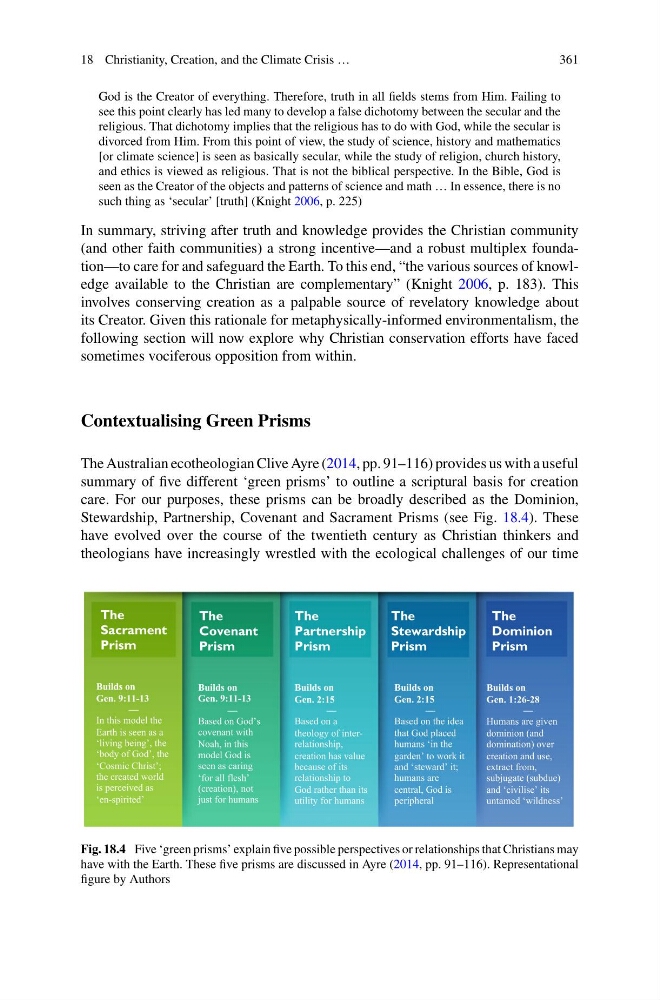
The Australian ecotheologian Clive Ayre (2014, pp. 91–116) provides us with a useful
summary of five different ‘green prisms’ to outline a scriptural basis for creation
care. For our purposes, these prisms can be broadly described as the Dominion,
Stewardship, Partnership, Covenant and Sacrament Prisms (see Fig. 18.4). These
have evolved over the course of the twentieth century as Christian thinkers and
theologians have increasingly wrestled with the ecological challenges of our time
The
Sacrament
Prism
The
Covenant
Prism
The
Partnership
Prism
The
Stewardship
Prism
The
Dominion
Prism
Builds on
Gen. 9:11-13
—
In this model the
Earth is seen as a
‘living being’, the
‘body of God’, the
‘Cosmic Christ’;
the created world
is perceived as
‘en-spirited’
Builds on
Gen. 9:11-13
—
Based on God’s
covenant with
Noah, in this
model God is
seen as caring
‘for all flesh’
(creation), not
just for humans
Builds on
Gen. 2:15
—
Based on a
theology of interrelationship,
creation has value
because of its
relationship to
God rather than its
utility for humans
Builds on
Gen. 2:15
—
Based on the idea
that God placed
humans ‘in the
garden’ to work it
and ‘steward’ it;
humans are
central, God is
peripheral
Builds on
Gen. 1:26-28
—
Humans are given
dominion (and
domination) over
creation and use,
extract from,
subjugate (subdue)
and ‘civilise’ its
untamed ‘wildness’
Fig. 18.4 Five ‘green prisms’ explain five possible perspectives or relationships that Christians may
have with the Earth. These five prisms are discussed in Ayre (2014, pp. 91–116). Representational
figure by Authors
361
God is the Creator of everything. Therefore, truth in all fields stems from Him. Failing to
see this point clearly has led many to develop a false dichotomy between the secular and the
religious. That dichotomy implies that the religious has to do with God, while the secular is
divorced from Him. From this point of view, the study of science, history and mathematics
[or climate science] is seen as basically secular, while the study of religion, church history,
and ethics is viewed as religious. That is not the biblical perspective. In the Bible, God is
seen as the Creator of the objects and patterns of science and math … In essence, there is no
such thing as ‘secular’ [truth] (Knight 2006, p. 225)
In summary, striving after truth and knowledge provides the Christian community
(and other faith communities) a strong incentive—and a robust multiplex foundation—to care for and safeguard the Earth. To this end, “the various sources of knowledge available to the Christian are complementary” (Knight 2006, p. 183). This
involves conserving creation as a palpable source of revelatory knowledge about
its Creator. Given this rationale for metaphysically-informed environmentalism, the
following section will now explore why Christian conservation efforts have faced
sometimes vociferous opposition from within.
Contextualising Green Prisms
The Australian ecotheologian Clive Ayre (2014, pp. 91–116) provides us with a useful
summary of five different ‘green prisms’ to outline a scriptural basis for creation
care. For our purposes, these prisms can be broadly described as the Dominion,
Stewardship, Partnership, Covenant and Sacrament Prisms (see Fig. 18.4). These
have evolved over the course of the twentieth century as Christian thinkers and
theologians have increasingly wrestled with the ecological challenges of our time
The
Sacrament
Prism
The
Covenant
Prism
The
Partnership
Prism
The
Stewardship
Prism
The
Dominion
Prism
Builds on
Gen. 9:11-13
—
In this model the
Earth is seen as a
‘living being’, the
‘body of God’, the
‘Cosmic Christ’;
the created world
is perceived as
‘en-spirited’
Builds on
Gen. 9:11-13
—
Based on God’s
covenant with
Noah, in this
model God is
seen as caring
‘for all flesh’
(creation), not
just for humans
Builds on
Gen. 2:15
—
Based on a
theology of interrelationship,
creation has value
because of its
relationship to
God rather than its
utility for humans
Builds on
Gen. 2:15
—
Based on the idea
that God placed
humans ‘in the
garden’ to work it
and ‘steward’ it;
humans are
central, God is
peripheral
Builds on
Gen. 1:26-28
—
Humans are given
dominion (and
domination) over
creation and use,
extract from,
subjugate (subdue)
and ‘civilise’ its
untamed ‘wildness’
Fig. 18.4 Five ‘green prisms’ explain five possible perspectives or relationships that Christians may
have with the Earth. These five prisms are discussed in Ayre (2014, pp. 91–116). Representational
figure by Authors