

348
J. M. Luetz and R. G. Leo
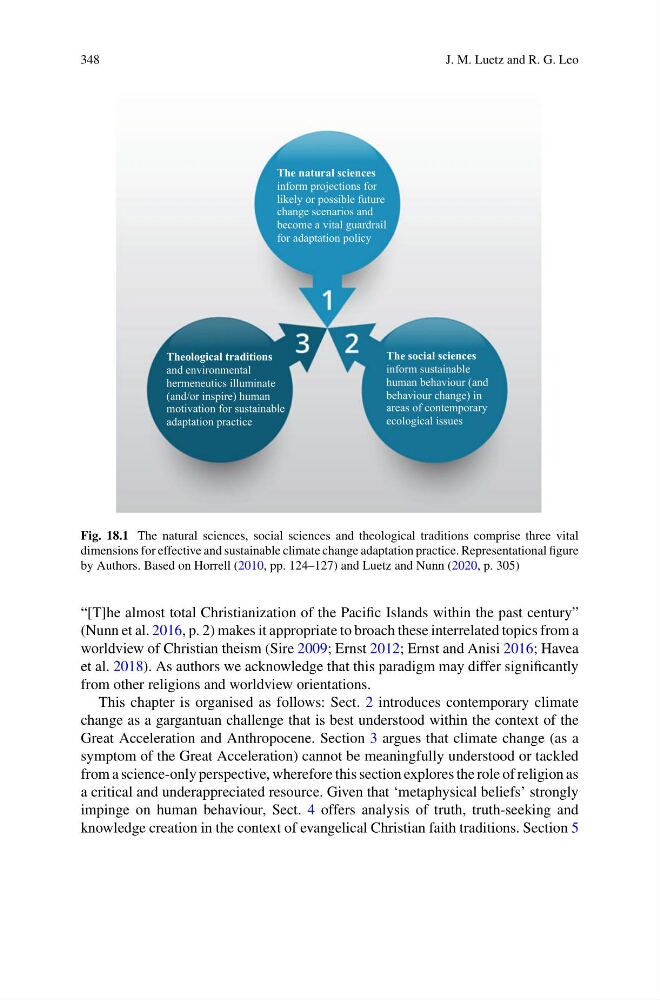
The social sciences
inform sustainable
human behaviour (and
behaviour change) in
areas of contemporary
ecological issues
The natural sciences
inform projections for
likely or possible future
change scenarios and
become a vital guardrail
for adaptation policy
Theological traditions
and environmental
hermeneutics illuminate
(and/or inspire) human
motivation for sustainable
adaptation practice
Fig. 18.1 The natural sciences, social sciences and theological traditions comprise three vital
dimensions for effective and sustainable climate change adaptation practice. Representational figure
by Authors. Based on Horrell (2010, pp. 124–127) and Luetz and Nunn (2020, p. 305)
“[T]he almost total Christianization of the Pacific Islands within the past century”
(Nunn et al. 2016, p. 2) makes it appropriate to broach these interrelated topics from a
worldview of Christian theism (Sire 2009; Ernst 2012; Ernst and Anisi 2016; Havea
et al. 2018). As authors we acknowledge that this paradigm may differ significantly
from other religions and worldview orientations.
This chapter is organised as follows: Sect. 2 introduces contemporary climate
change as a gargantuan challenge that is best understood within the context of the
Great Acceleration and Anthropocene. Section 3 argues that climate change (as a
symptom of the Great Acceleration) cannot be meaningfully understood or tackled
from a science-only perspective, wherefore this section explores the role of religion as
a critical and underappreciated resource. Given that ‘metaphysical beliefs’ strongly
impinge on human behaviour, Sect. 4 offers analysis of truth, truth-seeking and
knowledge creation in the context of evangelical Christian faith traditions. Section 5
J. M. Luetz and R. G. Leo
The social sciences
inform sustainable
human behaviour (and
behaviour change) in
areas of contemporary
ecological issues
The natural sciences
inform projections for
likely or possible future
change scenarios and
become a vital guardrail
for adaptation policy
Theological traditions
and environmental
hermeneutics illuminate
(and/or inspire) human
motivation for sustainable
adaptation practice
Fig. 18.1 The natural sciences, social sciences and theological traditions comprise three vital
dimensions for effective and sustainable climate change adaptation practice. Representational figure
by Authors. Based on Horrell (2010, pp. 124–127) and Luetz and Nunn (2020, p. 305)
“[T]he almost total Christianization of the Pacific Islands within the past century”
(Nunn et al. 2016, p. 2) makes it appropriate to broach these interrelated topics from a
worldview of Christian theism (Sire 2009; Ernst 2012; Ernst and Anisi 2016; Havea
et al. 2018). As authors we acknowledge that this paradigm may differ significantly
from other religions and worldview orientations.
This chapter is organised as follows: Sect. 2 introduces contemporary climate
change as a gargantuan challenge that is best understood within the context of the
Great Acceleration and Anthropocene. Section 3 argues that climate change (as a
symptom of the Great Acceleration) cannot be meaningfully understood or tackled
from a science-only perspective, wherefore this section explores the role of religion as
a critical and underappreciated resource. Given that ‘metaphysical beliefs’ strongly
impinge on human behaviour, Sect. 4 offers analysis of truth, truth-seeking and
knowledge creation in the context of evangelical Christian faith traditions. Section 5