

14 For Kin, God and Other Beings: Mixtures of Conservation …
281
different motivations for supporting the same environmental protections: conservation biologists and NGOs promoted the intrinsic value of biodiversity or specificbased protections, while many Beteo and Ma’ya communities cooperated with environmental programs as a means to greater cultural recognition for land rights, or
to support better harvests or fisheries landings, or to attract foreign eco-tourists to
village homestays and dive at nearby reefs.
West Papuans across island settlements of Raja Ampat think about their role in
protecting or making use of their nonhuman surrounds in diverse ways. They take
shape as a moral grammar of religious edicts with sasi gereja, an ethical stance of
‘do no harm’ when interacting with manta rays in tourist zones, a guarded caution
towards suanggi caves, a reverent attitude towards ancestors in mon areas, and an
economic view toward future profitability in garden plots. According to a Ma’ya
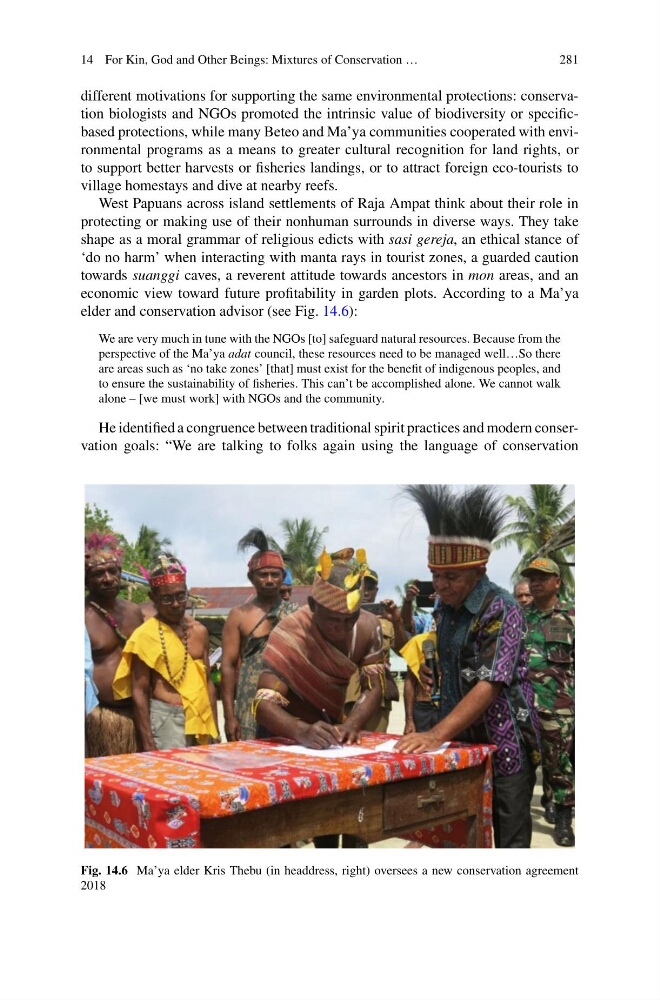
elder and conservation advisor (see Fig. 14.6):
We are very much in tune with the NGOs [to] safeguard natural resources. Because from the
perspective of the Ma’ya adat council, these resources need to be managed well…So there
are areas such as ‘no take zones’ [that] must exist for the benefit of indigenous peoples, and
to ensure the sustainability of fisheries. This can’t be accomplished alone. We cannot walk
alone – [we must work] with NGOs and the community.
He identified a congruence between traditional spirit practices and modern conservation goals: “We are talking to folks again using the language of conservation
Fig. 14.6 Ma’ya elder Kris Thebu (in headdress, right) oversees a new conservation agreement
2018
281
different motivations for supporting the same environmental protections: conservation biologists and NGOs promoted the intrinsic value of biodiversity or specificbased protections, while many Beteo and Ma’ya communities cooperated with environmental programs as a means to greater cultural recognition for land rights, or
to support better harvests or fisheries landings, or to attract foreign eco-tourists to
village homestays and dive at nearby reefs.
West Papuans across island settlements of Raja Ampat think about their role in
protecting or making use of their nonhuman surrounds in diverse ways. They take
shape as a moral grammar of religious edicts with sasi gereja, an ethical stance of
‘do no harm’ when interacting with manta rays in tourist zones, a guarded caution
towards suanggi caves, a reverent attitude towards ancestors in mon areas, and an
economic view toward future profitability in garden plots. According to a Ma’ya
elder and conservation advisor (see Fig. 14.6):
We are very much in tune with the NGOs [to] safeguard natural resources. Because from the
perspective of the Ma’ya adat council, these resources need to be managed well…So there
are areas such as ‘no take zones’ [that] must exist for the benefit of indigenous peoples, and
to ensure the sustainability of fisheries. This can’t be accomplished alone. We cannot walk
alone – [we must work] with NGOs and the community.
He identified a congruence between traditional spirit practices and modern conservation goals: “We are talking to folks again using the language of conservation
Fig. 14.6 Ma’ya elder Kris Thebu (in headdress, right) oversees a new conservation agreement
2018