

14 For Kin, God and Other Beings: Mixtures of Conservation …
271
became important traders, employees of commercial fishing companies, and more
recently, pioneers of village-based marine tourism.
While parts of Indonesia have been Christian since sixteenth century Jesuit
voyages, along New Guinea’s coastal zone a key moment occurred in 1855 when
German missionaries Carl Ottow and Johann Geissler introduced the Gospel to people
living near the modern city of Manokwari. Conversion signified a rupture from a
mobile past towards settled village life. It hailed the end to tribal wars (perang suku)
and roving witches. Many Papuans became defined as members of a congregation
(jemaat), rather than through dispersed family units. Today, most residents identify
with the Evangelical Christian Church (Gereja Keristen Injili de Tanah Papua, GKI),
followed by the Roman Catholic and Evangelical Tabernacle Church (Gereja Kemah
Injil di Indonesia, GKII) (Aritonang and Steenbrink 2008: 377–380).
The implementation of large-scale marine conservation programs in the late
2000s increased the frequency and variety of cross-cultural interactions, particularly between Papuan communities, conservation scientists, environmental NGOs
and ecotourists. Following surveys that identified Raja Ampat as a global refuge for
coral reef and forest habitats, the World Wildlife Fund for Nature (WWF), The Nature
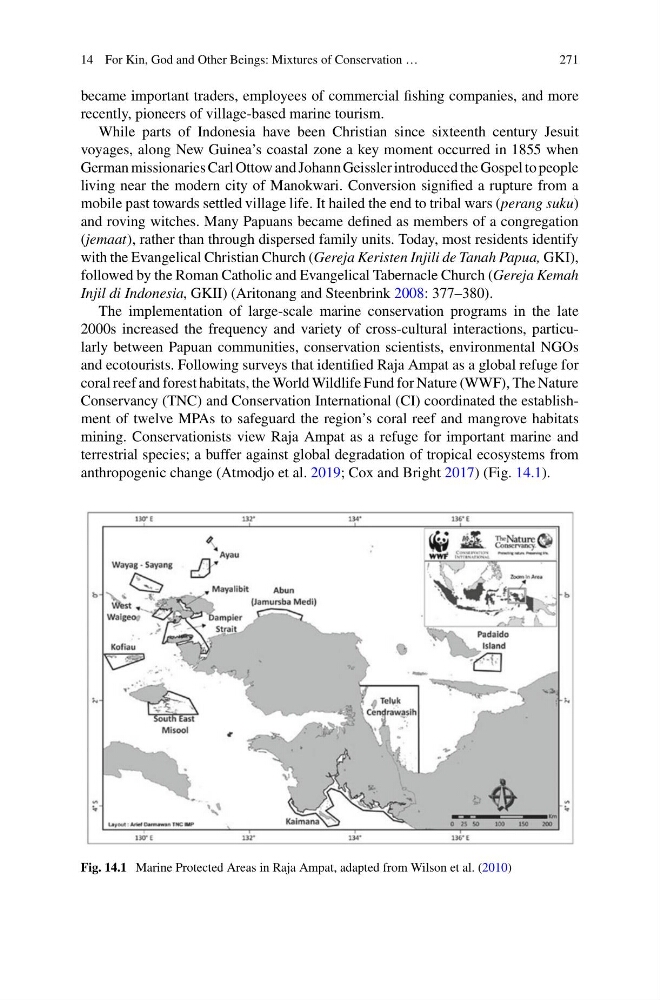
Conservancy (TNC) and Conservation International (CI) coordinated the establishment of twelve MPAs to safeguard the region’s coral reef and mangrove habitats
mining. Conservationists view Raja Ampat as a refuge for important marine and
terrestrial species; a buffer against global degradation of tropical ecosystems from
anthropogenic change (Atmodjo et al. 2019; Cox and Bright 2017) (Fig. 14.1).
Fig. 14.1 Marine Protected Areas in Raja Ampat, adapted from Wilson et al. (2010)
271
became important traders, employees of commercial fishing companies, and more
recently, pioneers of village-based marine tourism.
While parts of Indonesia have been Christian since sixteenth century Jesuit
voyages, along New Guinea’s coastal zone a key moment occurred in 1855 when
German missionaries Carl Ottow and Johann Geissler introduced the Gospel to people
living near the modern city of Manokwari. Conversion signified a rupture from a
mobile past towards settled village life. It hailed the end to tribal wars (perang suku)
and roving witches. Many Papuans became defined as members of a congregation
(jemaat), rather than through dispersed family units. Today, most residents identify
with the Evangelical Christian Church (Gereja Keristen Injili de Tanah Papua, GKI),
followed by the Roman Catholic and Evangelical Tabernacle Church (Gereja Kemah
Injil di Indonesia, GKII) (Aritonang and Steenbrink 2008: 377–380).
The implementation of large-scale marine conservation programs in the late
2000s increased the frequency and variety of cross-cultural interactions, particularly between Papuan communities, conservation scientists, environmental NGOs
and ecotourists. Following surveys that identified Raja Ampat as a global refuge for
coral reef and forest habitats, the World Wildlife Fund for Nature (WWF), The Nature
Conservancy (TNC) and Conservation International (CI) coordinated the establishment of twelve MPAs to safeguard the region’s coral reef and mangrove habitats
mining. Conservationists view Raja Ampat as a refuge for important marine and
terrestrial species; a buffer against global degradation of tropical ecosystems from
anthropogenic change (Atmodjo et al. 2019; Cox and Bright 2017) (Fig. 14.1).
Fig. 14.1 Marine Protected Areas in Raja Ampat, adapted from Wilson et al. (2010)