

2 Data Quality Control: Theory and Current Practice
2.1 Principles of Data Quality Control
Data is now considered one of the fundamental pieces of the daily operation across
many services [15]. Over the recent decades, rapid technological changes have
transformed multiple service fields into data-rich environments, where decisionmakers are increasingly called to evaluate and decide based on data. Smarter and
more frequent metering [16, 17], along with advances in hardware, editing technologies and new data analysis techniques have reshaped decision-making from an
empirical to an increasingly data-driven process [18]. Furthermore, the role of data is
foreseen to grow, with the inclusion of technologies such as cloud-based systems
and big data analytics in the systems analysis and, eventually, the decision-making
culture, thus causing a paradigm shift in the value of information, the nature of
expertise and, eventually, the practice of management and decision-making itself
[19, 20]. This paradigm shift is also occurring in the drinking water industry, as
drinking water networks become smarter, more networked and more complex
[16, 17], thus providing increasingly data-rich inputs to the operators and the
decision-makers.
The elevated role of data in decision-making leads to a pressing need for more
efficient data quality services, as poor data quality leads to ill-informed operational
decisions and, thus, less reliable systems and higher customer dissatisfaction
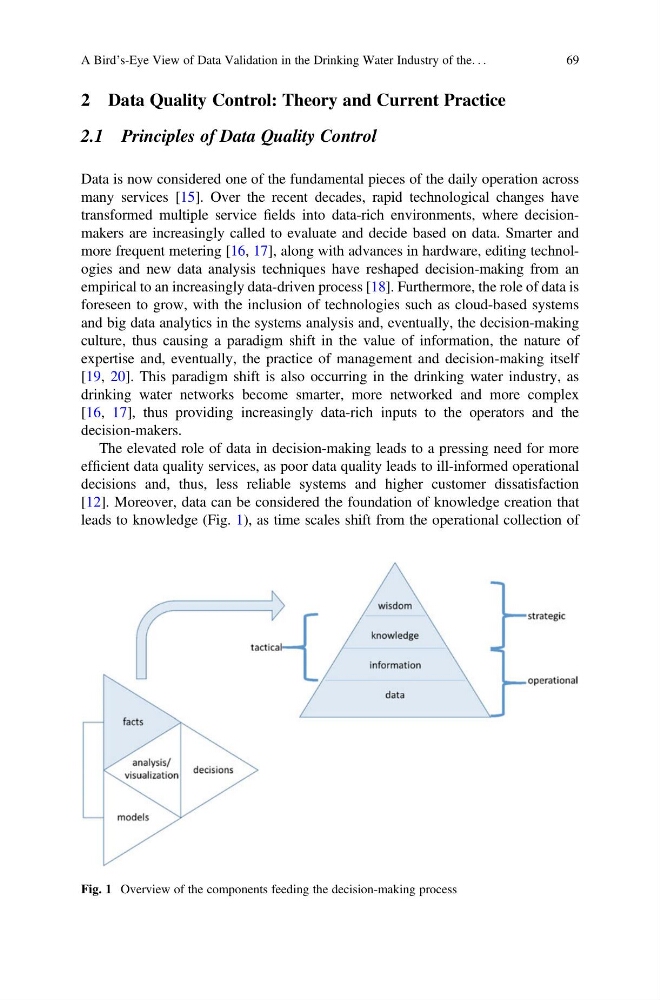
[12]. Moreover, data can be considered the foundation of knowledge creation that
leads to knowledge (Fig. 1), as time scales shift from the operational collection of
Fig. 1 Overview of the components feeding the decision-making process
A Bird’s-Eye View of Data Validation in the Drinking Water Industry of the. . .
69
2.1 Principles of Data Quality Control
Data is now considered one of the fundamental pieces of the daily operation across
many services [15]. Over the recent decades, rapid technological changes have
transformed multiple service fields into data-rich environments, where decisionmakers are increasingly called to evaluate and decide based on data. Smarter and
more frequent metering [16, 17], along with advances in hardware, editing technologies and new data analysis techniques have reshaped decision-making from an
empirical to an increasingly data-driven process [18]. Furthermore, the role of data is
foreseen to grow, with the inclusion of technologies such as cloud-based systems
and big data analytics in the systems analysis and, eventually, the decision-making
culture, thus causing a paradigm shift in the value of information, the nature of
expertise and, eventually, the practice of management and decision-making itself
[19, 20]. This paradigm shift is also occurring in the drinking water industry, as
drinking water networks become smarter, more networked and more complex
[16, 17], thus providing increasingly data-rich inputs to the operators and the
decision-makers.
The elevated role of data in decision-making leads to a pressing need for more
efficient data quality services, as poor data quality leads to ill-informed operational
decisions and, thus, less reliable systems and higher customer dissatisfaction
[12]. Moreover, data can be considered the foundation of knowledge creation that
leads to knowledge (Fig. 1), as time scales shift from the operational collection of
Fig. 1 Overview of the components feeding the decision-making process
A Bird’s-Eye View of Data Validation in the Drinking Water Industry of the. . .
69