

can be seen as that leak/burst signature. The calculated residuals are then evaluated
against a threshold (that may be selected to take into account the measurement noise
and model uncertainty – [36]). If a residual violates the threshold (for a given time
window, in the general case) then, the leak/burst isolation process is initiated. The
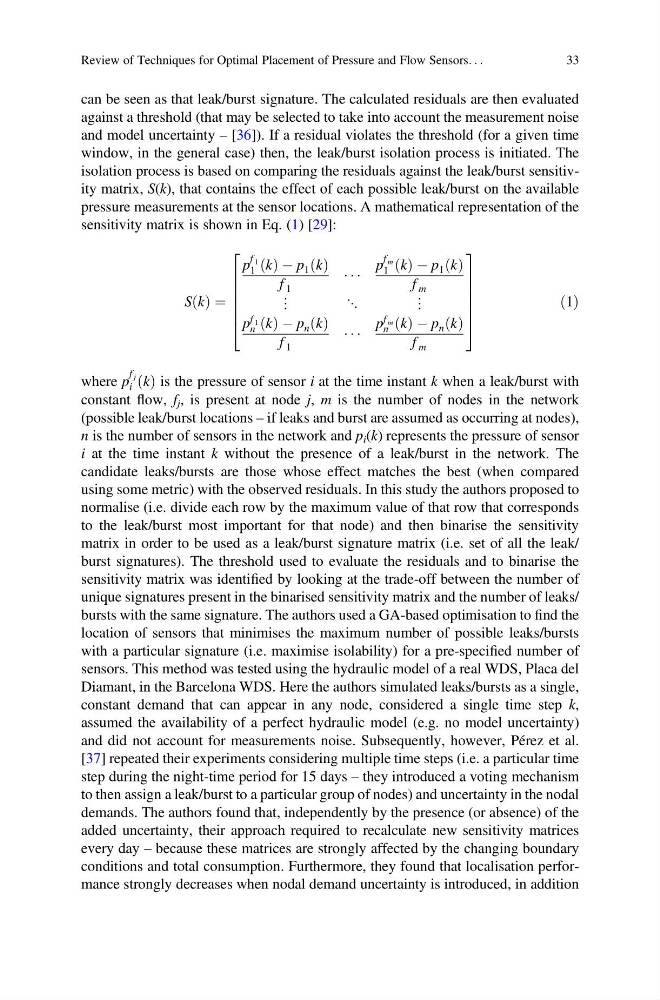
isolation process is based on comparing the residuals against the leak/burst sensitivity matrix, S(k), that contains the effect of each possible leak/burst on the available
pressure measurements at the sensor locations. A mathematical representation of the
sensitivity matrix is shown in Eq. (1) [29]:
S k
ð Þ ¼
p
f 1
1 k
ð Þ À p 1 k
ð Þ
f 1
Á Á Á
p
f m
1 k
ð Þ À p 1 k
ð Þ
f m
⋮
⋱
⋮
p
f 1
n k
ð Þ À p n k
ð Þ
f 1
Á Á Á
p
f m
n k
ð Þ À p n k
ð Þ
f m
2
6
6
6
6
6
4
3
7
7
7
7
7
5
ð1Þ
where p
f j
i k
ð Þ is the pressure of sensor i at the time instant k when a leak/burst with
constant flow, f j , is present at node j, m is the number of nodes in the network
(possible leak/burst locations – if leaks and burst are assumed as occurring at nodes),
n is the number of sensors in the network and p i (k) represents the pressure of sensor
i at the time instant k without the presence of a leak/burst in the network. The
candidate leaks/bursts are those whose effect matches the best (when compared
using some metric) with the observed residuals. In this study the authors proposed to
normalise (i.e. divide each row by the maximum value of that row that corresponds
to the leak/burst most important for that node) and then binarise the sensitivity
matrix in order to be used as a leak/burst signature matrix (i.e. set of all the leak/
burst signatures). The threshold used to evaluate the residuals and to binarise the
sensitivity matrix was identified by looking at the trade-off between the number of
unique signatures present in the binarised sensitivity matrix and the number of leaks/
bursts with the same signature. The authors used a GA-based optimisation to find the
location of sensors that minimises the maximum number of possible leaks/bursts
with a particular signature (i.e. maximise isolability) for a pre-specified number of
sensors. This method was tested using the hydraulic model of a real WDS, Placa del
Diamant, in the Barcelona WDS. Here the authors simulated leaks/bursts as a single,
constant demand that can appear in any node, considered a single time step k,
assumed the availability of a perfect hydraulic model (e.g. no model uncertainty)
and did not account for measurements noise. Subsequently, however, Pérez et al.
[37] repeated their experiments considering multiple time steps (i.e. a particular time
step during the night-time period for 15 days – they introduced a voting mechanism
to then assign a leak/burst to a particular group of nodes) and uncertainty in the nodal
demands. The authors found that, independently by the presence (or absence) of the
added uncertainty, their approach required to recalculate new sensitivity matrices
every day – because these matrices are strongly affected by the changing boundary
conditions and total consumption. Furthermore, they found that localisation performance strongly decreases when nodal demand uncertainty is introduced, in addition
Review of Techniques for Optimal Placement of Pressure and Flow Sensors. . .
33
against a threshold (that may be selected to take into account the measurement noise
and model uncertainty – [36]). If a residual violates the threshold (for a given time
window, in the general case) then, the leak/burst isolation process is initiated. The
isolation process is based on comparing the residuals against the leak/burst sensitivity matrix, S(k), that contains the effect of each possible leak/burst on the available
pressure measurements at the sensor locations. A mathematical representation of the
sensitivity matrix is shown in Eq. (1) [29]:
S k
ð Þ ¼
p
f 1
1 k
ð Þ À p 1 k
ð Þ
f 1
Á Á Á
p
f m
1 k
ð Þ À p 1 k
ð Þ
f m
⋮
⋱
⋮
p
f 1
n k
ð Þ À p n k
ð Þ
f 1
Á Á Á
p
f m
n k
ð Þ À p n k
ð Þ
f m
2
6
6
6
6
6
4
3
7
7
7
7
7
5
ð1Þ
where p
f j
i k
ð Þ is the pressure of sensor i at the time instant k when a leak/burst with
constant flow, f j , is present at node j, m is the number of nodes in the network
(possible leak/burst locations – if leaks and burst are assumed as occurring at nodes),
n is the number of sensors in the network and p i (k) represents the pressure of sensor
i at the time instant k without the presence of a leak/burst in the network. The
candidate leaks/bursts are those whose effect matches the best (when compared
using some metric) with the observed residuals. In this study the authors proposed to
normalise (i.e. divide each row by the maximum value of that row that corresponds
to the leak/burst most important for that node) and then binarise the sensitivity
matrix in order to be used as a leak/burst signature matrix (i.e. set of all the leak/
burst signatures). The threshold used to evaluate the residuals and to binarise the
sensitivity matrix was identified by looking at the trade-off between the number of
unique signatures present in the binarised sensitivity matrix and the number of leaks/
bursts with the same signature. The authors used a GA-based optimisation to find the
location of sensors that minimises the maximum number of possible leaks/bursts
with a particular signature (i.e. maximise isolability) for a pre-specified number of
sensors. This method was tested using the hydraulic model of a real WDS, Placa del
Diamant, in the Barcelona WDS. Here the authors simulated leaks/bursts as a single,
constant demand that can appear in any node, considered a single time step k,
assumed the availability of a perfect hydraulic model (e.g. no model uncertainty)
and did not account for measurements noise. Subsequently, however, Pérez et al.
[37] repeated their experiments considering multiple time steps (i.e. a particular time
step during the night-time period for 15 days – they introduced a voting mechanism
to then assign a leak/burst to a particular group of nodes) and uncertainty in the nodal
demands. The authors found that, independently by the presence (or absence) of the
added uncertainty, their approach required to recalculate new sensitivity matrices
every day – because these matrices are strongly affected by the changing boundary
conditions and total consumption. Furthermore, they found that localisation performance strongly decreases when nodal demand uncertainty is introduced, in addition
Review of Techniques for Optimal Placement of Pressure and Flow Sensors. . .
33