

web where all information is categorised and stored in such a way that a
computer (perhaps through AI) can understand it as well as a human. Machine to
machine communication in Web 3.0 will be key to a step change in optimising
performance with distributed middleware infrastructure allowing receiving systems
to communicate with downstream applications. The new focus for Web 3.0 is user
centric: decentralisation, privacy and security.
Blockchain is a shared, secure, distributed ledger which is ideal for applications
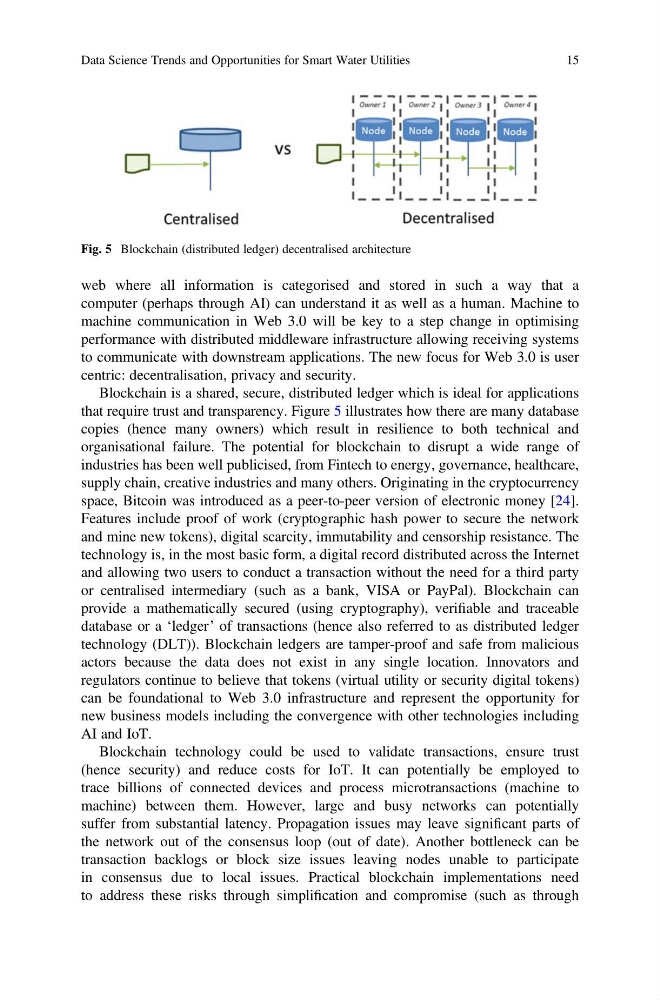
that require trust and transparency. Figure 5 illustrates how there are many database
copies (hence many owners) which result in resilience to both technical and
organisational failure. The potential for blockchain to disrupt a wide range of
industries has been well publicised, from Fintech to energy, governance, healthcare,
supply chain, creative industries and many others. Originating in the cryptocurrency
space, Bitcoin was introduced as a peer-to-peer version of electronic money [24].
Features include proof of work (cryptographic hash power to secure the network
and mine new tokens), digital scarcity, immutability and censorship resistance. The
technology is, in the most basic form, a digital record distributed across the Internet
and allowing two users to conduct a transaction without the need for a third party
or centralised intermediary (such as a bank, VISA or PayPal). Blockchain can
provide a mathematically secured (using cryptography), verifiable and traceable
database or a ‘ledger’ of transactions (hence also referred to as distributed ledger
technology (DLT)). Blockchain ledgers are tamper-proof and safe from malicious
actors because the data does not exist in any single location. Innovators and
regulators continue to believe that tokens (virtual utility or security digital tokens)
can be foundational to Web 3.0 infrastructure and represent the opportunity for
new business models including the convergence with other technologies including
AI and IoT.
Blockchain technology could be used to validate transactions, ensure trust
(hence security) and reduce costs for IoT. It can potentially be employed to
trace billions of connected devices and process microtransactions (machine to
machine) between them. However, large and busy networks can potentially
suffer from substantial latency. Propagation issues may leave significant parts of
the network out of the consensus loop (out of date). Another bottleneck can be
transaction backlogs or block size issues leaving nodes unable to participate
in consensus due to local issues. Practical blockchain implementations need
to address these risks through simplification and compromise (such as through
Fig. 5 Blockchain (distributed ledger) decentralised architecture
Data Science Trends and Opportunities for Smart Water Utilities
15
computer (perhaps through AI) can understand it as well as a human. Machine to
machine communication in Web 3.0 will be key to a step change in optimising
performance with distributed middleware infrastructure allowing receiving systems
to communicate with downstream applications. The new focus for Web 3.0 is user
centric: decentralisation, privacy and security.
Blockchain is a shared, secure, distributed ledger which is ideal for applications
that require trust and transparency. Figure 5 illustrates how there are many database
copies (hence many owners) which result in resilience to both technical and
organisational failure. The potential for blockchain to disrupt a wide range of
industries has been well publicised, from Fintech to energy, governance, healthcare,
supply chain, creative industries and many others. Originating in the cryptocurrency
space, Bitcoin was introduced as a peer-to-peer version of electronic money [24].
Features include proof of work (cryptographic hash power to secure the network
and mine new tokens), digital scarcity, immutability and censorship resistance. The
technology is, in the most basic form, a digital record distributed across the Internet
and allowing two users to conduct a transaction without the need for a third party
or centralised intermediary (such as a bank, VISA or PayPal). Blockchain can
provide a mathematically secured (using cryptography), verifiable and traceable
database or a ‘ledger’ of transactions (hence also referred to as distributed ledger
technology (DLT)). Blockchain ledgers are tamper-proof and safe from malicious
actors because the data does not exist in any single location. Innovators and
regulators continue to believe that tokens (virtual utility or security digital tokens)
can be foundational to Web 3.0 infrastructure and represent the opportunity for
new business models including the convergence with other technologies including
AI and IoT.
Blockchain technology could be used to validate transactions, ensure trust
(hence security) and reduce costs for IoT. It can potentially be employed to
trace billions of connected devices and process microtransactions (machine to
machine) between them. However, large and busy networks can potentially
suffer from substantial latency. Propagation issues may leave significant parts of
the network out of the consensus loop (out of date). Another bottleneck can be
transaction backlogs or block size issues leaving nodes unable to participate
in consensus due to local issues. Practical blockchain implementations need
to address these risks through simplification and compromise (such as through
Fig. 5 Blockchain (distributed ledger) decentralised architecture
Data Science Trends and Opportunities for Smart Water Utilities
15