

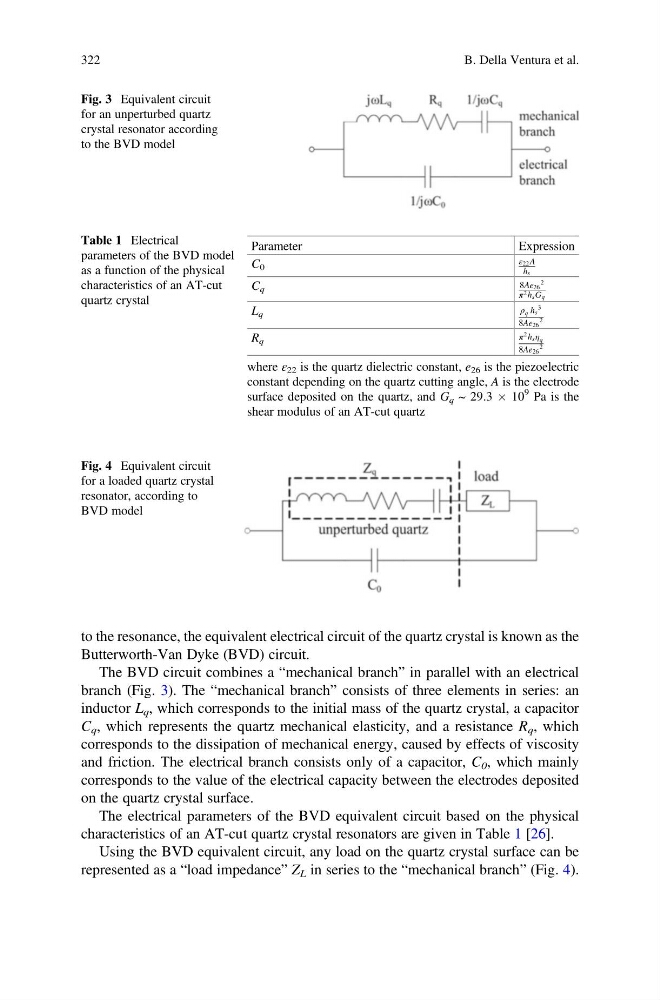
to the resonance, the equivalent electrical circuit of the quartz crystal is known as the
Butterworth-Van Dyke (BVD) circuit.
The BVD circuit combines a “mechanical branch” in parallel with an electrical
branch (Fig. 3). The “mechanical branch” consists of three elements in series: an
inductor L q , which corresponds to the initial mass of the quartz crystal, a capacitor
C q , which represents the quartz mechanical elasticity, and a resistance R q , which
corresponds to the dissipation of mechanical energy, caused by effects of viscosity
and friction. The electrical branch consists only of a capacitor, C 0 , which mainly
corresponds to the value of the electrical capacity between the electrodes deposited
on the quartz crystal surface.
The electrical parameters of the BVD equivalent circuit based on the physical
characteristics of an AT-cut quartz crystal resonators are given in Table 1 [26].
Using the BVD equivalent circuit, any load on the quartz crystal surface can be
represented as a “load impedance” Z L in series to the “mechanical branch” (Fig. 4).
Table 1 Electrical
parameters of the BVD model
as a function of the physical
characteristics of an AT-cut
quartz crystal
Parameter
Expression
C 0
ε22A
hs
C q
8Ae26
2
π 2 hsGq
L q
ρ q hs
3
8Ae26
2
R q
π
2 hsη q
8Ae26
2
where ε 22 is the quartz dielectric constant, e 26 is the piezoelectric
constant depending on the quartz cutting angle, A is the electrode
surface deposited on the quartz, and G q ~ 29.3 Â 10
9 Pa is the
shear modulus of an AT-cut quartz
Fig. 4 Equivalent circuit
for a loaded quartz crystal
resonator, according to
BVD model
Fig. 3 Equivalent circuit
for an unperturbed quartz
crystal resonator according
to the BVD model
322
B. Della Ventura et al.
Butterworth-Van Dyke (BVD) circuit.
The BVD circuit combines a “mechanical branch” in parallel with an electrical
branch (Fig. 3). The “mechanical branch” consists of three elements in series: an
inductor L q , which corresponds to the initial mass of the quartz crystal, a capacitor
C q , which represents the quartz mechanical elasticity, and a resistance R q , which
corresponds to the dissipation of mechanical energy, caused by effects of viscosity
and friction. The electrical branch consists only of a capacitor, C 0 , which mainly
corresponds to the value of the electrical capacity between the electrodes deposited
on the quartz crystal surface.
The electrical parameters of the BVD equivalent circuit based on the physical
characteristics of an AT-cut quartz crystal resonators are given in Table 1 [26].
Using the BVD equivalent circuit, any load on the quartz crystal surface can be
represented as a “load impedance” Z L in series to the “mechanical branch” (Fig. 4).
Table 1 Electrical
parameters of the BVD model
as a function of the physical
characteristics of an AT-cut
quartz crystal
Parameter
Expression
C 0
ε22A
hs
C q
8Ae26
2
π 2 hsGq
L q
ρ q hs
3
8Ae26
2
R q
π
2 hsη q
8Ae26
2
where ε 22 is the quartz dielectric constant, e 26 is the piezoelectric
constant depending on the quartz cutting angle, A is the electrode
surface deposited on the quartz, and G q ~ 29.3 Â 10
9 Pa is the
shear modulus of an AT-cut quartz
Fig. 4 Equivalent circuit
for a loaded quartz crystal
resonator, according to
BVD model
Fig. 3 Equivalent circuit
for an unperturbed quartz
crystal resonator according
to the BVD model
322
B. Della Ventura et al.