

2.3 Kanazawa: Gordon Equation: Quartz Crystal in Contact
with a Liquid
The first pioneering physical model for the quantitative determination of the
variation of the resonance frequency of a quartz crystal immersed in a liquid was
developed by Kanazawa and Gordon [22]. This model is based on the assumption
that the quartz crystal is a perfectly elastic solid, therefore not subject to mechanical
energy losses by dissipation, and the liquid is a purely viscous fluid (or Newtonian
fluid). Quartz crystal stable oscillation can be obtained when one side of the quartz is
in contact with a liquid. However, the viscous effect of the liquid causes not only a
large variation in the resonance frequency but also a loss in the Q quality factor,
causing instability and total damping of the oscillation. It is possible to determine the
physical behavior of the quartz crystal–liquid system, by considering the coupling
between the elastic shear wave in the crystal and the one propagating within the
viscous fluid. The resonance condition results from the choice of appropriate boundary conditions for the quartz crystal–liquid interface.
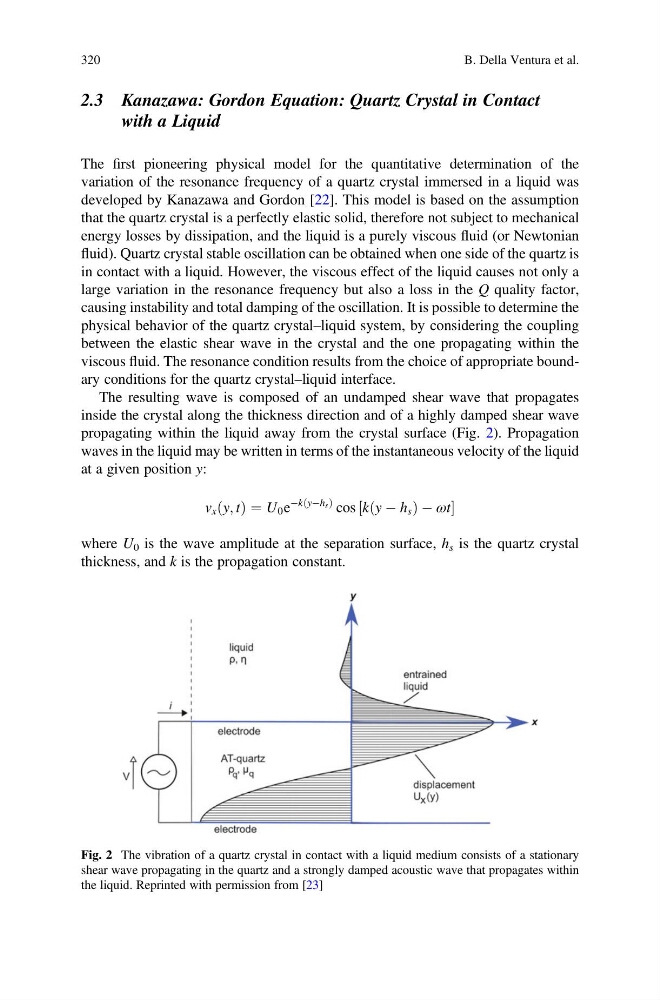
The resulting wave is composed of an undamped shear wave that propagates
inside the crystal along the thickness direction and of a highly damped shear wave
propagating within the liquid away from the crystal surface (Fig. 2). Propagation
waves in the liquid may be written in terms of the instantaneous velocity of the liquid
at a given position y:
v x y; t
ð Þ ¼ U 0 e
Àk yÀh s
ð
Þ cos k y À h s
ð
ÞÀωt
½
where U 0 is the wave amplitude at the separation surface, h s is the quartz crystal
thickness, and k is the propagation constant.
Fig. 2 The vibration of a quartz crystal in contact with a liquid medium consists of a stationary
shear wave propagating in the quartz and a strongly damped acoustic wave that propagates within
the liquid. Reprinted with permission from [23]
320
B. Della Ventura et al.
with a Liquid
The first pioneering physical model for the quantitative determination of the
variation of the resonance frequency of a quartz crystal immersed in a liquid was
developed by Kanazawa and Gordon [22]. This model is based on the assumption
that the quartz crystal is a perfectly elastic solid, therefore not subject to mechanical
energy losses by dissipation, and the liquid is a purely viscous fluid (or Newtonian
fluid). Quartz crystal stable oscillation can be obtained when one side of the quartz is
in contact with a liquid. However, the viscous effect of the liquid causes not only a
large variation in the resonance frequency but also a loss in the Q quality factor,
causing instability and total damping of the oscillation. It is possible to determine the
physical behavior of the quartz crystal–liquid system, by considering the coupling
between the elastic shear wave in the crystal and the one propagating within the
viscous fluid. The resonance condition results from the choice of appropriate boundary conditions for the quartz crystal–liquid interface.
The resulting wave is composed of an undamped shear wave that propagates
inside the crystal along the thickness direction and of a highly damped shear wave
propagating within the liquid away from the crystal surface (Fig. 2). Propagation
waves in the liquid may be written in terms of the instantaneous velocity of the liquid
at a given position y:
v x y; t
ð Þ ¼ U 0 e
Àk yÀh s
ð
Þ cos k y À h s
ð
ÞÀωt
½
where U 0 is the wave amplitude at the separation surface, h s is the quartz crystal
thickness, and k is the propagation constant.
Fig. 2 The vibration of a quartz crystal in contact with a liquid medium consists of a stationary
shear wave propagating in the quartz and a strongly damped acoustic wave that propagates within
the liquid. Reprinted with permission from [23]
320
B. Della Ventura et al.