

The deposition of an additional mass causes a decrease in the resonance
frequency of the quartz crystal resonators. The Sauerbrey’s equation provides a
linear relationship between variations in the resonance frequency and the mass of
a film present on the quartz crystal surface. This linear relationship is valid if the
following assumptions are fulfilled:
• the film mass and thickness are much smaller than those of the quartz crystal;
• the film is uniform, rigid, and rigidly attached to the quartz crystal surface;
• the quartz crystal oscillation takes place in vacuum or air.
Sauerbrey’s equation is not valid when the deposited film is liquid because it does
not follow the shear oscillations of the quartz crystal surface in a solid manner.
Indeed, if just one face of the quartz crystal is immersed in a viscous liquid, there are
mechanical dissipation phenomena that make the Sauerbrey’s relationship
inapplicable.
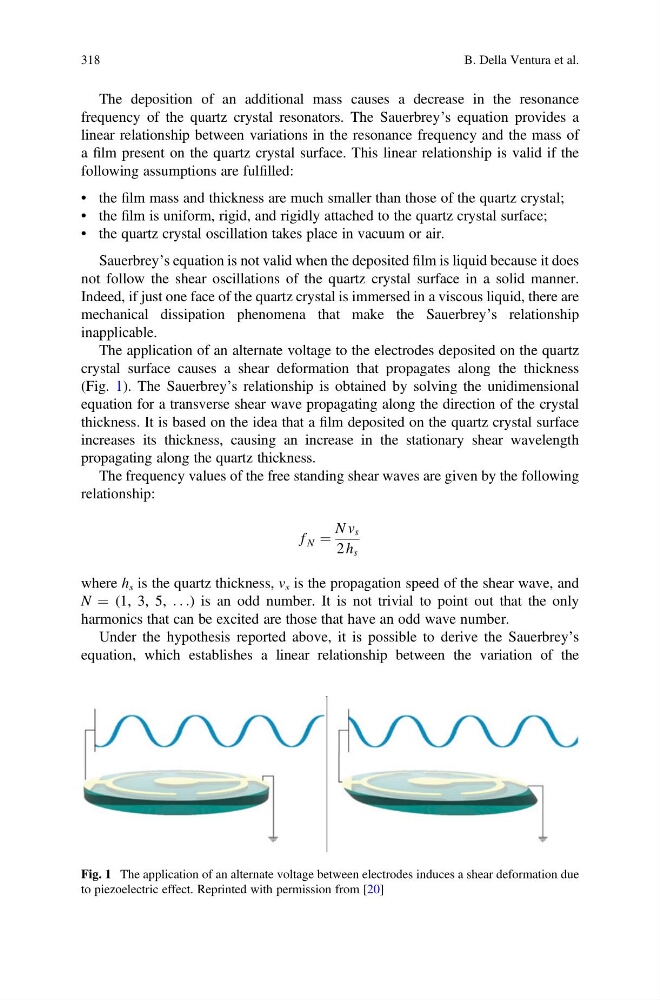
The application of an alternate voltage to the electrodes deposited on the quartz
crystal surface causes a shear deformation that propagates along the thickness
(Fig. 1). The Sauerbrey’s relationship is obtained by solving the unidimensional
equation for a transverse shear wave propagating along the direction of the crystal
thickness. It is based on the idea that a film deposited on the quartz crystal surface
increases its thickness, causing an increase in the stationary shear wavelength
propagating along the quartz thickness.
The frequency values of the free standing shear waves are given by the following
relationship:
f N ¼
N v s
2 h s
where h s is the quartz thickness, v s is the propagation speed of the shear wave, and
N ¼ (1, 3, 5, . . .) is an odd number. It is not trivial to point out that the only
harmonics that can be excited are those that have an odd wave number.
Under the hypothesis reported above, it is possible to derive the Sauerbrey’s
equation, which establishes a linear relationship between the variation of the
Fig. 1 The application of an alternate voltage between electrodes induces a shear deformation due
to piezoelectric effect. Reprinted with permission from [20]
318
B. Della Ventura et al.
frequency of the quartz crystal resonators. The Sauerbrey’s equation provides a
linear relationship between variations in the resonance frequency and the mass of
a film present on the quartz crystal surface. This linear relationship is valid if the
following assumptions are fulfilled:
• the film mass and thickness are much smaller than those of the quartz crystal;
• the film is uniform, rigid, and rigidly attached to the quartz crystal surface;
• the quartz crystal oscillation takes place in vacuum or air.
Sauerbrey’s equation is not valid when the deposited film is liquid because it does
not follow the shear oscillations of the quartz crystal surface in a solid manner.
Indeed, if just one face of the quartz crystal is immersed in a viscous liquid, there are
mechanical dissipation phenomena that make the Sauerbrey’s relationship
inapplicable.
The application of an alternate voltage to the electrodes deposited on the quartz
crystal surface causes a shear deformation that propagates along the thickness
(Fig. 1). The Sauerbrey’s relationship is obtained by solving the unidimensional
equation for a transverse shear wave propagating along the direction of the crystal
thickness. It is based on the idea that a film deposited on the quartz crystal surface
increases its thickness, causing an increase in the stationary shear wavelength
propagating along the quartz thickness.
The frequency values of the free standing shear waves are given by the following
relationship:
f N ¼
N v s
2 h s
where h s is the quartz thickness, v s is the propagation speed of the shear wave, and
N ¼ (1, 3, 5, . . .) is an odd number. It is not trivial to point out that the only
harmonics that can be excited are those that have an odd wave number.
Under the hypothesis reported above, it is possible to derive the Sauerbrey’s
equation, which establishes a linear relationship between the variation of the
Fig. 1 The application of an alternate voltage between electrodes induces a shear deformation due
to piezoelectric effect. Reprinted with permission from [20]
318
B. Della Ventura et al.