

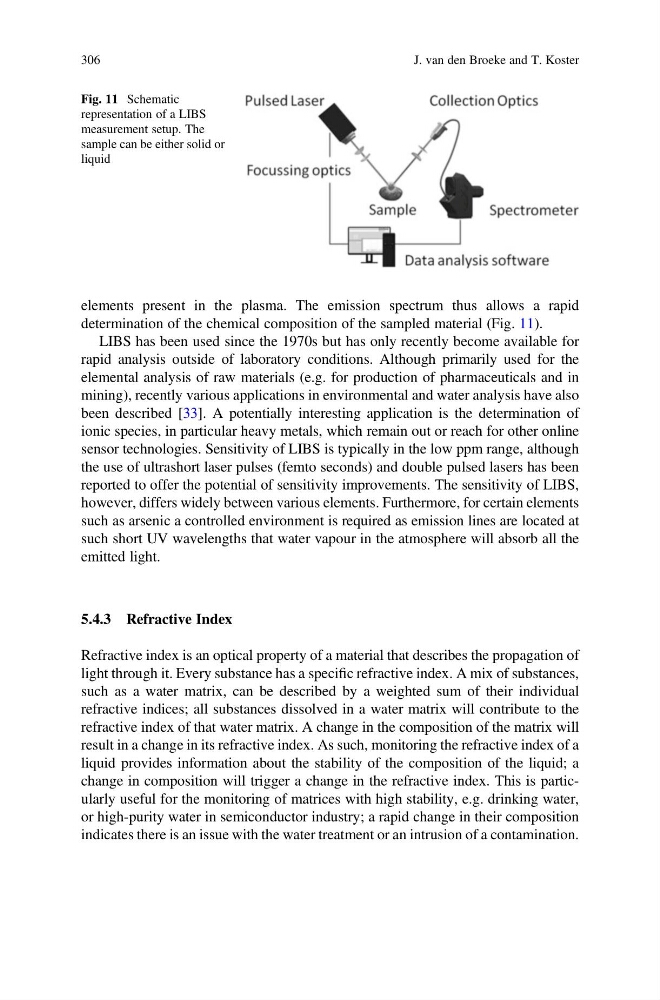
elements present in the plasma. The emission spectrum thus allows a rapid
determination of the chemical composition of the sampled material (Fig. 11).
LIBS has been used since the 1970s but has only recently become available for
rapid analysis outside of laboratory conditions. Although primarily used for the
elemental analysis of raw materials (e.g. for production of pharmaceuticals and in
mining), recently various applications in environmental and water analysis have also
been described [33]. A potentially interesting application is the determination of
ionic species, in particular heavy metals, which remain out or reach for other online
sensor technologies. Sensitivity of LIBS is typically in the low ppm range, although
the use of ultrashort laser pulses (femto seconds) and double pulsed lasers has been
reported to offer the potential of sensitivity improvements. The sensitivity of LIBS,
however, differs widely between various elements. Furthermore, for certain elements
such as arsenic a controlled environment is required as emission lines are located at
such short UV wavelengths that water vapour in the atmosphere will absorb all the
emitted light.
5.4.3 Refractive Index
Refractive index is an optical property of a material that describes the propagation of
light through it. Every substance has a specific refractive index. A mix of substances,
such as a water matrix, can be described by a weighted sum of their individual
refractive indices; all substances dissolved in a water matrix will contribute to the
refractive index of that water matrix. A change in the composition of the matrix will
result in a change in its refractive index. As such, monitoring the refractive index of a
liquid provides information about the stability of the composition of the liquid; a
change in composition will trigger a change in the refractive index. This is particularly useful for the monitoring of matrices with high stability, e.g. drinking water,
or high-purity water in semiconductor industry; a rapid change in their composition
indicates there is an issue with the water treatment or an intrusion of a contamination.
Fig. 11 Schematic
representation of a LIBS
measurement setup. The
sample can be either solid or
liquid
306
J. van den Broeke and T. Koster
determination of the chemical composition of the sampled material (Fig. 11).
LIBS has been used since the 1970s but has only recently become available for
rapid analysis outside of laboratory conditions. Although primarily used for the
elemental analysis of raw materials (e.g. for production of pharmaceuticals and in
mining), recently various applications in environmental and water analysis have also
been described [33]. A potentially interesting application is the determination of
ionic species, in particular heavy metals, which remain out or reach for other online
sensor technologies. Sensitivity of LIBS is typically in the low ppm range, although
the use of ultrashort laser pulses (femto seconds) and double pulsed lasers has been
reported to offer the potential of sensitivity improvements. The sensitivity of LIBS,
however, differs widely between various elements. Furthermore, for certain elements
such as arsenic a controlled environment is required as emission lines are located at
such short UV wavelengths that water vapour in the atmosphere will absorb all the
emitted light.
5.4.3 Refractive Index
Refractive index is an optical property of a material that describes the propagation of
light through it. Every substance has a specific refractive index. A mix of substances,
such as a water matrix, can be described by a weighted sum of their individual
refractive indices; all substances dissolved in a water matrix will contribute to the
refractive index of that water matrix. A change in the composition of the matrix will
result in a change in its refractive index. As such, monitoring the refractive index of a
liquid provides information about the stability of the composition of the liquid; a
change in composition will trigger a change in the refractive index. This is particularly useful for the monitoring of matrices with high stability, e.g. drinking water,
or high-purity water in semiconductor industry; a rapid change in their composition
indicates there is an issue with the water treatment or an intrusion of a contamination.
Fig. 11 Schematic
representation of a LIBS
measurement setup. The
sample can be either solid or
liquid
306
J. van den Broeke and T. Koster