

– Suitable for the measurement of one target substance (group).
• Multiple discrete excitation wavelengths (using multiple LEDs as light source in
combination with a broadband detector).
– Suitable for the measurement of multiple target substances or groups; requires
more advanced calibration and signal processing for deconvolution of the
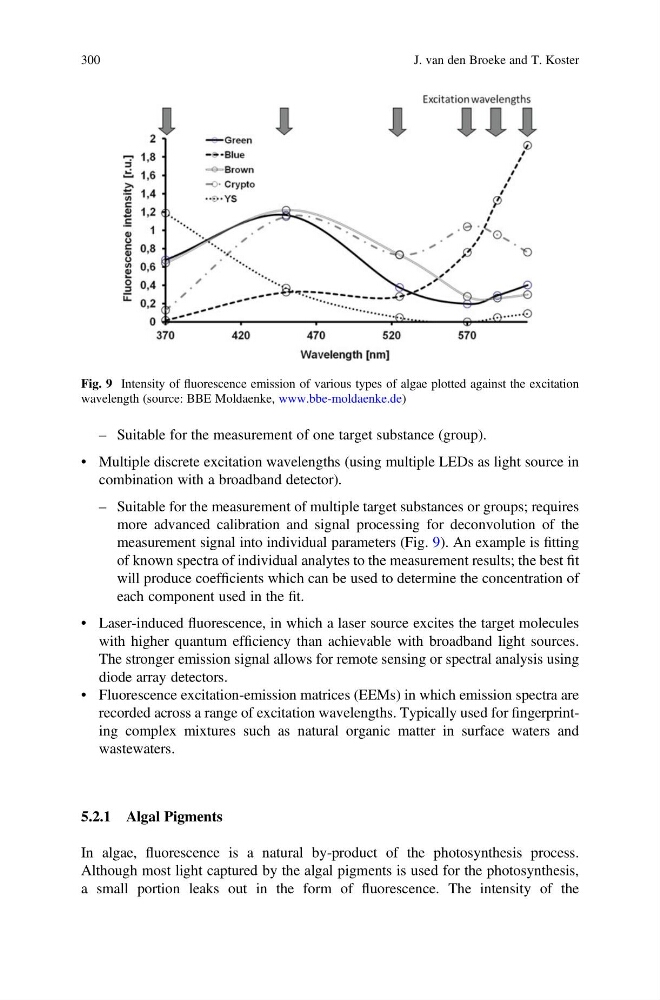
measurement signal into individual parameters (Fig. 9). An example is fitting
of known spectra of individual analytes to the measurement results; the best fit
will produce coefficients which can be used to determine the concentration of
each component used in the fit.
• Laser-induced fluorescence, in which a laser source excites the target molecules
with higher quantum efficiency than achievable with broadband light sources.
The stronger emission signal allows for remote sensing or spectral analysis using
diode array detectors.
• Fluorescence excitation-emission matrices (EEMs) in which emission spectra are
recorded across a range of excitation wavelengths. Typically used for fingerprinting complex mixtures such as natural organic matter in surface waters and
wastewaters.
5.2.1 Algal Pigments
In algae, fluorescence is a natural by-product of the photosynthesis process.
Although most light captured by the algal pigments is used for the photosynthesis,
a small portion leaks out in the form of fluorescence. The intensity of the
Fig. 9 Intensity of fluorescence emission of various types of algae plotted against the excitation
wavelength (source: BBE Moldaenke, www.bbe-moldaenke.de)
300
J. van den Broeke and T. Koster
• Multiple discrete excitation wavelengths (using multiple LEDs as light source in
combination with a broadband detector).
– Suitable for the measurement of multiple target substances or groups; requires
more advanced calibration and signal processing for deconvolution of the
measurement signal into individual parameters (Fig. 9). An example is fitting
of known spectra of individual analytes to the measurement results; the best fit
will produce coefficients which can be used to determine the concentration of
each component used in the fit.
• Laser-induced fluorescence, in which a laser source excites the target molecules
with higher quantum efficiency than achievable with broadband light sources.
The stronger emission signal allows for remote sensing or spectral analysis using
diode array detectors.
• Fluorescence excitation-emission matrices (EEMs) in which emission spectra are
recorded across a range of excitation wavelengths. Typically used for fingerprinting complex mixtures such as natural organic matter in surface waters and
wastewaters.
5.2.1 Algal Pigments
In algae, fluorescence is a natural by-product of the photosynthesis process.
Although most light captured by the algal pigments is used for the photosynthesis,
a small portion leaks out in the form of fluorescence. The intensity of the
Fig. 9 Intensity of fluorescence emission of various types of algae plotted against the excitation
wavelength (source: BBE Moldaenke, www.bbe-moldaenke.de)
300
J. van den Broeke and T. Koster