

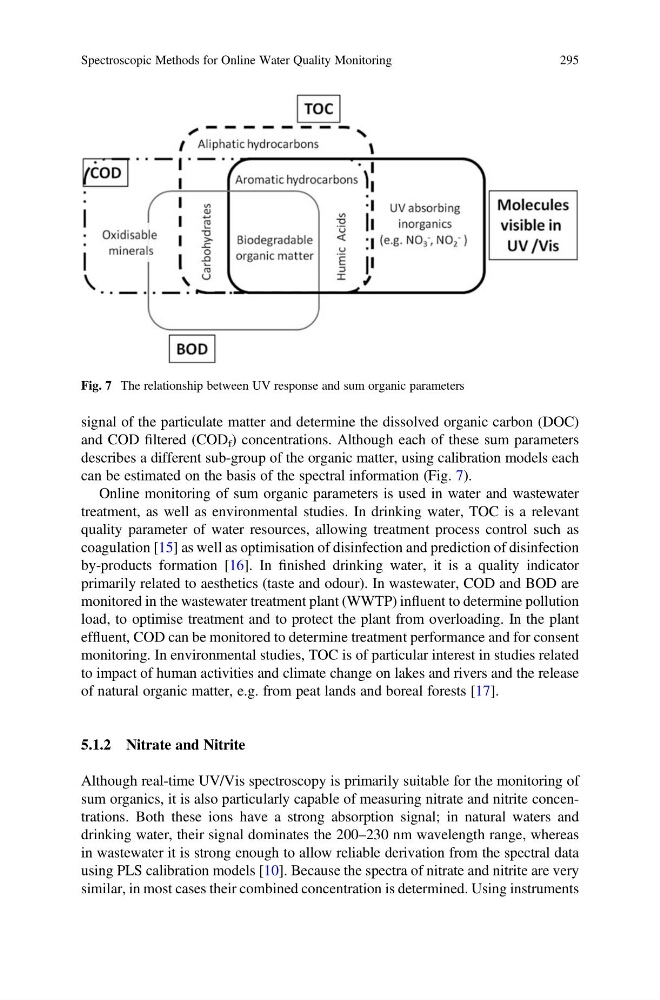
signal of the particulate matter and determine the dissolved organic carbon (DOC)
and COD filtered (COD f ) concentrations. Although each of these sum parameters
describes a different sub-group of the organic matter, using calibration models each
can be estimated on the basis of the spectral information (Fig. 7).
Online monitoring of sum organic parameters is used in water and wastewater
treatment, as well as environmental studies. In drinking water, TOC is a relevant
quality parameter of water resources, allowing treatment process control such as
coagulation [15] as well as optimisation of disinfection and prediction of disinfection
by-products formation [16]. In finished drinking water, it is a quality indicator
primarily related to aesthetics (taste and odour). In wastewater, COD and BOD are
monitored in the wastewater treatment plant (WWTP) influent to determine pollution
load, to optimise treatment and to protect the plant from overloading. In the plant
effluent, COD can be monitored to determine treatment performance and for consent
monitoring. In environmental studies, TOC is of particular interest in studies related
to impact of human activities and climate change on lakes and rivers and the release
of natural organic matter, e.g. from peat lands and boreal forests [17].
5.1.2 Nitrate and Nitrite
Although real-time UV/Vis spectroscopy is primarily suitable for the monitoring of
sum organics, it is also particularly capable of measuring nitrate and nitrite concentrations. Both these ions have a strong absorption signal; in natural waters and
drinking water, their signal dominates the 200–230 nm wavelength range, whereas
in wastewater it is strong enough to allow reliable derivation from the spectral data
using PLS calibration models [10]. Because the spectra of nitrate and nitrite are very
similar, in most cases their combined concentration is determined. Using instruments
Fig. 7 The relationship between UV response and sum organic parameters
Spectroscopic Methods for Online Water Quality Monitoring
295
and COD filtered (COD f ) concentrations. Although each of these sum parameters
describes a different sub-group of the organic matter, using calibration models each
can be estimated on the basis of the spectral information (Fig. 7).
Online monitoring of sum organic parameters is used in water and wastewater
treatment, as well as environmental studies. In drinking water, TOC is a relevant
quality parameter of water resources, allowing treatment process control such as
coagulation [15] as well as optimisation of disinfection and prediction of disinfection
by-products formation [16]. In finished drinking water, it is a quality indicator
primarily related to aesthetics (taste and odour). In wastewater, COD and BOD are
monitored in the wastewater treatment plant (WWTP) influent to determine pollution
load, to optimise treatment and to protect the plant from overloading. In the plant
effluent, COD can be monitored to determine treatment performance and for consent
monitoring. In environmental studies, TOC is of particular interest in studies related
to impact of human activities and climate change on lakes and rivers and the release
of natural organic matter, e.g. from peat lands and boreal forests [17].
5.1.2 Nitrate and Nitrite
Although real-time UV/Vis spectroscopy is primarily suitable for the monitoring of
sum organics, it is also particularly capable of measuring nitrate and nitrite concentrations. Both these ions have a strong absorption signal; in natural waters and
drinking water, their signal dominates the 200–230 nm wavelength range, whereas
in wastewater it is strong enough to allow reliable derivation from the spectral data
using PLS calibration models [10]. Because the spectra of nitrate and nitrite are very
similar, in most cases their combined concentration is determined. Using instruments
Fig. 7 The relationship between UV response and sum organic parameters
Spectroscopic Methods for Online Water Quality Monitoring
295