

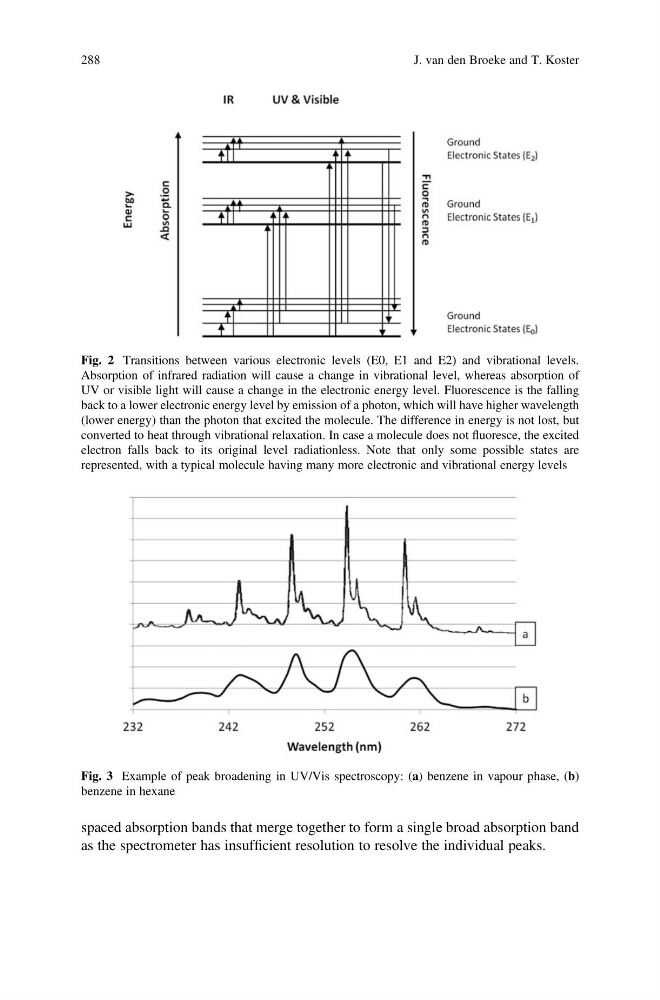
spaced absorption bands that merge together to form a single broad absorption band
as the spectrometer has insufficient resolution to resolve the individual peaks.
Fig. 2 Transitions between various electronic levels (E0, E1 and E2) and vibrational levels.
Absorption of infrared radiation will cause a change in vibrational level, whereas absorption of
UV or visible light will cause a change in the electronic energy level. Fluorescence is the falling
back to a lower electronic energy level by emission of a photon, which will have higher wavelength
(lower energy) than the photon that excited the molecule. The difference in energy is not lost, but
converted to heat through vibrational relaxation. In case a molecule does not fluoresce, the excited
electron falls back to its original level radiationless. Note that only some possible states are
represented, with a typical molecule having many more electronic and vibrational energy levels
Fig. 3 Example of peak broadening in UV/Vis spectroscopy: (a) benzene in vapour phase, (b)
benzene in hexane
288
J. van den Broeke and T. Koster
as the spectrometer has insufficient resolution to resolve the individual peaks.
Fig. 2 Transitions between various electronic levels (E0, E1 and E2) and vibrational levels.
Absorption of infrared radiation will cause a change in vibrational level, whereas absorption of
UV or visible light will cause a change in the electronic energy level. Fluorescence is the falling
back to a lower electronic energy level by emission of a photon, which will have higher wavelength
(lower energy) than the photon that excited the molecule. The difference in energy is not lost, but
converted to heat through vibrational relaxation. In case a molecule does not fluoresce, the excited
electron falls back to its original level radiationless. Note that only some possible states are
represented, with a typical molecule having many more electronic and vibrational energy levels
Fig. 3 Example of peak broadening in UV/Vis spectroscopy: (a) benzene in vapour phase, (b)
benzene in hexane
288
J. van den Broeke and T. Koster