

probability-distributed model (PDM) is selected for performance evaluation. The
results show that all the downscaled soil moisture products surpass the original
SMOS soil moisture estimation, which are more useful for hydrological modelling.
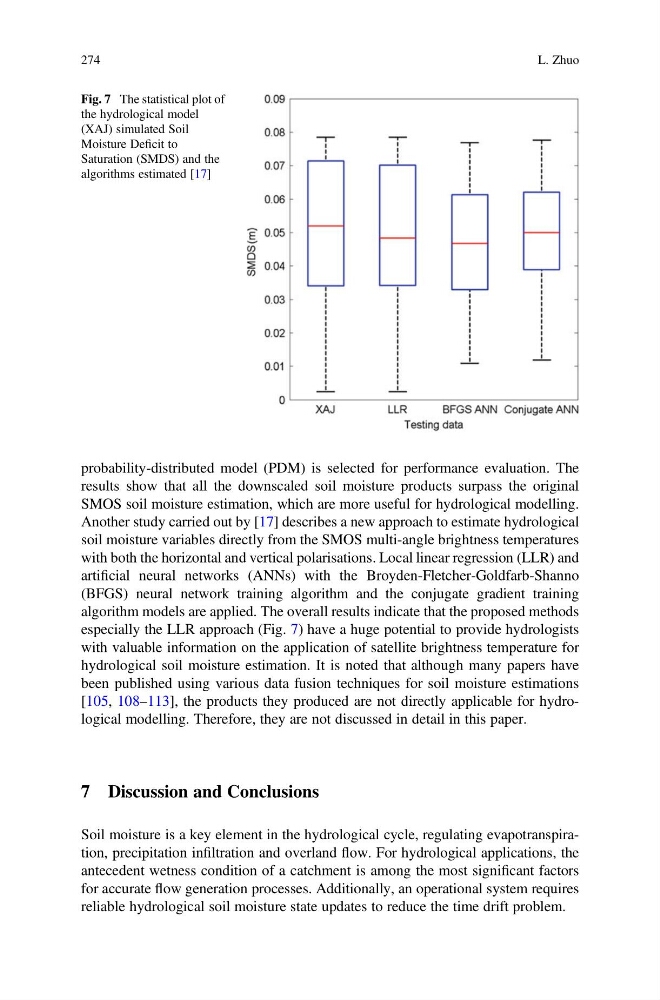
Another study carried out by [17] describes a new approach to estimate hydrological
soil moisture variables directly from the SMOS multi-angle brightness temperatures
with both the horizontal and vertical polarisations. Local linear regression (LLR) and
artificial neural networks (ANNs) with the Broyden-Fletcher-Goldfarb-Shanno
(BFGS) neural network training algorithm and the conjugate gradient training
algorithm models are applied. The overall results indicate that the proposed methods
especially the LLR approach (Fig. 7) have a huge potential to provide hydrologists
with valuable information on the application of satellite brightness temperature for
hydrological soil moisture estimation. It is noted that although many papers have
been published using various data fusion techniques for soil moisture estimations
[105, 108–113], the products they produced are not directly applicable for hydrological modelling. Therefore, they are not discussed in detail in this paper.
7 Discussion and Conclusions
Soil moisture is a key element in the hydrological cycle, regulating evapotranspiration, precipitation infiltration and overland flow. For hydrological applications, the
antecedent wetness condition of a catchment is among the most significant factors
for accurate flow generation processes. Additionally, an operational system requires
reliable hydrological soil moisture state updates to reduce the time drift problem.
Fig. 7 The statistical plot of
the hydrological model
(XAJ) simulated Soil
Moisture Deficit to
Saturation (SMDS) and the
algorithms estimated [17]
274
L. Zhuo
results show that all the downscaled soil moisture products surpass the original
SMOS soil moisture estimation, which are more useful for hydrological modelling.
Another study carried out by [17] describes a new approach to estimate hydrological
soil moisture variables directly from the SMOS multi-angle brightness temperatures
with both the horizontal and vertical polarisations. Local linear regression (LLR) and
artificial neural networks (ANNs) with the Broyden-Fletcher-Goldfarb-Shanno
(BFGS) neural network training algorithm and the conjugate gradient training
algorithm models are applied. The overall results indicate that the proposed methods
especially the LLR approach (Fig. 7) have a huge potential to provide hydrologists
with valuable information on the application of satellite brightness temperature for
hydrological soil moisture estimation. It is noted that although many papers have
been published using various data fusion techniques for soil moisture estimations
[105, 108–113], the products they produced are not directly applicable for hydrological modelling. Therefore, they are not discussed in detail in this paper.
7 Discussion and Conclusions
Soil moisture is a key element in the hydrological cycle, regulating evapotranspiration, precipitation infiltration and overland flow. For hydrological applications, the
antecedent wetness condition of a catchment is among the most significant factors
for accurate flow generation processes. Additionally, an operational system requires
reliable hydrological soil moisture state updates to reduce the time drift problem.
Fig. 7 The statistical plot of
the hydrological model
(XAJ) simulated Soil
Moisture Deficit to
Saturation (SMDS) and the
algorithms estimated [17]
274
L. Zhuo