

widespread stratiform rain, or when the precipitation system is moving perpendicular
to the direction of the radar beam (i.e. the radial velocity component is zero).
Moreover, the notch filtering of near-zero velocity echoes is ineffective for AP
over the sea as waves have true measurable velocities.
Other techniques developed more specifically to tackle AP echoes are mainly on
analyzing quantities derived from the spatial and temporal information of the
reflectivity field. Spatial information is usually presented in the form of gradients
in the reflectivity field between adjacent range gates in either the horizontal or
vertical dimensions [34]. The common descriptions of the gradient of the reflectivity
field are texture, the reflectivity fluctuations and the statistical features (e.g. mean,
median, mode and standard deviation). These reflectivity fields usually have different probability distribution functions (PDFs) for echoes from clutter, AP or precipitation. Parameters derived from the reflectivity gradient fields have been used
in probabilistic classification algorithms, such as Bayesian [35, 36], fuzzy logic
[37–39] and neural networks [40, 41] classification algorithms. Recently, a number
of classification methods based on dual-polarization radar measurements were also
introduced [42–44]. The advantage of multiparameter weather radars is their ability
to obtain measurements of hydrometeor characteristics such as the size, shape,
spatial orientation, phase state and fall behaviour [8]. The use of DP radar measurements has enabled more accurate classifications of non-meteorological echoes
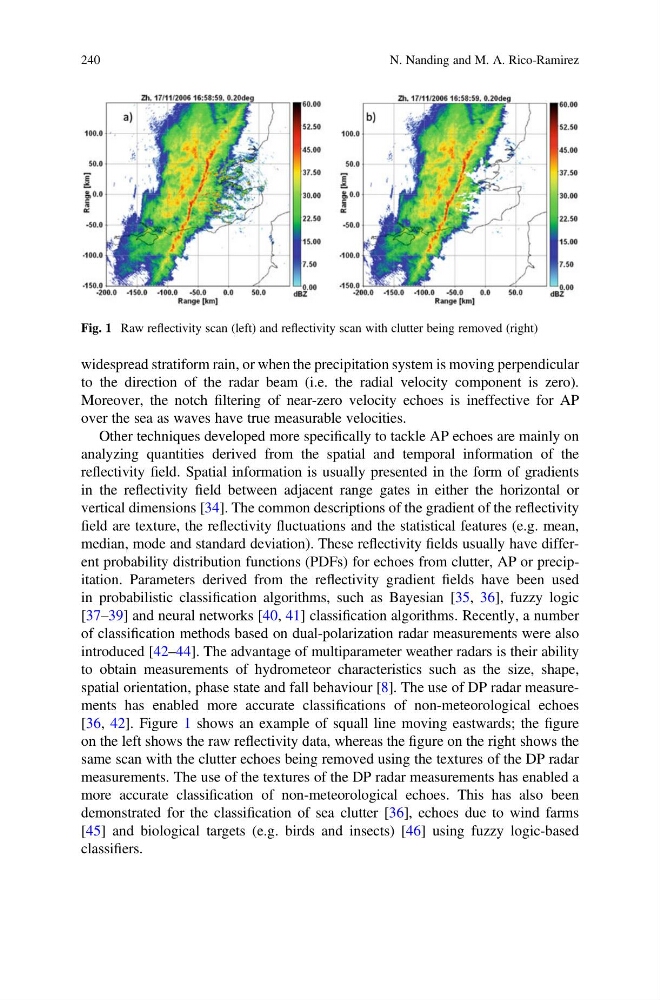
[36, 42]. Figure 1 shows an example of squall line moving eastwards; the figure
on the left shows the raw reflectivity data, whereas the figure on the right shows the
same scan with the clutter echoes being removed using the textures of the DP radar
measurements. The use of the textures of the DP radar measurements has enabled a
more accurate classification of non-meteorological echoes. This has also been
demonstrated for the classification of sea clutter [36], echoes due to wind farms
[45] and biological targets (e.g. birds and insects) [46] using fuzzy logic-based
classifiers.
Fig. 1 Raw reflectivity scan (left) and reflectivity scan with clutter being removed (right)
240
N. Nanding and M. A. Rico-Ramirez
to the direction of the radar beam (i.e. the radial velocity component is zero).
Moreover, the notch filtering of near-zero velocity echoes is ineffective for AP
over the sea as waves have true measurable velocities.
Other techniques developed more specifically to tackle AP echoes are mainly on
analyzing quantities derived from the spatial and temporal information of the
reflectivity field. Spatial information is usually presented in the form of gradients
in the reflectivity field between adjacent range gates in either the horizontal or
vertical dimensions [34]. The common descriptions of the gradient of the reflectivity
field are texture, the reflectivity fluctuations and the statistical features (e.g. mean,
median, mode and standard deviation). These reflectivity fields usually have different probability distribution functions (PDFs) for echoes from clutter, AP or precipitation. Parameters derived from the reflectivity gradient fields have been used
in probabilistic classification algorithms, such as Bayesian [35, 36], fuzzy logic
[37–39] and neural networks [40, 41] classification algorithms. Recently, a number
of classification methods based on dual-polarization radar measurements were also
introduced [42–44]. The advantage of multiparameter weather radars is their ability
to obtain measurements of hydrometeor characteristics such as the size, shape,
spatial orientation, phase state and fall behaviour [8]. The use of DP radar measurements has enabled more accurate classifications of non-meteorological echoes
[36, 42]. Figure 1 shows an example of squall line moving eastwards; the figure
on the left shows the raw reflectivity data, whereas the figure on the right shows the
same scan with the clutter echoes being removed using the textures of the DP radar
measurements. The use of the textures of the DP radar measurements has enabled a
more accurate classification of non-meteorological echoes. This has also been
demonstrated for the classification of sea clutter [36], echoes due to wind farms
[45] and biological targets (e.g. birds and insects) [46] using fuzzy logic-based
classifiers.
Fig. 1 Raw reflectivity scan (left) and reflectivity scan with clutter being removed (right)
240
N. Nanding and M. A. Rico-Ramirez