

1.1 Data Rich Information Poor: Fixing the DRIP
The water industry has often been perceived as being ‘data rich but information
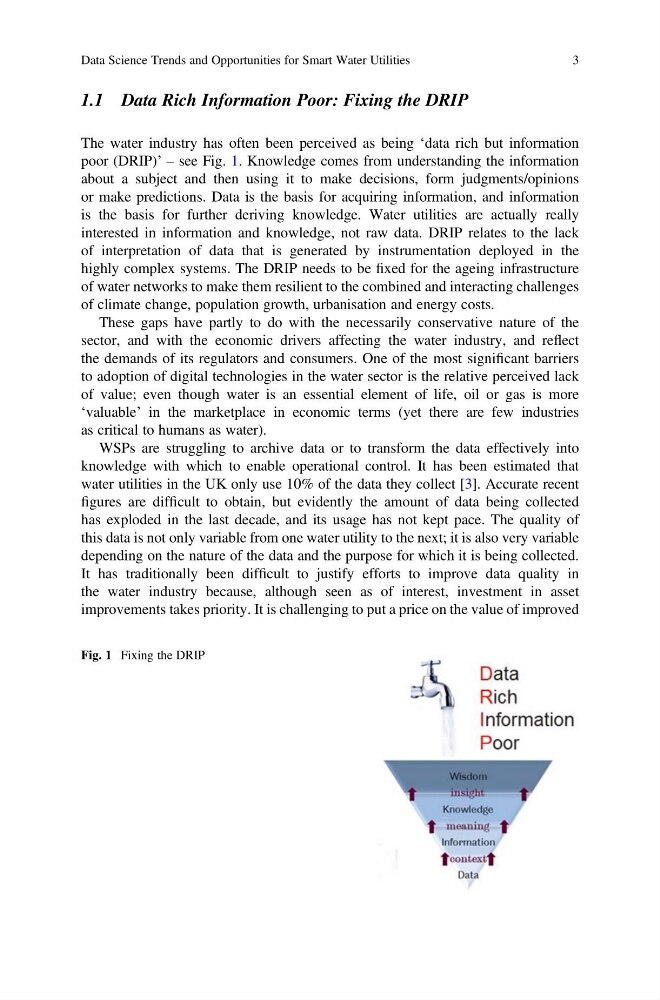
poor (DRIP)’ – see Fig. 1. Knowledge comes from understanding the information
about a subject and then using it to make decisions, form judgments/opinions
or make predictions. Data is the basis for acquiring information, and information
is the basis for further deriving knowledge. Water utilities are actually really
interested in information and knowledge, not raw data. DRIP relates to the lack
of interpretation of data that is generated by instrumentation deployed in the
highly complex systems. The DRIP needs to be fixed for the ageing infrastructure
of water networks to make them resilient to the combined and interacting challenges
of climate change, population growth, urbanisation and energy costs.
These gaps have partly to do with the necessarily conservative nature of the
sector, and with the economic drivers affecting the water industry, and reflect
the demands of its regulators and consumers. One of the most significant barriers
to adoption of digital technologies in the water sector is the relative perceived lack
of value; even though water is an essential element of life, oil or gas is more
‘valuable’ in the marketplace in economic terms (yet there are few industries
as critical to humans as water).
WSPs are struggling to archive data or to transform the data effectively into
knowledge with which to enable operational control. It has been estimated that
water utilities in the UK only use 10% of the data they collect [3]. Accurate recent
figures are difficult to obtain, but evidently the amount of data being collected
has exploded in the last decade, and its usage has not kept pace. The quality of
this data is not only variable from one water utility to the next; it is also very variable
depending on the nature of the data and the purpose for which it is being collected.
It has traditionally been difficult to justify efforts to improve data quality in
the water industry because, although seen as of interest, investment in asset
improvements takes priority. It is challenging to put a price on the value of improved
Fig. 1 Fixing the DRIP
Data Science Trends and Opportunities for Smart Water Utilities
3
The water industry has often been perceived as being ‘data rich but information
poor (DRIP)’ – see Fig. 1. Knowledge comes from understanding the information
about a subject and then using it to make decisions, form judgments/opinions
or make predictions. Data is the basis for acquiring information, and information
is the basis for further deriving knowledge. Water utilities are actually really
interested in information and knowledge, not raw data. DRIP relates to the lack
of interpretation of data that is generated by instrumentation deployed in the
highly complex systems. The DRIP needs to be fixed for the ageing infrastructure
of water networks to make them resilient to the combined and interacting challenges
of climate change, population growth, urbanisation and energy costs.
These gaps have partly to do with the necessarily conservative nature of the
sector, and with the economic drivers affecting the water industry, and reflect
the demands of its regulators and consumers. One of the most significant barriers
to adoption of digital technologies in the water sector is the relative perceived lack
of value; even though water is an essential element of life, oil or gas is more
‘valuable’ in the marketplace in economic terms (yet there are few industries
as critical to humans as water).
WSPs are struggling to archive data or to transform the data effectively into
knowledge with which to enable operational control. It has been estimated that
water utilities in the UK only use 10% of the data they collect [3]. Accurate recent
figures are difficult to obtain, but evidently the amount of data being collected
has exploded in the last decade, and its usage has not kept pace. The quality of
this data is not only variable from one water utility to the next; it is also very variable
depending on the nature of the data and the purpose for which it is being collected.
It has traditionally been difficult to justify efforts to improve data quality in
the water industry because, although seen as of interest, investment in asset
improvements takes priority. It is challenging to put a price on the value of improved
Fig. 1 Fixing the DRIP
Data Science Trends and Opportunities for Smart Water Utilities
3