

focused on only the ICT-WIPs supported by the VIA Water programme in Africa.
We assume that the collection of data on ICT-WIPs crafted and executed in other
conditions (e.g. not funded by the same partner, other continents) might produce
additional insights. Finally, it would be highly relevant to undertake comparative
studies to find out how ICT-focused water innovations developed and implemented
through partnerships compare (in terms of success) with those that are not generated
through partnerships.
7.3.2 Recommendations for VIA Water
This study results showed that the analysed ICT-WIPs faced some challenges, which
can be partly explained by the limited use of legally enforceable partnership governance instruments (contractual agreements). It also appeared from this study that
VIA Water facilitated linkages between partners in the ICT-WIPs and requested lead
innovators to provide proof of commitment (to collaborate) by selected working
partners. In most cases, such proof consisted of MoUs and reference letters. It is
recommended that, for future partnerships, VIA Water – in its capacity as innovation
broker – takes this a step further and advises partners to formalise their partnerships.
Notably, in the same way that VIA Water itself signs a contract with lead innovators,
these should be encouraged (or perhaps requested) to sign formal contracts too with
their working partners (e.g. a partnership agreement). Arguably, this would increase
the level of commitment of the different partners to the partnership and the successful generation of the envisaged innovation.
Acknowledgements This research was financially supported by the Dutch Ministry of Foreign
Affairs to generate insights on water innovation processes in Africa. We are grateful for the
constructive comments by Dick Bouman, Senior Fund Manager at Aqua for All, on a draft version
of this chapter.
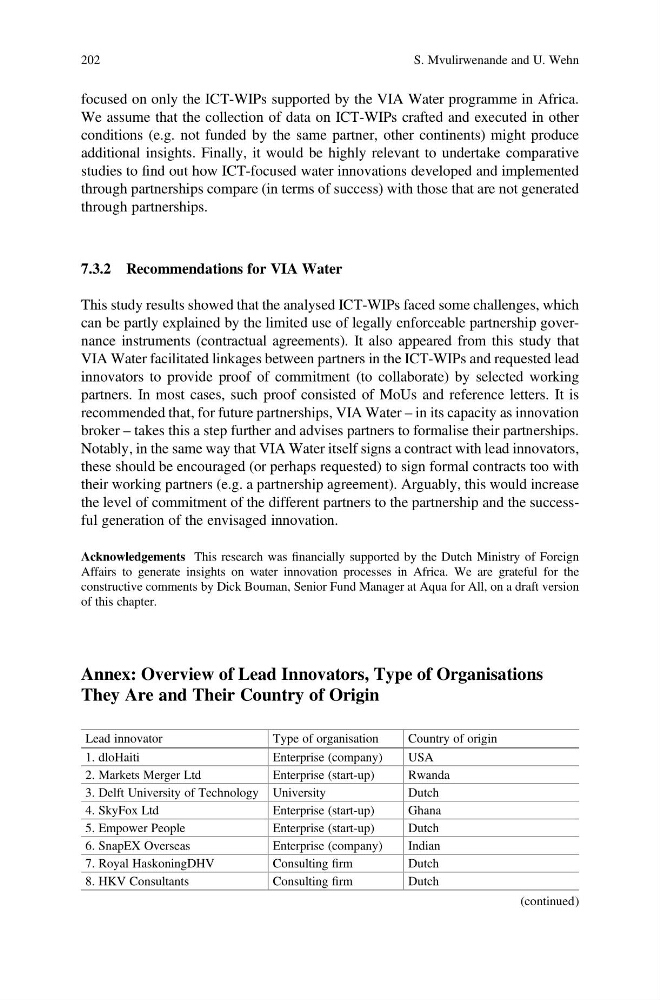
Annex: Overview of Lead Innovators, Type of Organisations
They Are and Their Country of Origin
Lead innovator
Type of organisation
Country of origin
1. dloHaiti
Enterprise (company)
USA
2. Markets Merger Ltd
Enterprise (start-up)
Rwanda
3. Delft University of Technology University
Dutch
4. SkyFox Ltd
Enterprise (start-up)
Ghana
5. Empower People
Enterprise (start-up)
Dutch
6. SnapEX Overseas
Enterprise (company)
Indian
7. Royal HaskoningDHV
Consulting firm
Dutch
8. HKV Consultants
Consulting firm
Dutch
(continued)
202
S. Mvulirwenande and U. Wehn
We assume that the collection of data on ICT-WIPs crafted and executed in other
conditions (e.g. not funded by the same partner, other continents) might produce
additional insights. Finally, it would be highly relevant to undertake comparative
studies to find out how ICT-focused water innovations developed and implemented
through partnerships compare (in terms of success) with those that are not generated
through partnerships.
7.3.2 Recommendations for VIA Water
This study results showed that the analysed ICT-WIPs faced some challenges, which
can be partly explained by the limited use of legally enforceable partnership governance instruments (contractual agreements). It also appeared from this study that
VIA Water facilitated linkages between partners in the ICT-WIPs and requested lead
innovators to provide proof of commitment (to collaborate) by selected working
partners. In most cases, such proof consisted of MoUs and reference letters. It is
recommended that, for future partnerships, VIA Water – in its capacity as innovation
broker – takes this a step further and advises partners to formalise their partnerships.
Notably, in the same way that VIA Water itself signs a contract with lead innovators,
these should be encouraged (or perhaps requested) to sign formal contracts too with
their working partners (e.g. a partnership agreement). Arguably, this would increase
the level of commitment of the different partners to the partnership and the successful generation of the envisaged innovation.
Acknowledgements This research was financially supported by the Dutch Ministry of Foreign
Affairs to generate insights on water innovation processes in Africa. We are grateful for the
constructive comments by Dick Bouman, Senior Fund Manager at Aqua for All, on a draft version
of this chapter.
Annex: Overview of Lead Innovators, Type of Organisations
They Are and Their Country of Origin
Lead innovator
Type of organisation
Country of origin
1. dloHaiti
Enterprise (company)
USA
2. Markets Merger Ltd
Enterprise (start-up)
Rwanda
3. Delft University of Technology University
Dutch
4. SkyFox Ltd
Enterprise (start-up)
Ghana
5. Empower People
Enterprise (start-up)
Dutch
6. SnapEX Overseas
Enterprise (company)
Indian
7. Royal HaskoningDHV
Consulting firm
Dutch
8. HKV Consultants
Consulting firm
Dutch
(continued)
202
S. Mvulirwenande and U. Wehn