

implementation. The study further found that VIA Water has played an instrumental
role in facilitating the actual formation of many of the partnerships, thus acting as an
innovation broker [70]. The partnership formation support was provided through
matchmaking mechanisms. During the project selection phase, VIA Water managers
would scan their network and propose (where relevant) possible cooperation partners
(e.g. universities, companies in the Netherlands) to the applicants. Examples include
the GARV toilet project in Ghana in which VIA Water facilitated linkages between
SnapEX Overseas – the lead partner – and Advocates and Trainers for Women’s
Welfare Advancement and Rights (ACTWAR). By establishing the online learning
community, VIA Water further anticipated – among other things – that some
organisations could use the platform to link up with potential partners [66].
The VIA Water-supported ICT-WIPs generally make a distinction between two
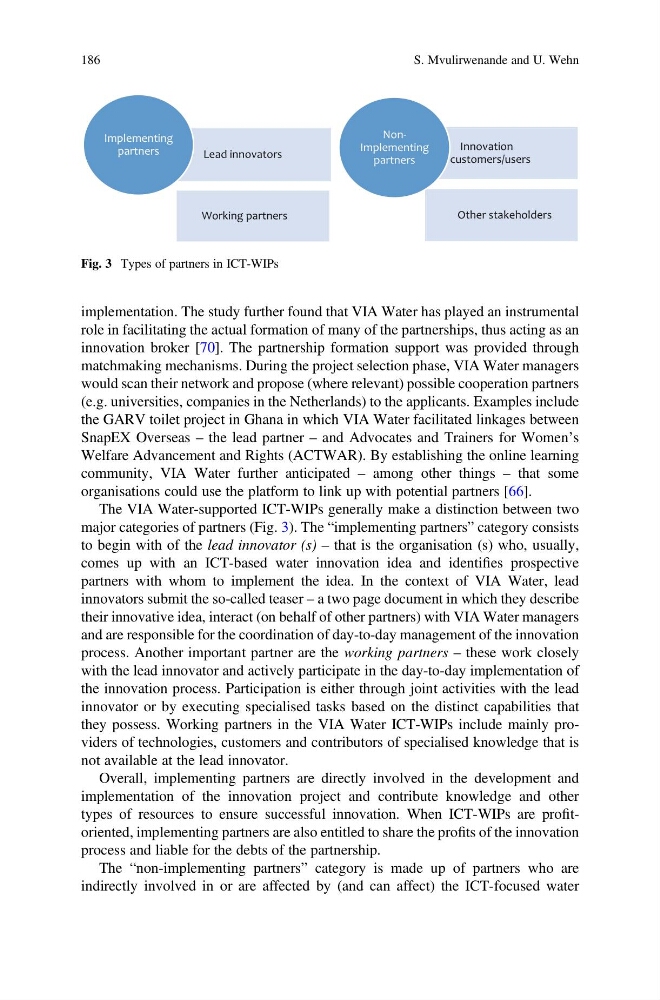
major categories of partners (Fig. 3). The “implementing partners” category consists
to begin with of the lead innovator (s) – that is the organisation (s) who, usually,
comes up with an ICT-based water innovation idea and identifies prospective
partners with whom to implement the idea. In the context of VIA Water, lead
innovators submit the so-called teaser – a two page document in which they describe
their innovative idea, interact (on behalf of other partners) with VIA Water managers
and are responsible for the coordination of day-to-day management of the innovation
process. Another important partner are the working partners – these work closely
with the lead innovator and actively participate in the day-to-day implementation of
the innovation process. Participation is either through joint activities with the lead
innovator or by executing specialised tasks based on the distinct capabilities that
they possess. Working partners in the VIA Water ICT-WIPs include mainly providers of technologies, customers and contributors of specialised knowledge that is
not available at the lead innovator.
Overall, implementing partners are directly involved in the development and
implementation of the innovation project and contribute knowledge and other
types of resources to ensure successful innovation. When ICT-WIPs are profitoriented, implementing partners are also entitled to share the profits of the innovation
process and liable for the debts of the partnership.
The “non-implementing partners” category is made up of partners who are
indirectly involved in or are affected by (and can affect) the ICT-focused water
Lead innovators
Working partners
Implementing
partners
Innovation
customers/users
Other stakeholders
NonImplementing
partners
Fig. 3 Types of partners in ICT-WIPs
186
S. Mvulirwenande and U. Wehn
role in facilitating the actual formation of many of the partnerships, thus acting as an
innovation broker [70]. The partnership formation support was provided through
matchmaking mechanisms. During the project selection phase, VIA Water managers
would scan their network and propose (where relevant) possible cooperation partners
(e.g. universities, companies in the Netherlands) to the applicants. Examples include
the GARV toilet project in Ghana in which VIA Water facilitated linkages between
SnapEX Overseas – the lead partner – and Advocates and Trainers for Women’s
Welfare Advancement and Rights (ACTWAR). By establishing the online learning
community, VIA Water further anticipated – among other things – that some
organisations could use the platform to link up with potential partners [66].
The VIA Water-supported ICT-WIPs generally make a distinction between two
major categories of partners (Fig. 3). The “implementing partners” category consists
to begin with of the lead innovator (s) – that is the organisation (s) who, usually,
comes up with an ICT-based water innovation idea and identifies prospective
partners with whom to implement the idea. In the context of VIA Water, lead
innovators submit the so-called teaser – a two page document in which they describe
their innovative idea, interact (on behalf of other partners) with VIA Water managers
and are responsible for the coordination of day-to-day management of the innovation
process. Another important partner are the working partners – these work closely
with the lead innovator and actively participate in the day-to-day implementation of
the innovation process. Participation is either through joint activities with the lead
innovator or by executing specialised tasks based on the distinct capabilities that
they possess. Working partners in the VIA Water ICT-WIPs include mainly providers of technologies, customers and contributors of specialised knowledge that is
not available at the lead innovator.
Overall, implementing partners are directly involved in the development and
implementation of the innovation project and contribute knowledge and other
types of resources to ensure successful innovation. When ICT-WIPs are profitoriented, implementing partners are also entitled to share the profits of the innovation
process and liable for the debts of the partnership.
The “non-implementing partners” category is made up of partners who are
indirectly involved in or are affected by (and can affect) the ICT-focused water
Lead innovators
Working partners
Implementing
partners
Innovation
customers/users
Other stakeholders
NonImplementing
partners
Fig. 3 Types of partners in ICT-WIPs
186
S. Mvulirwenande and U. Wehn