

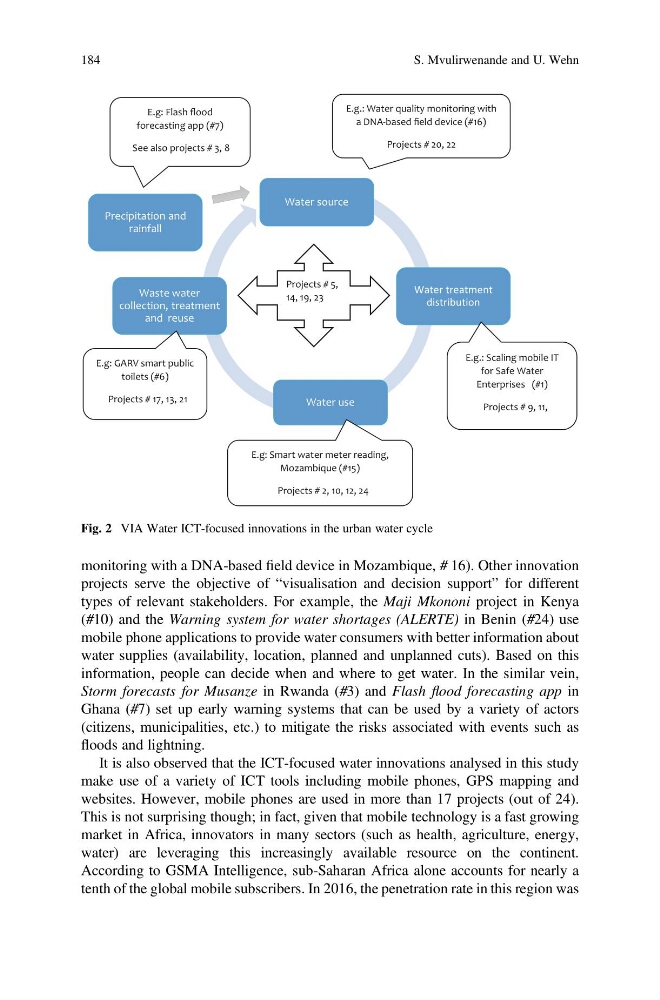
monitoring with a DNA-based field device in Mozambique, # 16). Other innovation
projects serve the objective of “visualisation and decision support” for different
types of relevant stakeholders. For example, the Maji Mkononi project in Kenya
(#10) and the Warning system for water shortages (ALERTE) in Benin (#24) use
mobile phone applications to provide water consumers with better information about
water supplies (availability, location, planned and unplanned cuts). Based on this
information, people can decide when and where to get water. In the similar vein,
Storm forecasts for Musanze in Rwanda (#3) and Flash flood forecasting app in
Ghana (#7) set up early warning systems that can be used by a variety of actors
(citizens, municipalities, etc.) to mitigate the risks associated with events such as
floods and lightning.
It is also observed that the ICT-focused water innovations analysed in this study
make use of a variety of ICT tools including mobile phones, GPS mapping and
websites. However, mobile phones are used in more than 17 projects (out of 24).
This is not surprising though; in fact, given that mobile technology is a fast growing
market in Africa, innovators in many sectors (such as health, agriculture, energy,
water) are leveraging this increasingly available resource on the continent.
According to GSMA Intelligence, sub-Saharan Africa alone accounts for nearly a
tenth of the global mobile subscribers. In 2016, the penetration rate in this region was
Water source
Water treatment
distribution
Water use
Waste water
collection, treatment
and reuse
Precipitation and
rainfall
E.g: Smart water meter reading,
Mozambique (#15)
Projects # 2, 10, 12, 24
E.g: Flash flood
forecasting app (#7)
See also projects # 3, 8
E.g.: Water quality monitoring with
a DNA-based field device (#16)
Projects # 20, 22
E.g: GARV smart public
toilets (#6)
Projects # 17, 13, 21
E.g.: Scaling mobile IT
for Safe Water
Enterprises (#1)
Projects # 9, 11,
Projects # 5,
14, 19, 23
Fig. 2 VIA Water ICT-focused innovations in the urban water cycle
184
S. Mvulirwenande and U. Wehn
projects serve the objective of “visualisation and decision support” for different
types of relevant stakeholders. For example, the Maji Mkononi project in Kenya
(#10) and the Warning system for water shortages (ALERTE) in Benin (#24) use
mobile phone applications to provide water consumers with better information about
water supplies (availability, location, planned and unplanned cuts). Based on this
information, people can decide when and where to get water. In the similar vein,
Storm forecasts for Musanze in Rwanda (#3) and Flash flood forecasting app in
Ghana (#7) set up early warning systems that can be used by a variety of actors
(citizens, municipalities, etc.) to mitigate the risks associated with events such as
floods and lightning.
It is also observed that the ICT-focused water innovations analysed in this study
make use of a variety of ICT tools including mobile phones, GPS mapping and
websites. However, mobile phones are used in more than 17 projects (out of 24).
This is not surprising though; in fact, given that mobile technology is a fast growing
market in Africa, innovators in many sectors (such as health, agriculture, energy,
water) are leveraging this increasingly available resource on the continent.
According to GSMA Intelligence, sub-Saharan Africa alone accounts for nearly a
tenth of the global mobile subscribers. In 2016, the penetration rate in this region was
Water source
Water treatment
distribution
Water use
Waste water
collection, treatment
and reuse
Precipitation and
rainfall
E.g: Smart water meter reading,
Mozambique (#15)
Projects # 2, 10, 12, 24
E.g: Flash flood
forecasting app (#7)
See also projects # 3, 8
E.g.: Water quality monitoring with
a DNA-based field device (#16)
Projects # 20, 22
E.g: GARV smart public
toilets (#6)
Projects # 17, 13, 21
E.g.: Scaling mobile IT
for Safe Water
Enterprises (#1)
Projects # 9, 11,
Projects # 5,
14, 19, 23
Fig. 2 VIA Water ICT-focused innovations in the urban water cycle
184
S. Mvulirwenande and U. Wehn