

4.2 Data Collection and Analysis
Our analysis draws on secondary as well as primary data. We reviewed a variety of
relevant documents related to the ICT-WIPs available in the VIA Water database.
The documents include project proposals submitted to VIA Water by the innovating
organisations, project contracts signed between the VIA Water Fund Manager and
the lead partner, as well as interim and final project reports. We also consulted VIA
Water corporate documents, reports (including those produced by consultants hired
for specific assignments) and website. In the VIA Water online learning platform,
project owners post useful information related to the day-to-day management of their
innovations. Our analysis further draws on interviews with representatives of
10 ICT-WIPs in Ghana (July and November 2017), Kenya (September 2017) and
Mozambique (February 2018), and discussions held with VIA Water managers – all
of which resulted in primary data and information. Relevant information was also
collected via informal discussions held with representatives of the ICT-WIPs at VIA
Water events such as the sharing skills seminar in Ghana (November, 2017) and the
“VIA GO” event organised at the Amsterdam Water Week Conference (October,
2017). The analysis conducted in this research is purely qualitative. For the analysis,
we used the key themes selected based on the theoretical framework used in this
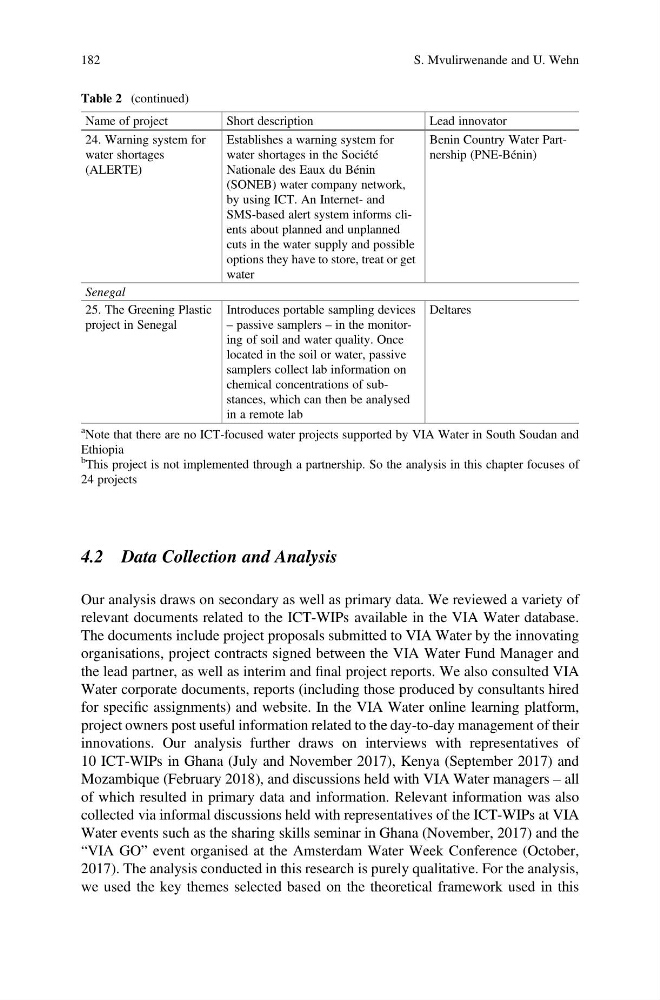
Table 2 (continued)
Name of project
Short description
Lead innovator
24. Warning system for
water shortages
(ALERTE)
Establishes a warning system for
water shortages in the Société
Nationale des Eaux du Bénin
(SONEB) water company network,
by using ICT. An Internet- and
SMS-based alert system informs clients about planned and unplanned
cuts in the water supply and possible
options they have to store, treat or get
water
Benin Country Water Partnership (PNE-Bénin)
Senegal
25. The Greening Plastic
project in Senegal
Introduces portable sampling devices
– passive samplers – in the monitoring of soil and water quality. Once
located in the soil or water, passive
samplers collect lab information on
chemical concentrations of substances, which can then be analysed
in a remote lab
Deltares
a Note that there are no ICT-focused water projects supported by VIA Water in South Soudan and
Ethiopia
b
This project is not implemented through a partnership. So the analysis in this chapter focuses of
24 projects
182
S. Mvulirwenande and U. Wehn
Our analysis draws on secondary as well as primary data. We reviewed a variety of
relevant documents related to the ICT-WIPs available in the VIA Water database.
The documents include project proposals submitted to VIA Water by the innovating
organisations, project contracts signed between the VIA Water Fund Manager and
the lead partner, as well as interim and final project reports. We also consulted VIA
Water corporate documents, reports (including those produced by consultants hired
for specific assignments) and website. In the VIA Water online learning platform,
project owners post useful information related to the day-to-day management of their
innovations. Our analysis further draws on interviews with representatives of
10 ICT-WIPs in Ghana (July and November 2017), Kenya (September 2017) and
Mozambique (February 2018), and discussions held with VIA Water managers – all
of which resulted in primary data and information. Relevant information was also
collected via informal discussions held with representatives of the ICT-WIPs at VIA
Water events such as the sharing skills seminar in Ghana (November, 2017) and the
“VIA GO” event organised at the Amsterdam Water Week Conference (October,
2017). The analysis conducted in this research is purely qualitative. For the analysis,
we used the key themes selected based on the theoretical framework used in this
Table 2 (continued)
Name of project
Short description
Lead innovator
24. Warning system for
water shortages
(ALERTE)
Establishes a warning system for
water shortages in the Société
Nationale des Eaux du Bénin
(SONEB) water company network,
by using ICT. An Internet- and
SMS-based alert system informs clients about planned and unplanned
cuts in the water supply and possible
options they have to store, treat or get
water
Benin Country Water Partnership (PNE-Bénin)
Senegal
25. The Greening Plastic
project in Senegal
Introduces portable sampling devices
– passive samplers – in the monitoring of soil and water quality. Once
located in the soil or water, passive
samplers collect lab information on
chemical concentrations of substances, which can then be analysed
in a remote lab
Deltares
a Note that there are no ICT-focused water projects supported by VIA Water in South Soudan and
Ethiopia
b
This project is not implemented through a partnership. So the analysis in this chapter focuses of
24 projects
182
S. Mvulirwenande and U. Wehn