

Further details on this programme can be found in Nagel et al. [15] and
Mvulirwenande et al. [66]. The reasons for selecting cases from this programme are
twofold. On the one hand, most VIA Water projects are implemented through
partnerships. The programme promotes this approach and encourages lead applicants
to partner with other organisations to ensure successful innovation processes – both at
pilot- and large-scale implementation stages. As of 2018, the programme had
supported 64 water innovation projects of which 25 are ICT-focused (they are either
entirely ICT or have an important ICT component) (see description in Table 2). The
analysis in this chapter is focused on the 24 ICT-focused projects that are
implemented through partnerships (only 1 is not); they cover a variety of areas in
which ICTs can make a contribution in promoting smart management of water
resources and sanitation. This is a reasonable number of cases on the basis of which
insights can be generated on how to successfully design and manage innovation
partnerships for smart water systems. On the other hand, the fact that all 24 projects
were developed and supported through one support programme implies that we are
able to have easy access to data and information related to these innovations – notably
through the VIA Water database. Of note is that most of the ICT-WIPs analysed in
this study are not yet completed, and, for some, little information is available about
their performance. This implies that it is still too early to evaluate their success rates
and success factors.
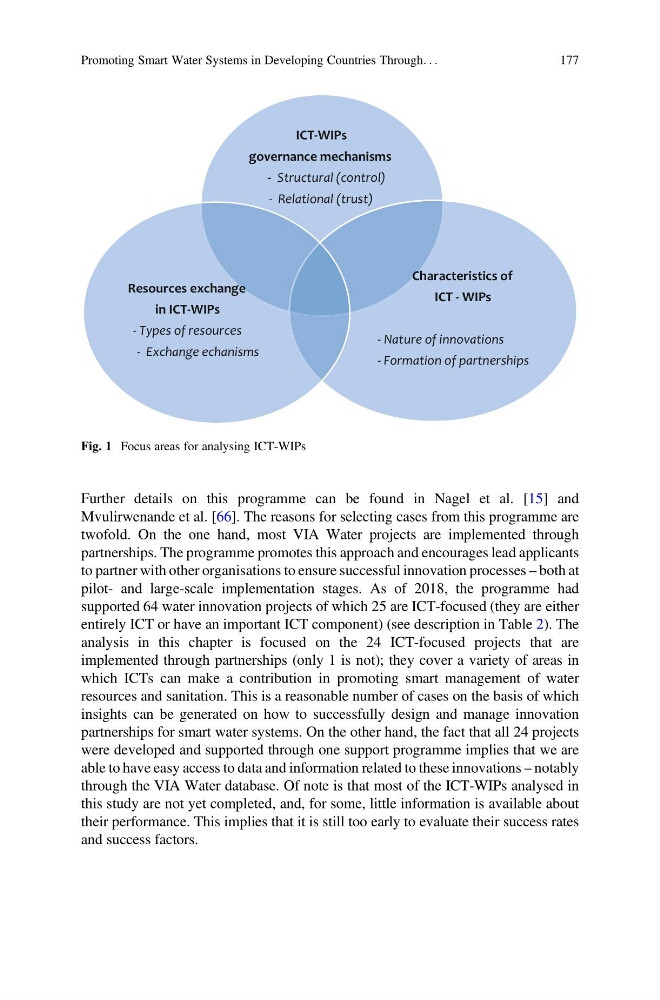
ICT-WIPs
governance mechanisms
- Structural (control)
- Relational (trust)
Characteristics of
ICT - WIPs
- Nature of innovations
- Formation of partnerships
Resources exchange
in ICT-WIPs
- Types of resources
- Exchange echanisms
Fig. 1 Focus areas for analysing ICT-WIPs
Promoting Smart Water Systems in Developing Countries Through. . .
177
Mvulirwenande et al. [66]. The reasons for selecting cases from this programme are
twofold. On the one hand, most VIA Water projects are implemented through
partnerships. The programme promotes this approach and encourages lead applicants
to partner with other organisations to ensure successful innovation processes – both at
pilot- and large-scale implementation stages. As of 2018, the programme had
supported 64 water innovation projects of which 25 are ICT-focused (they are either
entirely ICT or have an important ICT component) (see description in Table 2). The
analysis in this chapter is focused on the 24 ICT-focused projects that are
implemented through partnerships (only 1 is not); they cover a variety of areas in
which ICTs can make a contribution in promoting smart management of water
resources and sanitation. This is a reasonable number of cases on the basis of which
insights can be generated on how to successfully design and manage innovation
partnerships for smart water systems. On the other hand, the fact that all 24 projects
were developed and supported through one support programme implies that we are
able to have easy access to data and information related to these innovations – notably
through the VIA Water database. Of note is that most of the ICT-WIPs analysed in
this study are not yet completed, and, for some, little information is available about
their performance. This implies that it is still too early to evaluate their success rates
and success factors.
ICT-WIPs
governance mechanisms
- Structural (control)
- Relational (trust)
Characteristics of
ICT - WIPs
- Nature of innovations
- Formation of partnerships
Resources exchange
in ICT-WIPs
- Types of resources
- Exchange echanisms
Fig. 1 Focus areas for analysing ICT-WIPs
Promoting Smart Water Systems in Developing Countries Through. . .
177