

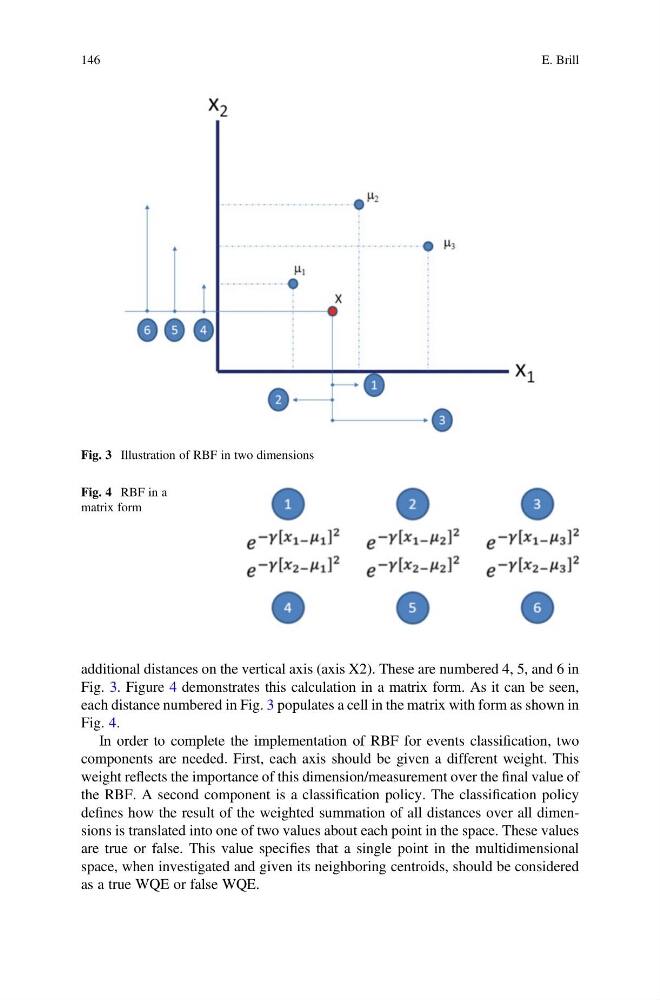
additional distances on the vertical axis (axis X2). These are numbered 4, 5, and 6 in
Fig. 3. Figure 4 demonstrates this calculation in a matrix form. As it can be seen,
each distance numbered in Fig. 3 populates a cell in the matrix with form as shown in
Fig. 4.
In order to complete the implementation of RBF for events classification, two
components are needed. First, each axis should be given a different weight. This
weight reflects the importance of this dimension/measurement over the final value of
the RBF. A second component is a classification policy. The classification policy
defines how the result of the weighted summation of all distances over all dimensions is translated into one of two values about each point in the space. These values
are true or false. This value specifies that a single point in the multidimensional
space, when investigated and given its neighboring centroids, should be considered
as a true WQE or false WQE.
Fig. 3 Illustration of RBF in two dimensions
Fig. 4 RBF in a
matrix form
146
E. Brill
Fig. 3. Figure 4 demonstrates this calculation in a matrix form. As it can be seen,
each distance numbered in Fig. 3 populates a cell in the matrix with form as shown in
Fig. 4.
In order to complete the implementation of RBF for events classification, two
components are needed. First, each axis should be given a different weight. This
weight reflects the importance of this dimension/measurement over the final value of
the RBF. A second component is a classification policy. The classification policy
defines how the result of the weighted summation of all distances over all dimensions is translated into one of two values about each point in the space. These values
are true or false. This value specifies that a single point in the multidimensional
space, when investigated and given its neighboring centroids, should be considered
as a true WQE or false WQE.
Fig. 3 Illustration of RBF in two dimensions
Fig. 4 RBF in a
matrix form
146
E. Brill