

measurement could mean that the cost to the customer is higher than necessary (or if
the instrument is measuring low the cost could actually be reduced but normally
instruments, if inaccurate, will read higher than actual).
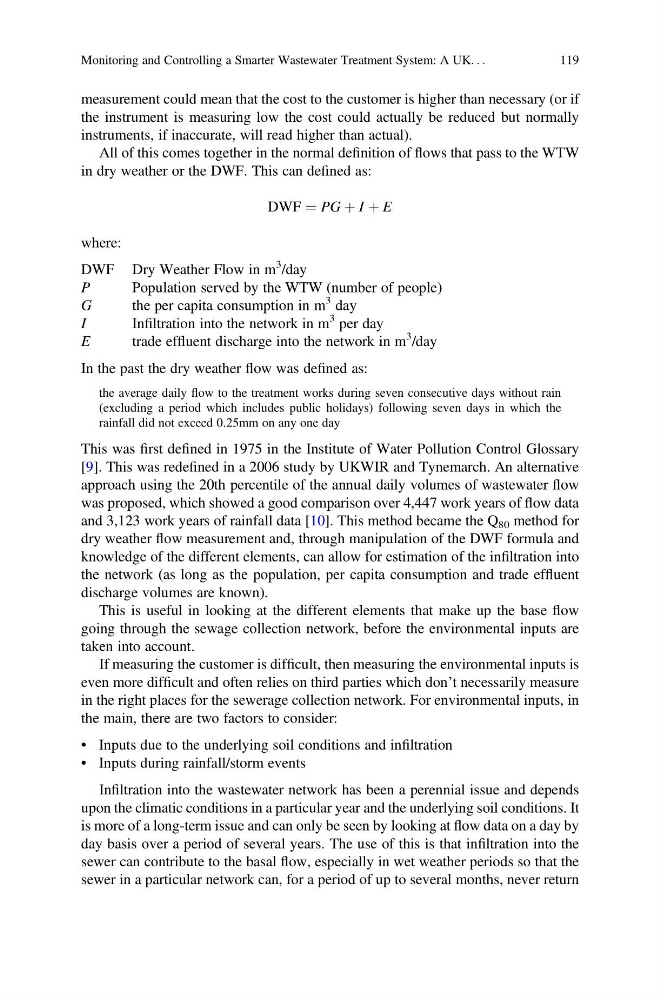
All of this comes together in the normal definition of flows that pass to the WTW
in dry weather or the DWF. This can defined as:
DWF ¼ PG þ I þ E
where:
DWF Dry Weather Flow in m
3 /day
P
Population served by the WTW (number of people)
G
the per capita consumption in m
3 day
I
Infiltration into the network in m
3 per day
E
trade effluent discharge into the network in m
3 /day
In the past the dry weather flow was defined as:
the average daily flow to the treatment works during seven consecutive days without rain
(excluding a period which includes public holidays) following seven days in which the
rainfall did not exceed 0.25mm on any one day
This was first defined in 1975 in the Institute of Water Pollution Control Glossary
[9]. This was redefined in a 2006 study by UKWIR and Tynemarch. An alternative
approach using the 20th percentile of the annual daily volumes of wastewater flow
was proposed, which showed a good comparison over 4,447 work years of flow data
and 3,123 work years of rainfall data [10]. This method became the Q 80 method for
dry weather flow measurement and, through manipulation of the DWF formula and
knowledge of the different elements, can allow for estimation of the infiltration into
the network (as long as the population, per capita consumption and trade effluent
discharge volumes are known).
This is useful in looking at the different elements that make up the base flow
going through the sewage collection network, before the environmental inputs are
taken into account.
If measuring the customer is difficult, then measuring the environmental inputs is
even more difficult and often relies on third parties which don’t necessarily measure
in the right places for the sewerage collection network. For environmental inputs, in
the main, there are two factors to consider:
• Inputs due to the underlying soil conditions and infiltration
• Inputs during rainfall/storm events
Infiltration into the wastewater network has been a perennial issue and depends
upon the climatic conditions in a particular year and the underlying soil conditions. It
is more of a long-term issue and can only be seen by looking at flow data on a day by
day basis over a period of several years. The use of this is that infiltration into the
sewer can contribute to the basal flow, especially in wet weather periods so that the
sewer in a particular network can, for a period of up to several months, never return
Monitoring and Controlling a Smarter Wastewater Treatment System: A UK. . .
119
the instrument is measuring low the cost could actually be reduced but normally
instruments, if inaccurate, will read higher than actual).
All of this comes together in the normal definition of flows that pass to the WTW
in dry weather or the DWF. This can defined as:
DWF ¼ PG þ I þ E
where:
DWF Dry Weather Flow in m
3 /day
P
Population served by the WTW (number of people)
G
the per capita consumption in m
3 day
I
Infiltration into the network in m
3 per day
E
trade effluent discharge into the network in m
3 /day
In the past the dry weather flow was defined as:
the average daily flow to the treatment works during seven consecutive days without rain
(excluding a period which includes public holidays) following seven days in which the
rainfall did not exceed 0.25mm on any one day
This was first defined in 1975 in the Institute of Water Pollution Control Glossary
[9]. This was redefined in a 2006 study by UKWIR and Tynemarch. An alternative
approach using the 20th percentile of the annual daily volumes of wastewater flow
was proposed, which showed a good comparison over 4,447 work years of flow data
and 3,123 work years of rainfall data [10]. This method became the Q 80 method for
dry weather flow measurement and, through manipulation of the DWF formula and
knowledge of the different elements, can allow for estimation of the infiltration into
the network (as long as the population, per capita consumption and trade effluent
discharge volumes are known).
This is useful in looking at the different elements that make up the base flow
going through the sewage collection network, before the environmental inputs are
taken into account.
If measuring the customer is difficult, then measuring the environmental inputs is
even more difficult and often relies on third parties which don’t necessarily measure
in the right places for the sewerage collection network. For environmental inputs, in
the main, there are two factors to consider:
• Inputs due to the underlying soil conditions and infiltration
• Inputs during rainfall/storm events
Infiltration into the wastewater network has been a perennial issue and depends
upon the climatic conditions in a particular year and the underlying soil conditions. It
is more of a long-term issue and can only be seen by looking at flow data on a day by
day basis over a period of several years. The use of this is that infiltration into the
sewer can contribute to the basal flow, especially in wet weather periods so that the
sewer in a particular network can, for a period of up to several months, never return
Monitoring and Controlling a Smarter Wastewater Treatment System: A UK. . .
119