

32
distribution of plankton and the general factors limiting the productivity of the seas
(Mills 2012). In the late 1800s, Karl Brandt of the Zoological Institute of Kiel (or
often referred to as the “Kiel School” of plankton researchers at the Zoological and
Botanical Institutes in Kiel) postulated that the newly discovered pathway of BNF
was largely a terrestrial process, and that the source of combined N 2 to the sea was
mainly through terrestrial runoff and BNF was not an important process in the sea.
He further posited that denitrification in the ocean maintained the N balance. One
young researcher in the group did identify several genera of N 2 -fixing bacteria in
seawater samples including Azotobacter and Clostridium (Benecke and Keutner
1903). Nonetheless, while these early marine microbiological studies concluded
that N 2 -fixing bacteria were indeed present, its overall importance in seawater
was minor.
Independent of these ponderings, marine phycologists were collecting data on
the distribution of several important marine diazotrophs, although they did not realize it at the time. The historic German Plankton Expedition (GPE) of 1889 aimed to
resolve a controversy as to whether marine plankton were uniformly distributed in
the upper ocean, as held by Victor Henson, head of the Kiel plankton group and the
GPE cruise leader, as opposed to their heterogeneous distribution with higher abundance in the tropics as posited by Ernst Haeckel (Mills 2012). The GPE cruise followed a large figure 8 cruise track leaving from Kiel Jul 15, 1889 transiting across
the northern N. Atlantic Ocean to the tip of Greenland, and down to Bermuda,
thence through the central N. Atlantic to the Cape Verdes and Ascension Islands,
across to Belem at the mouth of the Amazon, and back to Kiel by early November
(Fig. 3.2). Samples were collected from 278 stations. Subsequent analysis of the
cyanobacteria by Wille (Wille 1904) revealed the distribution of, among other
organisms, the macroscopic filamentous cyanobacterium Trichodesmium spp.
whose distribution had highest densities in the tropical reaches of the cruise. Earlier,
James Cook (see Beaglehole 1955) and his botanist, Joseph Banks (see Beaglehole
1962) in the late 1700s and Charles Darwin (Darwin 1889) on his global voyage on
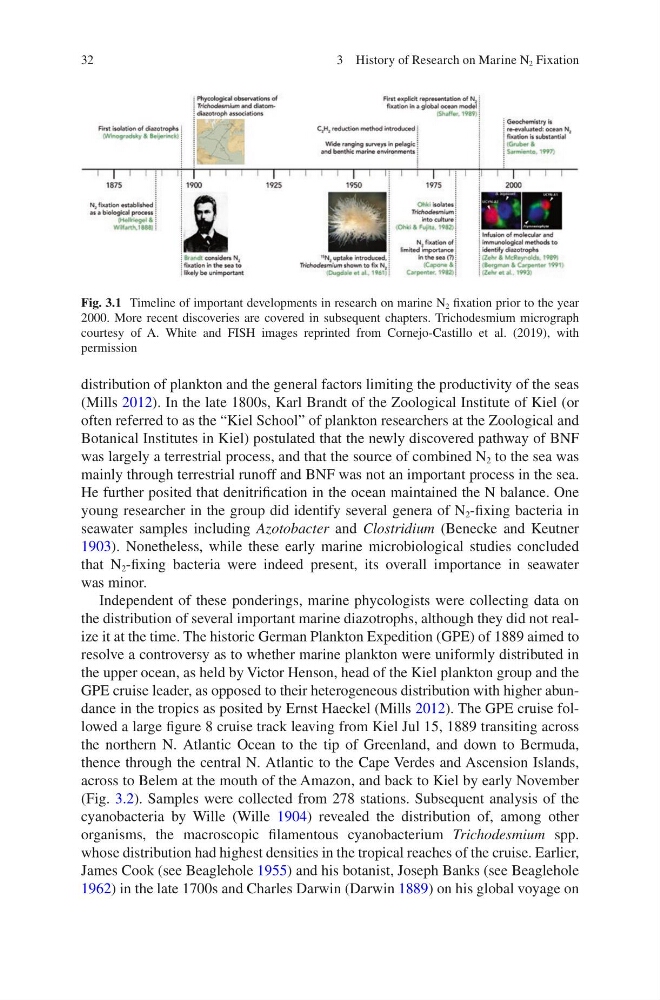
Fig. 3.1 Timeline of important developments in research on marine N 2 fixation prior to the year
2000. More recent discoveries are covered in subsequent chapters. Trichodesmium micrograph
courtesy of A. White and FISH images reprinted from Cornejo-Castillo et al. (2019), with
permission
3 History of Research on Marine N 2 Fixation
distribution of plankton and the general factors limiting the productivity of the seas
(Mills 2012). In the late 1800s, Karl Brandt of the Zoological Institute of Kiel (or
often referred to as the “Kiel School” of plankton researchers at the Zoological and
Botanical Institutes in Kiel) postulated that the newly discovered pathway of BNF
was largely a terrestrial process, and that the source of combined N 2 to the sea was
mainly through terrestrial runoff and BNF was not an important process in the sea.
He further posited that denitrification in the ocean maintained the N balance. One
young researcher in the group did identify several genera of N 2 -fixing bacteria in
seawater samples including Azotobacter and Clostridium (Benecke and Keutner
1903). Nonetheless, while these early marine microbiological studies concluded
that N 2 -fixing bacteria were indeed present, its overall importance in seawater
was minor.
Independent of these ponderings, marine phycologists were collecting data on
the distribution of several important marine diazotrophs, although they did not realize it at the time. The historic German Plankton Expedition (GPE) of 1889 aimed to
resolve a controversy as to whether marine plankton were uniformly distributed in
the upper ocean, as held by Victor Henson, head of the Kiel plankton group and the
GPE cruise leader, as opposed to their heterogeneous distribution with higher abundance in the tropics as posited by Ernst Haeckel (Mills 2012). The GPE cruise followed a large figure 8 cruise track leaving from Kiel Jul 15, 1889 transiting across
the northern N. Atlantic Ocean to the tip of Greenland, and down to Bermuda,
thence through the central N. Atlantic to the Cape Verdes and Ascension Islands,
across to Belem at the mouth of the Amazon, and back to Kiel by early November
(Fig. 3.2). Samples were collected from 278 stations. Subsequent analysis of the
cyanobacteria by Wille (Wille 1904) revealed the distribution of, among other
organisms, the macroscopic filamentous cyanobacterium Trichodesmium spp.
whose distribution had highest densities in the tropical reaches of the cruise. Earlier,
James Cook (see Beaglehole 1955) and his botanist, Joseph Banks (see Beaglehole
1962) in the late 1700s and Charles Darwin (Darwin 1889) on his global voyage on
Fig. 3.1 Timeline of important developments in research on marine N 2 fixation prior to the year
2000. More recent discoveries are covered in subsequent chapters. Trichodesmium micrograph
courtesy of A. White and FISH images reprinted from Cornejo-Castillo et al. (2019), with
permission
3 History of Research on Marine N 2 Fixation