

21
the scope of this review, but involves secretion of molecules (flavonoids) by the
plant and release of Nod factors by the rhizobia (Roy et al. 2019). The signals and
receptors can be highly species or strain-specific and include host recognition of
bacterial exopolysaccharides (Roy et al. 2019). Rhizobia, the bacterial symbionts of
legumes, are some of the best understood from a genetic perspective (MassonBoivin et al. 2009). Genes for N 2 fixation (nif) and nodulation (nod) are characteristic in this group, although not all bacteria use Nod factors (Masson-Boivin et al.
2009). Surprisingly, there is variability in the number of nif genes in rhizobia, and
fewer when compared to free-living Klebsiella (Masson-Boivin et al. 2009). Genes
are retained for the nitrogenase proteins, nifEN and nifB and the regulatory gene
nifA (Masson-Boivin et al. 2009). Nod factors are involved in the excretion of lipochitooligosaccharidic Nod factors (NFs) in response to plant flavonoid signals that
then lead to formation of nodules (Masson-Boivin et al. 2009). The nod genes are
involved in symbiosis in forming the root nodules in most rhizobia, but not in some
photosynthetic Bradyrhizobium strains (Masson-Boivin et al. 2009).
The fix genes were first described in Rhizobium meliloti, do not have equivalent
homologs in Klebsiella, and are believed to be involved in regulation and possibly
electron flow to nitrogenase (Fischer 1994). They are required for N 2 fixation in
rhizobia (Fischer 1994; Masson-Boivin et al. 2009). Some of these are transcription
regulators, including fix and fnr genes (Tsoy et al. 2016).
The evolution of the symbiotic rhizobia and diversification with their hosts have
involved horizontal gene transfers and the genes involved in N 2 fixation and symbiosis are found on some plasmids and in symbiotic islands (Lindstrom et al. 2015).
Symbiosis is the focus of many studies, now including experimental evolution (de
Moura et al. 2020) and the subject of bioengineering efforts (Huisman and
Geurts 2020).
2.5 Cellular Regulation of Nitrogenase
Since the N 2 fixation reaction is energetically expensive, sensitive to O 2 , requires
synthesis of multiple gene products, and is a relatively slow turnover enzyme, nitrogenase genes and some proteins are highly regulated (Dixon 2004; Klipp et al.
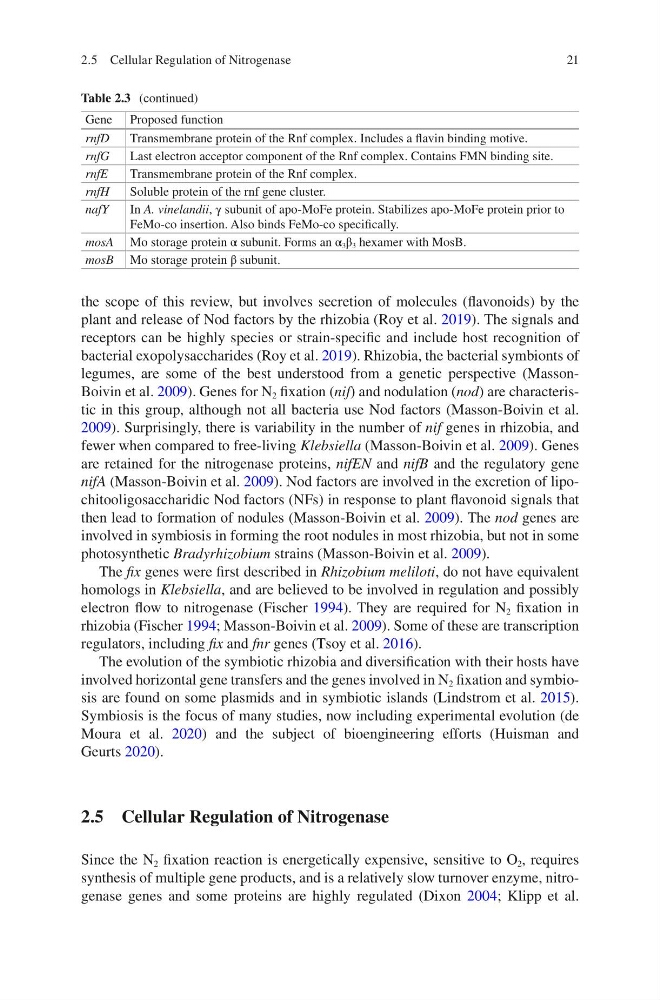
Table 2.3 (continued)
Gene Proposed function
rnfD
Transmembrane protein of the Rnf complex. Includes a flavin binding motive.
rnfG
Last electron acceptor component of the Rnf complex. Contains FMN binding site.
rnfE
Transmembrane protein of the Rnf complex.
rnfH
Soluble protein of the rnf gene cluster.
nafY
In A. vinelandii, γ subunit of apo-MoFe protein. Stabilizes apo-MoFe protein prior to
FeMo-co insertion. Also binds FeMo-co specifically.
mosA Mo storage protein α subunit. Forms an α 3 β 3 hexamer with MosB.
mosB Mo storage protein β subunit.
2.5 Cellular Regulation of Nitrogenase
the scope of this review, but involves secretion of molecules (flavonoids) by the
plant and release of Nod factors by the rhizobia (Roy et al. 2019). The signals and
receptors can be highly species or strain-specific and include host recognition of
bacterial exopolysaccharides (Roy et al. 2019). Rhizobia, the bacterial symbionts of
legumes, are some of the best understood from a genetic perspective (MassonBoivin et al. 2009). Genes for N 2 fixation (nif) and nodulation (nod) are characteristic in this group, although not all bacteria use Nod factors (Masson-Boivin et al.
2009). Surprisingly, there is variability in the number of nif genes in rhizobia, and
fewer when compared to free-living Klebsiella (Masson-Boivin et al. 2009). Genes
are retained for the nitrogenase proteins, nifEN and nifB and the regulatory gene
nifA (Masson-Boivin et al. 2009). Nod factors are involved in the excretion of lipochitooligosaccharidic Nod factors (NFs) in response to plant flavonoid signals that
then lead to formation of nodules (Masson-Boivin et al. 2009). The nod genes are
involved in symbiosis in forming the root nodules in most rhizobia, but not in some
photosynthetic Bradyrhizobium strains (Masson-Boivin et al. 2009).
The fix genes were first described in Rhizobium meliloti, do not have equivalent
homologs in Klebsiella, and are believed to be involved in regulation and possibly
electron flow to nitrogenase (Fischer 1994). They are required for N 2 fixation in
rhizobia (Fischer 1994; Masson-Boivin et al. 2009). Some of these are transcription
regulators, including fix and fnr genes (Tsoy et al. 2016).
The evolution of the symbiotic rhizobia and diversification with their hosts have
involved horizontal gene transfers and the genes involved in N 2 fixation and symbiosis are found on some plasmids and in symbiotic islands (Lindstrom et al. 2015).
Symbiosis is the focus of many studies, now including experimental evolution (de
Moura et al. 2020) and the subject of bioengineering efforts (Huisman and
Geurts 2020).
2.5 Cellular Regulation of Nitrogenase
Since the N 2 fixation reaction is energetically expensive, sensitive to O 2 , requires
synthesis of multiple gene products, and is a relatively slow turnover enzyme, nitrogenase genes and some proteins are highly regulated (Dixon 2004; Klipp et al.
Table 2.3 (continued)
Gene Proposed function
rnfD
Transmembrane protein of the Rnf complex. Includes a flavin binding motive.
rnfG
Last electron acceptor component of the Rnf complex. Contains FMN binding site.
rnfE
Transmembrane protein of the Rnf complex.
rnfH
Soluble protein of the rnf gene cluster.
nafY
In A. vinelandii, γ subunit of apo-MoFe protein. Stabilizes apo-MoFe protein prior to
FeMo-co insertion. Also binds FeMo-co specifically.
mosA Mo storage protein α subunit. Forms an α 3 β 3 hexamer with MosB.
mosB Mo storage protein β subunit.
2.5 Cellular Regulation of Nitrogenase