

16
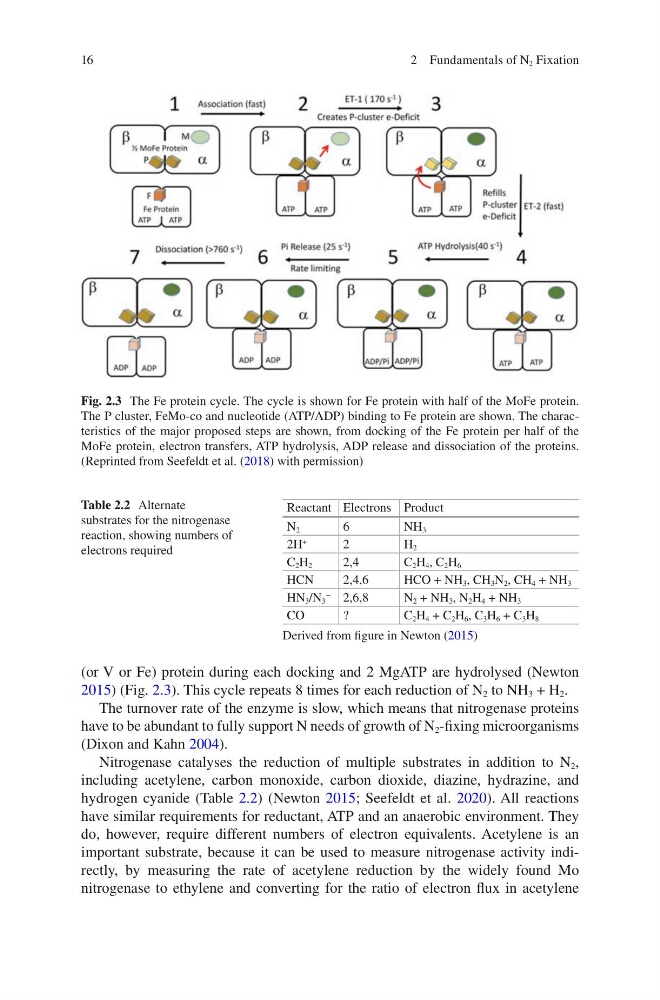
(or V or Fe) protein during each docking and 2 MgATP are hydrolysed (Newton
2015) (Fig. 2.3). This cycle repeats 8 times for each reduction of N 2 to NH 3 + H 2 .
The turnover rate of the enzyme is slow, which means that nitrogenase proteins
have to be abundant to fully support N needs of growth of N 2 -fixing microorganisms
(Dixon and Kahn 2004).
Nitrogenase catalyses the reduction of multiple substrates in addition to N 2 ,
including acetylene, carbon monoxide, carbon dioxide, diazine, hydrazine, and
hydrogen cyanide (Table 2.2) (Newton 2015; Seefeldt et al. 2020). All reactions
have similar requirements for reductant, ATP and an anaerobic environment. They
do, however, require different numbers of electron equivalents. Acetylene is an
important substrate, because it can be used to measure nitrogenase activity indirectly, by measuring the rate of acetylene reduction by the widely found Mo
nitrogenase to ethylene and converting for the ratio of electron flux in acetylene
Fig. 2.3 The Fe protein cycle. The cycle is shown for Fe protein with half of the MoFe protein.
The P cluster, FeMo-co and nucleotide (ATP/ADP) binding to Fe protein are shown. The characteristics of the major proposed steps are shown, from docking of the Fe protein per half of the
MoFe protein, electron transfers, ATP hydrolysis, ADP release and dissociation of the proteins.
(Reprinted from Seefeldt et al. (2018) with permission)
Table 2.2 Alternate
substrates for the nitrogenase
reaction, showing numbers of
electrons required
Reactant Electrons Product
N 2
6
NH 3
2H
+
2
H 2
C 2 H 2
2,4
C 2 H 4 , C 2 H 6
HCN
2,4,6
HCO + NH 3 , CH 3 N 2 , CH 4 + NH 3
HN 3 /N 3
−
2,6,8
N 2 + NH 3 , N 2 H 4 + NH 3
CO
?
C 2 H 4 + C 2 H 6 , C 3 H 6 + C 3 H 8
Derived from figure in Newton (2015)
2 Fundamentals of N 2 Fixation
(or V or Fe) protein during each docking and 2 MgATP are hydrolysed (Newton
2015) (Fig. 2.3). This cycle repeats 8 times for each reduction of N 2 to NH 3 + H 2 .
The turnover rate of the enzyme is slow, which means that nitrogenase proteins
have to be abundant to fully support N needs of growth of N 2 -fixing microorganisms
(Dixon and Kahn 2004).
Nitrogenase catalyses the reduction of multiple substrates in addition to N 2 ,
including acetylene, carbon monoxide, carbon dioxide, diazine, hydrazine, and
hydrogen cyanide (Table 2.2) (Newton 2015; Seefeldt et al. 2020). All reactions
have similar requirements for reductant, ATP and an anaerobic environment. They
do, however, require different numbers of electron equivalents. Acetylene is an
important substrate, because it can be used to measure nitrogenase activity indirectly, by measuring the rate of acetylene reduction by the widely found Mo
nitrogenase to ethylene and converting for the ratio of electron flux in acetylene
Fig. 2.3 The Fe protein cycle. The cycle is shown for Fe protein with half of the MoFe protein.
The P cluster, FeMo-co and nucleotide (ATP/ADP) binding to Fe protein are shown. The characteristics of the major proposed steps are shown, from docking of the Fe protein per half of the
MoFe protein, electron transfers, ATP hydrolysis, ADP release and dissociation of the proteins.
(Reprinted from Seefeldt et al. (2018) with permission)
Table 2.2 Alternate
substrates for the nitrogenase
reaction, showing numbers of
electrons required
Reactant Electrons Product
N 2
6
NH 3
2H
+
2
H 2
C 2 H 2
2,4
C 2 H 4 , C 2 H 6
HCN
2,4,6
HCO + NH 3 , CH 3 N 2 , CH 4 + NH 3
HN 3 /N 3
−
2,6,8
N 2 + NH 3 , N 2 H 4 + NH 3
CO
?
C 2 H 4 + C 2 H 6 , C 3 H 6 + C 3 H 8
Derived from figure in Newton (2015)
2 Fundamentals of N 2 Fixation