

124
7.4 Oligotrophic Oceans
Tropical and subtropical waters, including the large central ocean gyres of the Atlantic,
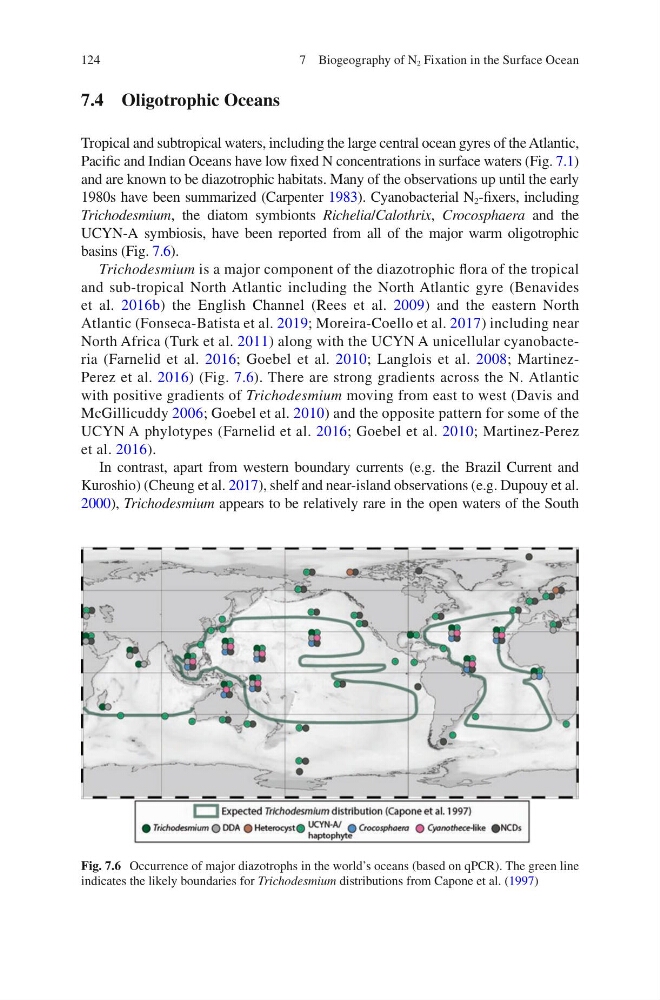
Pacific and Indian Oceans have low fixed N concentrations in surface waters (Fig. 7.1)
and are known to be diazotrophic habitats. Many of the observations up until the early
1980s have been summarized (Carpenter 1983). Cyanobacterial N 2 -fixers, including
Trichodesmium, the diatom symbionts Richelia/Calothrix, Crocosphaera and the
UCYN-A symbiosis, have been reported from all of the major warm oligotrophic
basins (Fig. 7.6).
Trichodesmium is a major component of the diazotrophic flora of the tropical
and sub-tropical North Atlantic including the North Atlantic gyre (Benavides
et al. 2016b) the English Channel (Rees et al. 2009) and the eastern North
Atlantic (Fonseca-Batista et al. 2019; Moreira-Coello et al. 2017) including near
North Africa (Turk et al. 2011) along with the UCYN A unicellular cyanobacteria (Farnelid et al. 2016; Goebel et al. 2010; Langlois et al. 2008; MartinezPerez et al. 2016) (Fig. 7.6). There are strong gradients across the N. Atlantic
with positive gradients of Trichodesmium moving from east to west (Davis and
McGillicuddy 2006; Goebel et al. 2010) and the opposite pattern for some of the
UCYN A phylotypes (Farnelid et al. 2016; Goebel et al. 2010; Martinez-Perez
et al. 2016).
In contrast, apart from western boundary currents (e.g. the Brazil Current and
Kuroshio) (Cheung et al. 2017), shelf and near-island observations (e.g. Dupouy et al.
2000), Trichodesmium appears to be relatively rare in the open waters of the South
Fig. 7.6 Occurrence of major diazotrophs in the world’s oceans (based on qPCR). The green line
indicates the likely boundaries for Trichodesmium distributions from Capone et al. (1997)
7 Biogeography of N 2 Fixation in the Surface Ocean
7.4 Oligotrophic Oceans
Tropical and subtropical waters, including the large central ocean gyres of the Atlantic,
Pacific and Indian Oceans have low fixed N concentrations in surface waters (Fig. 7.1)
and are known to be diazotrophic habitats. Many of the observations up until the early
1980s have been summarized (Carpenter 1983). Cyanobacterial N 2 -fixers, including
Trichodesmium, the diatom symbionts Richelia/Calothrix, Crocosphaera and the
UCYN-A symbiosis, have been reported from all of the major warm oligotrophic
basins (Fig. 7.6).
Trichodesmium is a major component of the diazotrophic flora of the tropical
and sub-tropical North Atlantic including the North Atlantic gyre (Benavides
et al. 2016b) the English Channel (Rees et al. 2009) and the eastern North
Atlantic (Fonseca-Batista et al. 2019; Moreira-Coello et al. 2017) including near
North Africa (Turk et al. 2011) along with the UCYN A unicellular cyanobacteria (Farnelid et al. 2016; Goebel et al. 2010; Langlois et al. 2008; MartinezPerez et al. 2016) (Fig. 7.6). There are strong gradients across the N. Atlantic
with positive gradients of Trichodesmium moving from east to west (Davis and
McGillicuddy 2006; Goebel et al. 2010) and the opposite pattern for some of the
UCYN A phylotypes (Farnelid et al. 2016; Goebel et al. 2010; Martinez-Perez
et al. 2016).
In contrast, apart from western boundary currents (e.g. the Brazil Current and
Kuroshio) (Cheung et al. 2017), shelf and near-island observations (e.g. Dupouy et al.
2000), Trichodesmium appears to be relatively rare in the open waters of the South
Fig. 7.6 Occurrence of major diazotrophs in the world’s oceans (based on qPCR). The green line
indicates the likely boundaries for Trichodesmium distributions from Capone et al. (1997)
7 Biogeography of N 2 Fixation in the Surface Ocean