

2.2 In Vitro Assays
1. Bacterial strains. Most commonly used are E. coli strains BL21
DE3pLysS, BL21A1, and XL1-Blue.
2. Plasmids: pGro7, encoding the groES-groEL-chaperone system used to improve protein folding.
3. Luria Bertani (LB) medium. See item 2 in Subheading 2.1.
4. 2YT medium. Dissolve 16 g tryptone, 5 g NaCl and 10 g yeast
extract in 900 mL ddH 2 O, adjust the pH to 7.0 with 5 N
NaOH and the final volume of the solution to 1 L with
ddH 2 O. Sterilize by autoclaving for 20 min at 15 psi.
5. Purified carotenoid and apocarotenoid substrates.
6. Carotenoid and apocarotenoid substrates for the assays (see
Note 1). Resuspend the substrates in 200 μL of benzene
(or dichloromethane) at a final concentration of 50–100 μM
and mixed with 150 μL of an ethanolic detergent mixture
consisting of 0.7% (v/v) Triton X-100 and 1.6% (v/v) Triton
X-405, for lycopene and prolycopene substrates or with 250 μL
of an ethanolic β-octylglucoside solution (4% w/v) for apocarotenoids and other carotenoids. The final mix is evaporated to
dryness in a vacuum centrifuge to get a carotenoid gel on the
bottom of the tube (see Note 2).
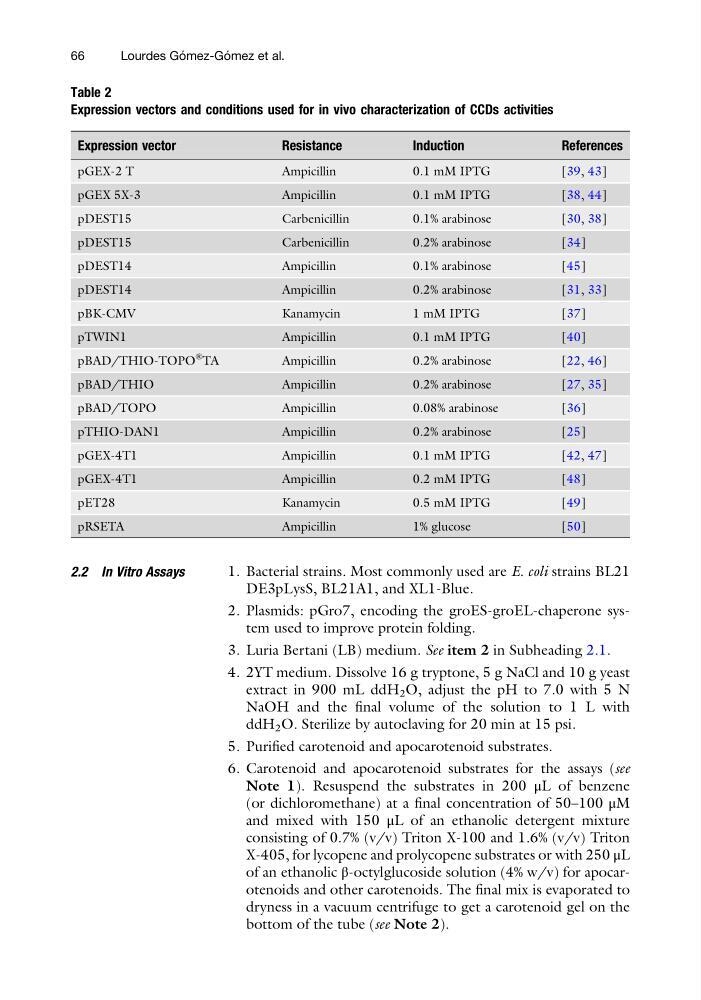
Table 2
Expression vectors and conditions used for in vivo characterization of CCDs activities
Expression vector
Resistance
Induction
References
pGEX-2 T
Ampicillin
0.1 mM IPTG
[39, 43]
pGEX 5X-3
Ampicillin
0.1 mM IPTG
[38, 44]
pDEST15
Carbenicillin
0.1% arabinose
[30, 38]
pDEST15
Carbenicillin
0.2% arabinose
[34]
pDEST14
Ampicillin
0.1% arabinose
[45]
pDEST14
Ampicillin
0.2% arabinose
[31, 33]
pBK-CMV
Kanamycin
1 mM IPTG
[37]
pTWIN1
Ampicillin
0.1 mM IPTG
[40]
pBAD/THIO-TOPO
® TA
Ampicillin
0.2% arabinose
[22, 46]
pBAD/THIO
Ampicillin
0.2% arabinose
[27, 35]
pBAD/TOPO
Ampicillin
0.08% arabinose
[36]
pTHIO-DAN1
Ampicillin
0.2% arabinose
[25]
pGEX-4T1
Ampicillin
0.1 mM IPTG
[42, 47]
pGEX-4T1
Ampicillin
0.2 mM IPTG
[48]
pET28
Kanamycin
0.5 mM IPTG
[49]
pRSETA
Ampicillin
1% glucose
[50]
66
Lourdes Go ´ mez-Go ´ mez et al.
1. Bacterial strains. Most commonly used are E. coli strains BL21
DE3pLysS, BL21A1, and XL1-Blue.
2. Plasmids: pGro7, encoding the groES-groEL-chaperone system used to improve protein folding.
3. Luria Bertani (LB) medium. See item 2 in Subheading 2.1.
4. 2YT medium. Dissolve 16 g tryptone, 5 g NaCl and 10 g yeast
extract in 900 mL ddH 2 O, adjust the pH to 7.0 with 5 N
NaOH and the final volume of the solution to 1 L with
ddH 2 O. Sterilize by autoclaving for 20 min at 15 psi.
5. Purified carotenoid and apocarotenoid substrates.
6. Carotenoid and apocarotenoid substrates for the assays (see
Note 1). Resuspend the substrates in 200 μL of benzene
(or dichloromethane) at a final concentration of 50–100 μM
and mixed with 150 μL of an ethanolic detergent mixture
consisting of 0.7% (v/v) Triton X-100 and 1.6% (v/v) Triton
X-405, for lycopene and prolycopene substrates or with 250 μL
of an ethanolic β-octylglucoside solution (4% w/v) for apocarotenoids and other carotenoids. The final mix is evaporated to
dryness in a vacuum centrifuge to get a carotenoid gel on the
bottom of the tube (see Note 2).
Table 2
Expression vectors and conditions used for in vivo characterization of CCDs activities
Expression vector
Resistance
Induction
References
pGEX-2 T
Ampicillin
0.1 mM IPTG
[39, 43]
pGEX 5X-3
Ampicillin
0.1 mM IPTG
[38, 44]
pDEST15
Carbenicillin
0.1% arabinose
[30, 38]
pDEST15
Carbenicillin
0.2% arabinose
[34]
pDEST14
Ampicillin
0.1% arabinose
[45]
pDEST14
Ampicillin
0.2% arabinose
[31, 33]
pBK-CMV
Kanamycin
1 mM IPTG
[37]
pTWIN1
Ampicillin
0.1 mM IPTG
[40]
pBAD/THIO-TOPO
® TA
Ampicillin
0.2% arabinose
[22, 46]
pBAD/THIO
Ampicillin
0.2% arabinose
[27, 35]
pBAD/TOPO
Ampicillin
0.08% arabinose
[36]
pTHIO-DAN1
Ampicillin
0.2% arabinose
[25]
pGEX-4T1
Ampicillin
0.1 mM IPTG
[42, 47]
pGEX-4T1
Ampicillin
0.2 mM IPTG
[48]
pET28
Kanamycin
0.5 mM IPTG
[49]
pRSETA
Ampicillin
1% glucose
[50]
66
Lourdes Go ´ mez-Go ´ mez et al.