

synthetic biology applications conceived to meet needs of food
security in an ever-changing climate [1, 2].
The biosynthesis of carotenoids in plants is mediated by
nuclear-encoded enzymes that are imported into chloroplasts and
other plastids [1]. A new enzyme required for the biosynthesis of all
plant carotenoids, 15-cis-ζ-carotene isomerase (Z-ISO), was
recently discovered [3, 4]. Z-ISO is an integral membrane protein
having multiple transmembrane domains that mediates carotenoid
isomerization by a novel mechanism involving a heme b cofactor.
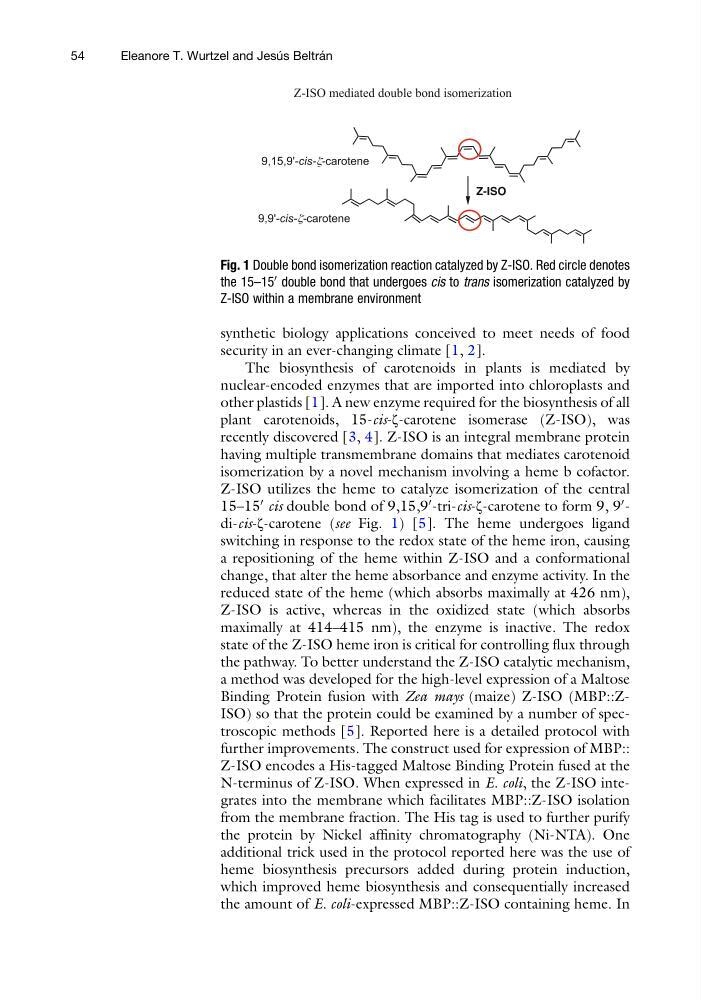
Z-ISO utilizes the heme to catalyze isomerization of the central
15–15
0
cis double bond of 9,15,9
0 -tri-cis-ζ-carotene to form 9, 9
0 -
di-cis-ζ-carotene (see Fig. 1) [5]. The heme undergoes ligand
switching in response to the redox state of the heme iron, causing
a repositioning of the heme within Z-ISO and a conformational
change, that alter the heme absorbance and enzyme activity. In the
reduced state of the heme (which absorbs maximally at 426 nm),
Z-ISO is active, whereas in the oxidized state (which absorbs
maximally at 414–415 nm), the enzyme is inactive. The redox
state of the Z-ISO heme iron is critical for controlling flux through
the pathway. To better understand the Z-ISO catalytic mechanism,
a method was developed for the high-level expression of a Maltose
Binding Protein fusion with Zea mays (maize) Z-ISO (MBP::ZISO) so that the protein could be examined by a number of spectroscopic methods [5]. Reported here is a detailed protocol with
further improvements. The construct used for expression of MBP::
Z-ISO encodes a His-tagged Maltose Binding Protein fused at the
N-terminus of Z-ISO. When expressed in E. coli, the Z-ISO integrates into the membrane which facilitates MBP::Z-ISO isolation
from the membrane fraction. The His tag is used to further purify
the protein by Nickel affinity chromatography (Ni-NTA). One
additional trick used in the protocol reported here was the use of
heme biosynthesis precursors added during protein induction,
which improved heme biosynthesis and consequentially increased
the amount of E. coli-expressed MBP::Z-ISO containing heme. In
Z-ISO mediated double bond isomerization
Fig. 1 Double bond isomerization reaction catalyzed by Z-ISO. Red circle denotes
the 15–15
0 double bond that undergoes cis to trans isomerization catalyzed by
Z-ISO within a membrane environment
54
Eleanore T. Wurtzel and Jesu ´ s Beltra ´ n
security in an ever-changing climate [1, 2].
The biosynthesis of carotenoids in plants is mediated by
nuclear-encoded enzymes that are imported into chloroplasts and
other plastids [1]. A new enzyme required for the biosynthesis of all
plant carotenoids, 15-cis-ζ-carotene isomerase (Z-ISO), was
recently discovered [3, 4]. Z-ISO is an integral membrane protein
having multiple transmembrane domains that mediates carotenoid
isomerization by a novel mechanism involving a heme b cofactor.
Z-ISO utilizes the heme to catalyze isomerization of the central
15–15
0
cis double bond of 9,15,9
0 -tri-cis-ζ-carotene to form 9, 9
0 -
di-cis-ζ-carotene (see Fig. 1) [5]. The heme undergoes ligand
switching in response to the redox state of the heme iron, causing
a repositioning of the heme within Z-ISO and a conformational
change, that alter the heme absorbance and enzyme activity. In the
reduced state of the heme (which absorbs maximally at 426 nm),
Z-ISO is active, whereas in the oxidized state (which absorbs
maximally at 414–415 nm), the enzyme is inactive. The redox
state of the Z-ISO heme iron is critical for controlling flux through
the pathway. To better understand the Z-ISO catalytic mechanism,
a method was developed for the high-level expression of a Maltose
Binding Protein fusion with Zea mays (maize) Z-ISO (MBP::ZISO) so that the protein could be examined by a number of spectroscopic methods [5]. Reported here is a detailed protocol with
further improvements. The construct used for expression of MBP::
Z-ISO encodes a His-tagged Maltose Binding Protein fused at the
N-terminus of Z-ISO. When expressed in E. coli, the Z-ISO integrates into the membrane which facilitates MBP::Z-ISO isolation
from the membrane fraction. The His tag is used to further purify
the protein by Nickel affinity chromatography (Ni-NTA). One
additional trick used in the protocol reported here was the use of
heme biosynthesis precursors added during protein induction,
which improved heme biosynthesis and consequentially increased
the amount of E. coli-expressed MBP::Z-ISO containing heme. In
Z-ISO mediated double bond isomerization
Fig. 1 Double bond isomerization reaction catalyzed by Z-ISO. Red circle denotes
the 15–15
0 double bond that undergoes cis to trans isomerization catalyzed by
Z-ISO within a membrane environment
54
Eleanore T. Wurtzel and Jesu ´ s Beltra ´ n