

3.2 Expression
and Purification
of Arabidopsis
Phytoene Synthase
1. The following protocol yields up to 5 mg recombinant Arabidopsis PSY which is sufficient for a large number of PSY activity
assays. We’ve successfully applied this protocol to PSYs from
other plants as well, but a reduction in yield should be
expected.
2. Transform pCOLD1-PSY vector into Rosetta (DE3) competent E. coli cells as described for GGPS expression vectors
above. Spread on LB-A/C agar plate and incubate over night
at 37
C.
3. Pick one single colony and incubate in 2 ml liquid LB-A/C at
37
C under shaking at 200 rpm for 3–5 h, then transfer into
50 ml LB-A/C and continue incubation at 37
C overnight.
On the next day, use 15 ml each of the overnight culture to
inoculate three baffled flasks with a capacity of 1 l each containing 350 ml LB-A/C. Incubate at 37
C while shaking at
200 rpm.
4. If OD 600 ¼ 0.6 is reached, switch off the shaker and lower the
temperature of the incubator to 15
C. After 30 min, add
1 mM isopropyl-D-1-thiogalactopyranoside (IPTG), switch
on the shaker to 200 rpm and incubate for 24 h at 15
C.
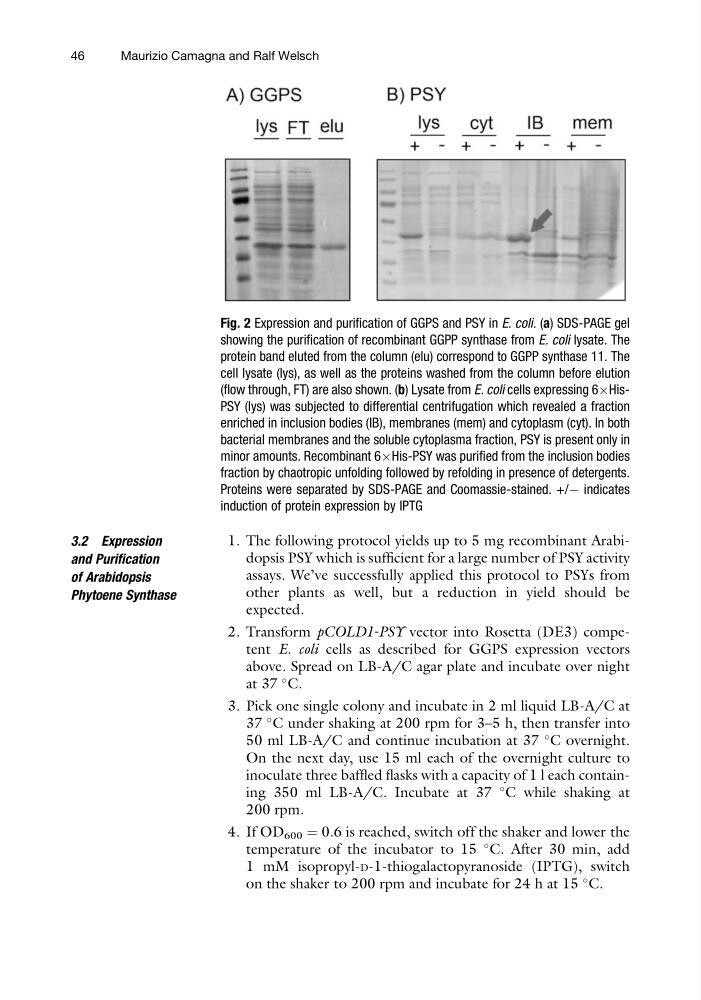
Fig. 2 Expression and purification of GGPS and PSY in E. coli. (a) SDS-PAGE gel
showing the purification of recombinant GGPP synthase from E. coli lysate. The
protein band eluted from the column (elu) correspond to GGPP synthase 11. The
cell lysate (lys), as well as the proteins washed from the column before elution
(flow through, FT) are also shown. (b) Lysate from E. coli cells expressing 6ÂHisPSY (lys) was subjected to differential centrifugation which revealed a fraction
enriched in inclusion bodies (IB), membranes (mem) and cytoplasm (cyt). In both
bacterial membranes and the soluble cytoplasma fraction, PSY is present only in
minor amounts. Recombinant 6ÂHis-PSY was purified from the inclusion bodies
fraction by chaotropic unfolding followed by refolding in presence of detergents.
Proteins were separated by SDS-PAGE and Coomassie-stained. +/À indicates
induction of protein expression by IPTG
46
Maurizio Camagna and Ralf Welsch
and Purification
of Arabidopsis
Phytoene Synthase
1. The following protocol yields up to 5 mg recombinant Arabidopsis PSY which is sufficient for a large number of PSY activity
assays. We’ve successfully applied this protocol to PSYs from
other plants as well, but a reduction in yield should be
expected.
2. Transform pCOLD1-PSY vector into Rosetta (DE3) competent E. coli cells as described for GGPS expression vectors
above. Spread on LB-A/C agar plate and incubate over night
at 37
C.
3. Pick one single colony and incubate in 2 ml liquid LB-A/C at
37
C under shaking at 200 rpm for 3–5 h, then transfer into
50 ml LB-A/C and continue incubation at 37
C overnight.
On the next day, use 15 ml each of the overnight culture to
inoculate three baffled flasks with a capacity of 1 l each containing 350 ml LB-A/C. Incubate at 37
C while shaking at
200 rpm.
4. If OD 600 ¼ 0.6 is reached, switch off the shaker and lower the
temperature of the incubator to 15
C. After 30 min, add
1 mM isopropyl-D-1-thiogalactopyranoside (IPTG), switch
on the shaker to 200 rpm and incubate for 24 h at 15
C.
Fig. 2 Expression and purification of GGPS and PSY in E. coli. (a) SDS-PAGE gel
showing the purification of recombinant GGPP synthase from E. coli lysate. The
protein band eluted from the column (elu) correspond to GGPP synthase 11. The
cell lysate (lys), as well as the proteins washed from the column before elution
(flow through, FT) are also shown. (b) Lysate from E. coli cells expressing 6ÂHisPSY (lys) was subjected to differential centrifugation which revealed a fraction
enriched in inclusion bodies (IB), membranes (mem) and cytoplasm (cyt). In both
bacterial membranes and the soluble cytoplasma fraction, PSY is present only in
minor amounts. Recombinant 6ÂHis-PSY was purified from the inclusion bodies
fraction by chaotropic unfolding followed by refolding in presence of detergents.
Proteins were separated by SDS-PAGE and Coomassie-stained. +/À indicates
induction of protein expression by IPTG
46
Maurizio Camagna and Ralf Welsch