

correlate with changes in carotenoid content of cassava roots and
maize seeds [25, 26].
These observations suggest a strong impact of individual amino
acids on PSY enzymatic activity. Investigation of the molecular
reason for these differences requires characterization of in vitro
PSY activity allowing to compare enzymatic properties of different
PSY variants in parallel. However, PSY is membrane-associated and
its purification is linked with the notorious complications associated
with the purification of membrane-proteins. Furthermore, the solubility of the substrate GGPP changes dramatically during the
catalysis requiring a biphasic system to accommodate the lipophilic
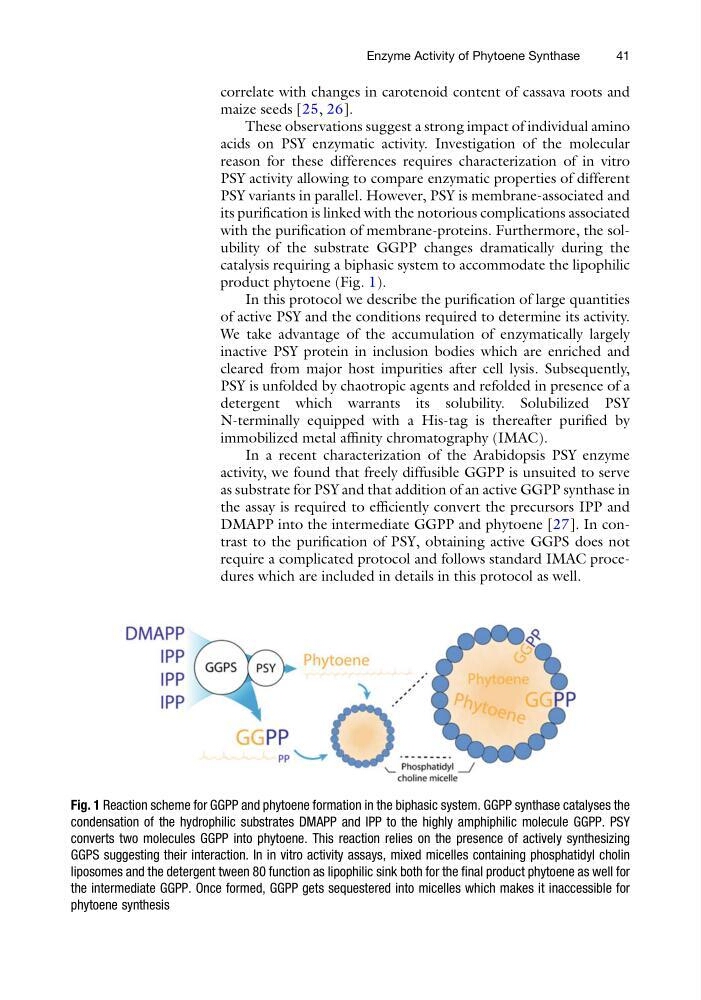
product phytoene (Fig. 1).
In this protocol we describe the purification of large quantities
of active PSY and the conditions required to determine its activity.
We take advantage of the accumulation of enzymatically largely
inactive PSY protein in inclusion bodies which are enriched and
cleared from major host impurities after cell lysis. Subsequently,
PSY is unfolded by chaotropic agents and refolded in presence of a
detergent which warrants its solubility. Solubilized PSY
N-terminally equipped with a His-tag is thereafter purified by
immobilized metal affinity chromatography (IMAC).
In a recent characterization of the Arabidopsis PSY enzyme
activity, we found that freely diffusible GGPP is unsuited to serve
as substrate for PSY and that addition of an active GGPP synthase in
the assay is required to efficiently convert the precursors IPP and
DMAPP into the intermediate GGPP and phytoene [27]. In contrast to the purification of PSY, obtaining active GGPS does not
require a complicated protocol and follows standard IMAC procedures which are included in details in this protocol as well.
Fig. 1 Reaction scheme for GGPP and phytoene formation in the biphasic system. GGPP synthase catalyses the
condensation of the hydrophilic substrates DMAPP and IPP to the highly amphiphilic molecule GGPP. PSY
converts two molecules GGPP into phytoene. This reaction relies on the presence of actively synthesizing
GGPS suggesting their interaction. In in vitro activity assays, mixed micelles containing phosphatidyl cholin
liposomes and the detergent tween 80 function as lipophilic sink both for the final product phytoene as well for
the intermediate GGPP. Once formed, GGPP gets sequestered into micelles which makes it inaccessible for
phytoene synthesis
Enzyme Activity of Phytoene Synthase
41
maize seeds [25, 26].
These observations suggest a strong impact of individual amino
acids on PSY enzymatic activity. Investigation of the molecular
reason for these differences requires characterization of in vitro
PSY activity allowing to compare enzymatic properties of different
PSY variants in parallel. However, PSY is membrane-associated and
its purification is linked with the notorious complications associated
with the purification of membrane-proteins. Furthermore, the solubility of the substrate GGPP changes dramatically during the
catalysis requiring a biphasic system to accommodate the lipophilic
product phytoene (Fig. 1).
In this protocol we describe the purification of large quantities
of active PSY and the conditions required to determine its activity.
We take advantage of the accumulation of enzymatically largely
inactive PSY protein in inclusion bodies which are enriched and
cleared from major host impurities after cell lysis. Subsequently,
PSY is unfolded by chaotropic agents and refolded in presence of a
detergent which warrants its solubility. Solubilized PSY
N-terminally equipped with a His-tag is thereafter purified by
immobilized metal affinity chromatography (IMAC).
In a recent characterization of the Arabidopsis PSY enzyme
activity, we found that freely diffusible GGPP is unsuited to serve
as substrate for PSY and that addition of an active GGPP synthase in
the assay is required to efficiently convert the precursors IPP and
DMAPP into the intermediate GGPP and phytoene [27]. In contrast to the purification of PSY, obtaining active GGPS does not
require a complicated protocol and follows standard IMAC procedures which are included in details in this protocol as well.
Fig. 1 Reaction scheme for GGPP and phytoene formation in the biphasic system. GGPP synthase catalyses the
condensation of the hydrophilic substrates DMAPP and IPP to the highly amphiphilic molecule GGPP. PSY
converts two molecules GGPP into phytoene. This reaction relies on the presence of actively synthesizing
GGPS suggesting their interaction. In in vitro activity assays, mixed micelles containing phosphatidyl cholin
liposomes and the detergent tween 80 function as lipophilic sink both for the final product phytoene as well for
the intermediate GGPP. Once formed, GGPP gets sequestered into micelles which makes it inaccessible for
phytoene synthesis
Enzyme Activity of Phytoene Synthase
41