

9. The evacuated and washed nematode pellets are recovered with
a micropipette and transferred to 2 mL cryovials. Centrifuge
the cryovials at 1500 Â g, 2 min, 20
C, to completely remove
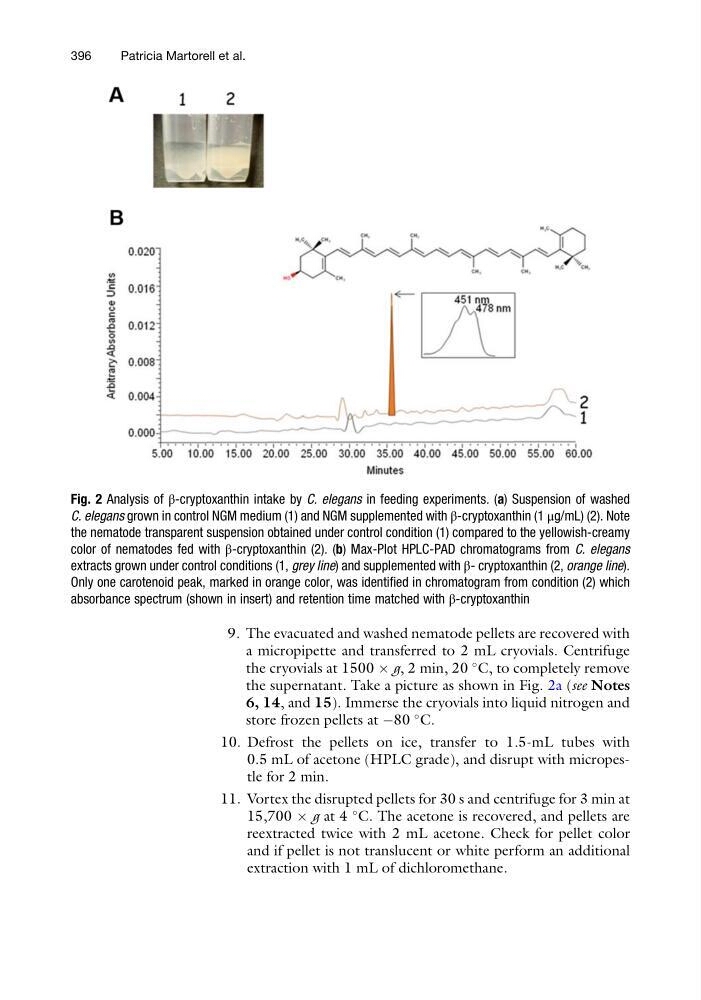
the supernatant. Take a picture as shown in Fig. 2a (see Notes
6, 14, and 15). Immerse the cryovials into liquid nitrogen and
store frozen pellets at À80
C.
10. Defrost the pellets on ice, transfer to 1.5-mL tubes with
0.5 mL of acetone (HPLC grade), and disrupt with micropestle for 2 min.
11. Vortex the disrupted pellets for 30 s and centrifuge for 3 min at
15,700 Â g at 4
C. The acetone is recovered, and pellets are
reextracted twice with 2 mL acetone. Check for pellet color
and if pellet is not translucent or white perform an additional
extraction with 1 mL of dichloromethane.
Fig. 2 Analysis of β-cryptoxanthin intake by C. elegans in feeding experiments. (a) Suspension of washed
C. elegans grown in control NGM medium (1) and NGM supplemented with β-cryptoxanthin (1 μg/mL) (2). Note
the nematode transparent suspension obtained under control condition (1) compared to the yellowish-creamy
color of nematodes fed with β-cryptoxanthin (2). (b) Max-Plot HPLC-PAD chromatograms from C. elegans
extracts grown under control conditions (1, grey line) and supplemented with β- cryptoxanthin (2, orange line).
Only one carotenoid peak, marked in orange color, was identified in chromatogram from condition (2) which
absorbance spectrum (shown in insert) and retention time matched with β-cryptoxanthin
396
Patricia Martorell et al.
a micropipette and transferred to 2 mL cryovials. Centrifuge
the cryovials at 1500 Â g, 2 min, 20
C, to completely remove
the supernatant. Take a picture as shown in Fig. 2a (see Notes
6, 14, and 15). Immerse the cryovials into liquid nitrogen and
store frozen pellets at À80
C.
10. Defrost the pellets on ice, transfer to 1.5-mL tubes with
0.5 mL of acetone (HPLC grade), and disrupt with micropestle for 2 min.
11. Vortex the disrupted pellets for 30 s and centrifuge for 3 min at
15,700 Â g at 4
C. The acetone is recovered, and pellets are
reextracted twice with 2 mL acetone. Check for pellet color
and if pellet is not translucent or white perform an additional
extraction with 1 mL of dichloromethane.
Fig. 2 Analysis of β-cryptoxanthin intake by C. elegans in feeding experiments. (a) Suspension of washed
C. elegans grown in control NGM medium (1) and NGM supplemented with β-cryptoxanthin (1 μg/mL) (2). Note
the nematode transparent suspension obtained under control condition (1) compared to the yellowish-creamy
color of nematodes fed with β-cryptoxanthin (2). (b) Max-Plot HPLC-PAD chromatograms from C. elegans
extracts grown under control conditions (1, grey line) and supplemented with β- cryptoxanthin (2, orange line).
Only one carotenoid peak, marked in orange color, was identified in chromatogram from condition (2) which
absorbance spectrum (shown in insert) and retention time matched with β-cryptoxanthin
396
Patricia Martorell et al.